 MMXXVI
Vellekla: the poem Einarr skálaglamm made for Jarl Hákon, and the battle of Hjörungavágr
Vellekla, "lack of gold", is a poem the Icelandic skald Einarr Helgason skálaglamm made for Hákon Sigurðarson, and it speaks, among other things, of the battle of Hjörungavágr, in 986.
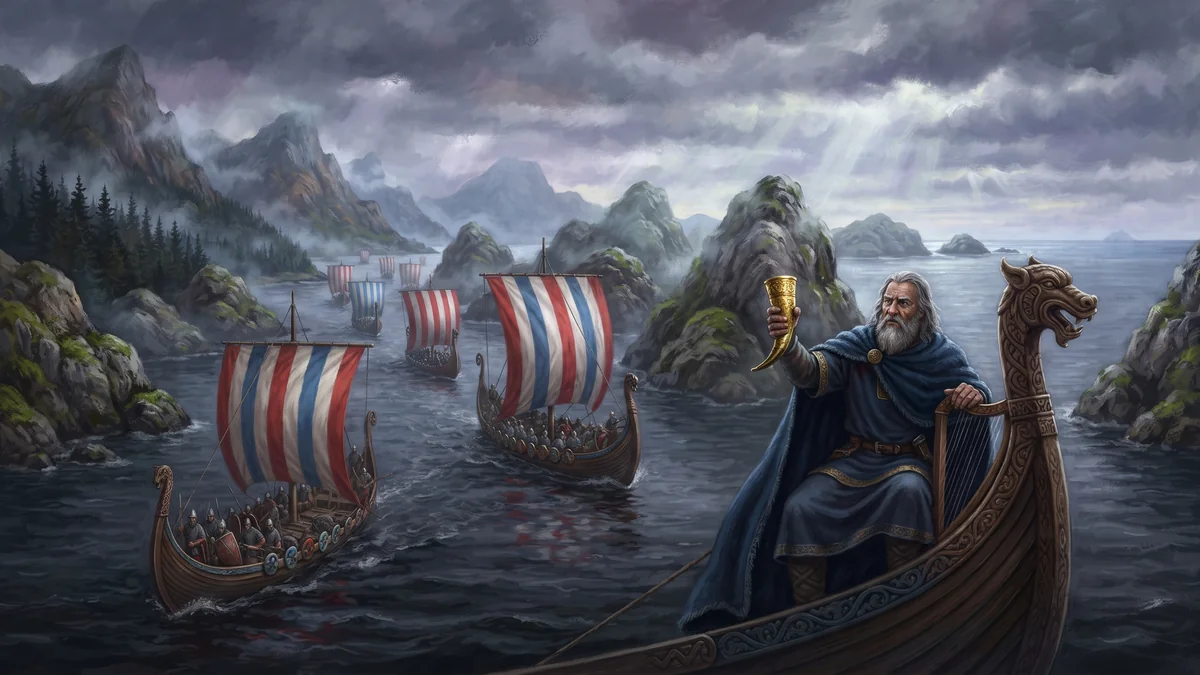
Vellekla, in Old Norse “lack of gold”, is a partially preserved drápa: a series of stanzas with a refrain. It was composed in the late 10th century by the Icelandic poet Einar Helgason, called skálaglamm. Finnur Jónsson dates it to 986. It is one of the two drápur that Einarr made for Jarl Hákon.
What the poem is about
The poem speaks, among other subjects, of the battle of Hjörungavágr and of Hákon’s campaign in Denmark. No manuscript preserves the whole Vellekla: verses and sequences of verses survive as quotations in several prose works, such as Fagrskinna, Heimskringla, Óláfs saga Tryggvasonar en mesta and Flateyjarbók. Finnur Jónsson reconstructed most of the central narrative from the kings’ sagas: 37 verses, 21 of them complete and 16 half-verses.
The battle
The battle of Hjörungavágr is a semi-legendary naval battle of the late 10th century, fought between the jarls of Lade, allies of Hákon Sigurðarson, and a Danish invasion fleet led by the Jomsvikings. Tradition dates it to 986, on the coast of Sunnmøre. Hákon ruled Norway as a vassal of the Danish king Harald Bluetooth. Around 975 Harald tried to impose Christianity on Hákon, who was a devotee of the Norse gods, and Hákon broke his allegiance. Harald’s defeat by Otto II in 974 weakened him, and Hákon used this to make Norway independent.
The commanders
On the Norwegian side were Hákon Sigurðarson, Eric Haakonsson, Sweyn Haakonsson, Skjegge Asbjørnsson and Ragnvald Lodinsson. On the Danish and Jomsviking side, Sigvaldi Strut-Haraldsson, Vagn Åkesson and Búi digri. Wikipedia gives a Norwegian victory.
Sources that disagree
The sources are the kings’ sagas, including Heimskringla, the Jómsvíkinga saga, which gives two contradictory descriptions of the bay of the battle, and Saxo’s Gesta Danorum, besides verses by poets of the time, Þórðr Kolbeinsson and Tindr Hallkelsson, and later works, such as Bjarni Kolbeinsson’s Jómsvíkingadrápa, Vellekla itself and Fagrskinna.
In short
Vellekla is a commissioned poem, made to praise a chieftain, and at the same time one of the sources for a battle that the sagas tell in many ways. To sail the coast of Sunnmøre after the poet’s gold, play The gold of Vellekla.
Sources.
- English Wikipedia, articles "Vellekla" and "Battle of Hjörungavágr"
- Fagrskinna, Heimskringla, Óláfs saga Tryggvasonar en mesta and Flateyjarbók, which quote verses of the poem
- Finnur Jónsson, edition (1912 to 1915)