 MMXXVI
Vladimir the Great: the prince of Kiev who came back from exile with an army of Varangians and chose the faith of Byzantium
A son of Sviatoslav, Vladimir took Kiev in 978 with Varangians, worshipped Perun and, in 988, was baptised and married Anna, sister of Emperor Basil II. The Primary Chronicle tells how he chose his religion.
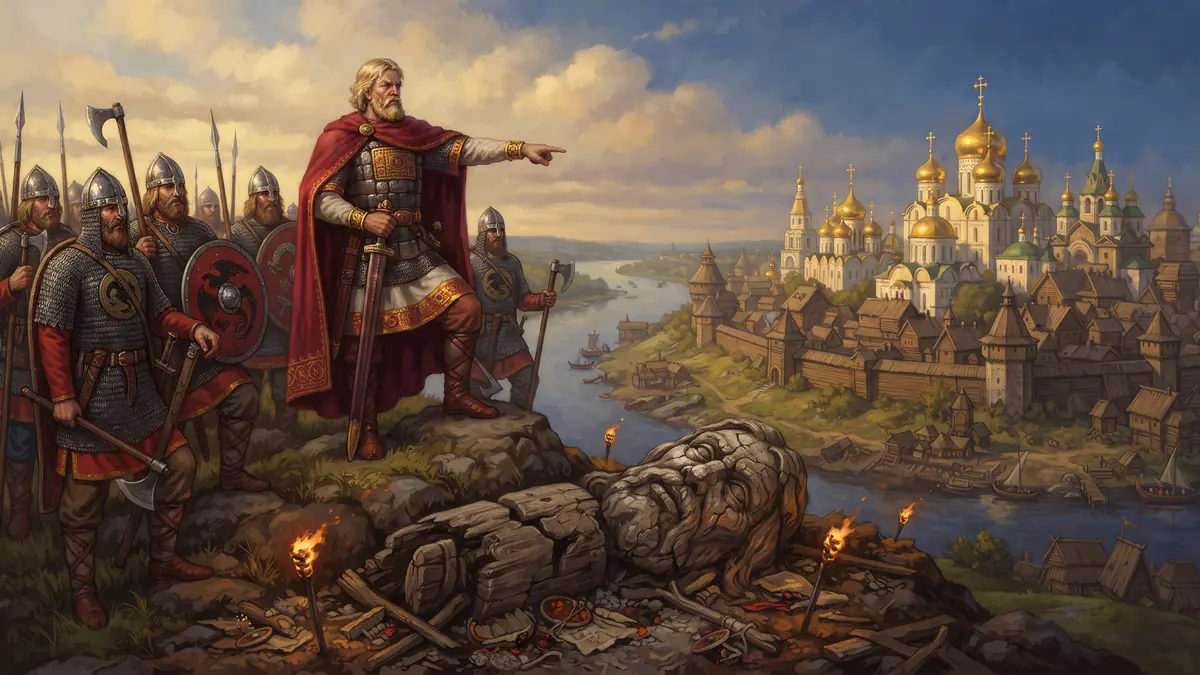
Vladimir Sviatoslavich (c. 958 – 15 July 1015) was prince of Novgorod from 970 and grand prince of Kiev until his death. According to the sources, the Catholic and Eastern Orthodox churches both canonised him as Saint Vladimir. He was the youngest, illegitimate son of Sviatoslav I of the Rurik dynasty and of Malusha, his father’s housekeeper. His maternal uncle Dobrynya was his tutor and trusted adviser.
The war between brothers
Sviatoslav made Vladimir ruler of Novgorod in 970 but gave Kiev to Yaropolk, his legitimate son, and was killed by the Pechenegs in 972. In 977 Yaropolk killed his brother Oleg, and Vladimir fled abroad and gathered an army of Varangians, Scandinavian warriors. He returned in 978 and took Polotsk, where he seized Rogneda, daughter of Prince Rogvolod, after killing her parents. He took Kiev by treachery, killed Yaropolk and proclaimed himself ruler of all Kievan Rus’.
The pagan pantheon
Vladimir remained a pagan and, according to the chronicles, had many wives and concubines. On a hill in Kiev he built a temple to six gods, headed by Perun, god of thunder and war, favoured by his retinue. The others were Stribog, Dazhbog, Mokosh, Khors and Simargl.
The choice of faith
According to the Primary Chronicle, Vladimir sent envoys to study Islam, Latin Christianity, Judaism and Byzantine Christianity. Those who visited Constantinople said they could not tell whether they were in heaven or on earth. Vladimir finally chose Eastern Christianity.
988
In 988 Vladimir took Chersonesus in Crimea and asked for the hand of Anna Porphyrogenita, sister of Emperor Basil II. Basil faced the revolt of Bardas Phocas and asked for help: Vladimir agreed, in exchange for the marriage and conversion, and sent about 6,000 soldiers. He was baptised at Chersonesus, taking the Christian name Basil, and married Anna. Back in Kiev he destroyed the pagan monuments, built churches, among them the Church of the Tithes (989), and founded schools. Byzantine sources barely mention the baptism, and the canonical version may have been shaped in the 1040s.
The end
Vladimir divided the realm among twelve sons and defended himself against the Pechenegs, whose attacks on Kiev cut short the campaign of 992. He died on 15 July 1015 at Berestove, near Kiev.
To defend Kiev and parry every blow of the Pechenegs with your shield, play The Pechenegs at Kiev.
Sources.
- Reference work in English, article "Vladimir the Great"