 MMXXVI
Widsith: the Anglo-Saxon poem of the travelling singer who listed kings, peoples and heroes, from Attila to the Danes
Widsith ("far-traveller") has 143 lines and survives only in the Exeter Book. The singer says he visited kings and peoples, from Attila and Eormanric to the Danes and Swedes.
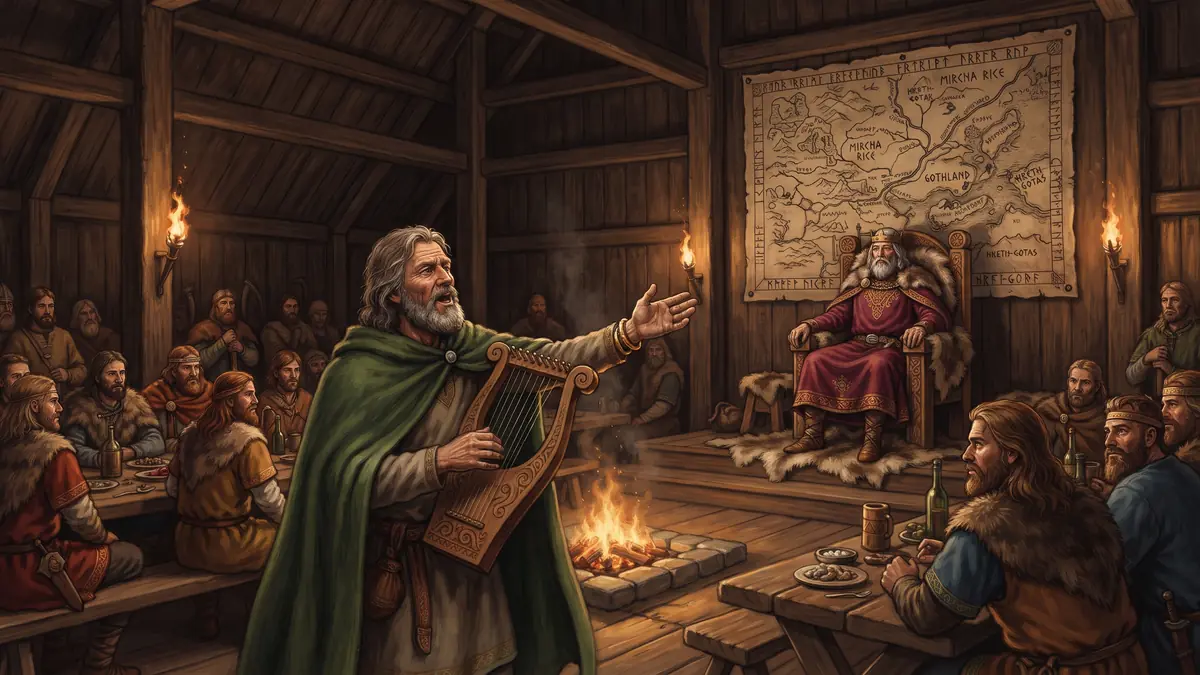
Widsith, in Old English Wīdsīþ, roughly “far-traveller”, is a poem of 143 lines also called “The Traveller’s Song”. According to the sources, it survives only in the Exeter Book (pages 84v–87r), a late-10th-century manuscript that holds about one-sixth of all surviving Old English verse. The book has been at Exeter Cathedral since it was donated in 1076.
Three catalogues
Apart from the introduction of the scop (the singer), the closing lines and a few passages some scholars take for later additions, the poem is made of three lists. The first gathers rulers, in the pattern “such a king ruled such a people”, such as Attila over the Huns and Eormanric over the Goths. The second lists the peoples the narrator visited (“I was with…”). The third deals with heroes of legend he sought out.
The narrator
Widsith claims descent from the Myrgings and says he first travelled with Ealhhild, a “peace-weaver”, to the court of Eormanric, king of the Goths, described as cruel and treacherous. Ealhhild gave him a gold torc, which he later gave to Eadgils in return for land that had been his father’s. Among the Burgundians he received another torc from King Guthere for a song. Scholars debate whether this is autobiography or a poetic identity.
The Northerners in the poem
The poem names the Swedes, the Geats and the South-Danes. It says Offa ruled the Angles while Alewih ruled the Danes, and that Offa fixed the border with the Myrgings at the river Eider. It tells how Hrothgar and Hrothwulf, uncle and nephew, kept peace for a long time after driving off the wicinga cynn and humbling Ingeld, whose line was cut down at Heorot. The phrase wicinga cynn may be the earliest appearance of the word “Viking”.
When was it composed?
There is no agreement. Some argue for a late date, in the 9th and 10th centuries, while others, such as Kemp Malone in 1962, argue that the poem took its form around the early 8th century. Lotte Hedeager, in 2011, argued that at least part comes from the 6th century.
To keep the beat of the singer’s harp and carry the song to its end, play The singer’s harp.
Sources.
- Reference work in English, article "Widsith"