Did the Vikings wear horned helmets? What the Gjermundbu find shows
No Viking horned helmet has ever been found. The only nearly complete one, found in Norway in 1943, is iron and round. The horned image is a 19th-century invention.
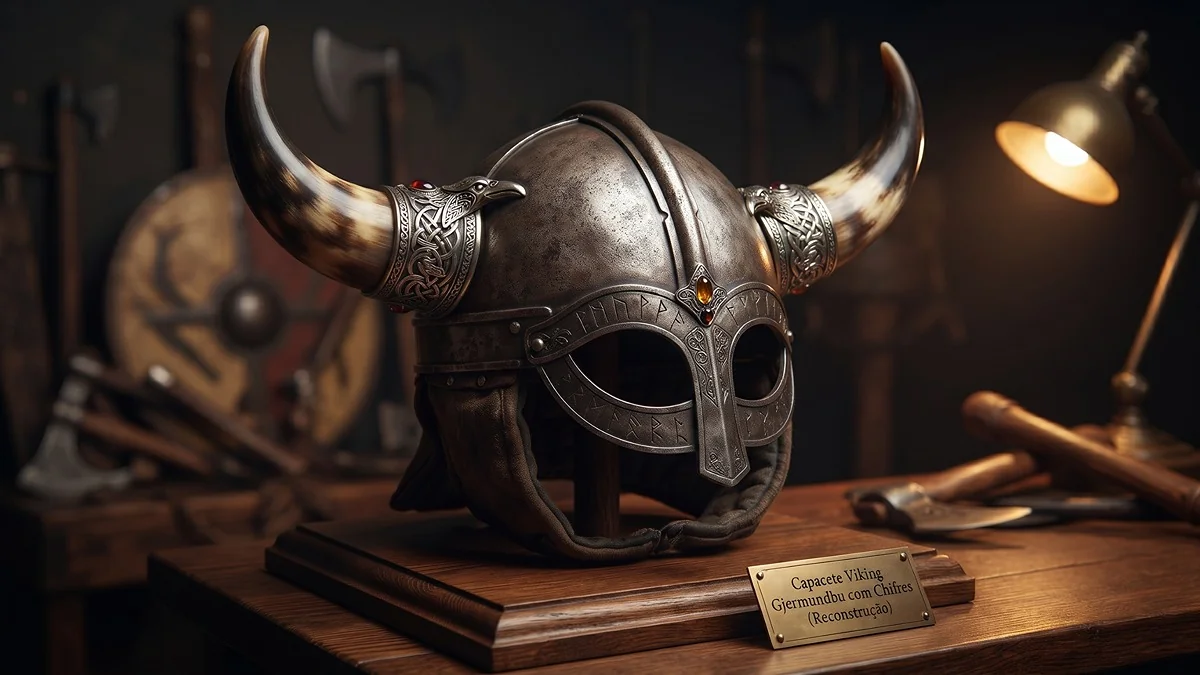
The image of the Viking in a helmet with two horns appears in drawings, costumes and films, but there is no archaeological record of it. No Viking horned helmet has been found to this day.
The helmet that survived
The most complete object is the Gjermundbu helmet, discovered in 1943 in a grave at Ringerike, in Norway. It dates from the 10th century and is kept in the Museum of Cultural History, in Oslo.
It is made of iron, shaped like a rounded cap, with a piece that protects the face around the eyes and nose. It has no horns. It was practical protection, not a ritual ornament.
One detail matters: the Gjermundbu helmet is the only nearly whole one of its kind from the entire Viking period. That means little is known about the variety of helmets warriors wore. Many were probably of leather, which rots and does not survive, and much of what protected the head may have been simple. Scholars do not know how many Vikings wore a helmet.
Where the image came from
Horned helmets did exist, but long before. The ones from Veksø, in Denmark, are from the Bronze Age, about a thousand years before the Viking Age, and were probably ceremonial.
The modern image came from the 19th century, when medieval Scandinavia became fashionable in European Romanticism. Scandinavian Romantic illustrations already showed Norse warriors with horns. In 1876, the German costume designer Carl Emil Doepler dressed the characters of Richard Wagner’s opera The Ring of the Nibelung in helmets with horns and wings, in Bayreuth. The drawings spread and fixed the image in popular culture.
Why the horn does not work
Historians often point out that a horn on a helmet would be a flaw in combat, because it would give the enemy something to grab or to turn a blow against one’s own skull. In hand-to-hand fighting, the most practical shape was smooth and round.
The Gjermundbu helmet is just one find. But so far, no other archaeological evidence contradicts the conclusion that horned Vikings belong to the theatre, not to history.
What the Vikings actually wore
The written sources and the finds give a more modest picture than the cinema. Besides iron helmets like the one from Gjermundbu, protective equipment included round wooden shields, which were the main defence, and, for the wealthier, mail shirts. The Gjermundbu grave contained a mail shirt, as well as weapons, which indicates that the dead man was a warrior of means.
Many ordinary fighters, however, probably fought without a helmet, in leather or wool caps, which left no trace.
To do the digging yourself, play Digging at Gjermundbu.
Sources.
- Museum of Cultural History, University of Oslo, information on the Gjermundbu helmet
- National Museum of Denmark, information on the Veksø horned helmets (Bronze Age)
- Carl Emil Doepler, costumes for Richard Wagner's *The Ring of the Nibelung*, Bayreuth, 1876