Egil Skallagrímsson and the poem that, according to the saga, saved his head
Egil's saga tells how the warrior-poet escaped death in York by composing, in a single night, a poem in praise of King Eric Bloodaxe.
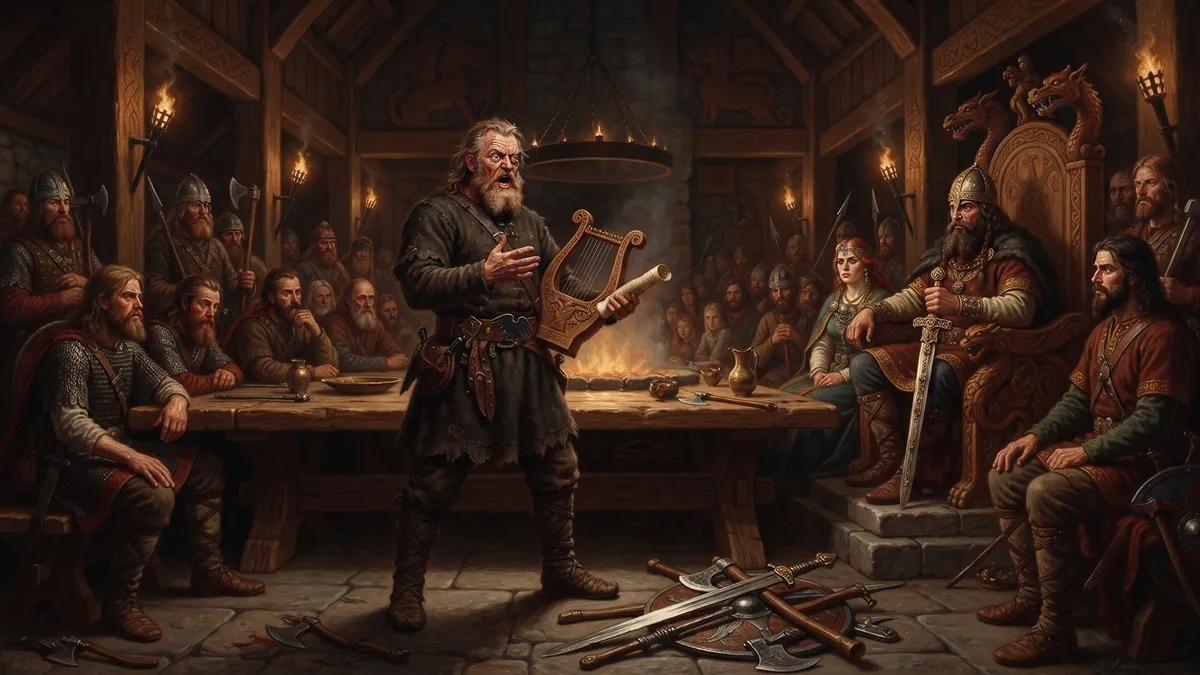
Egil’s Saga, written in Iceland in the early 13th century, tells the life of a violent and gifted poet and warrior: Egil Skallagrímsson. Among its most famous episodes is the night when, according to the text, he composed a poem to save his own life.
The enemy on the throne of York
The saga places Egil in the 10th century. He has a long enmity with King Eric Bloodaxe and with the king’s queen, Gunnhild, caused, according to the saga, by inheritance disputes and deaths between their families. One day, a storm throws Egil’s ship onto the coast of Northumbria, in England, and he finds that the region is ruled by none other than Eric, who reigned in York.
Eric Bloodaxe is a historical figure, mentioned in other sources as king of York in the mid-10th century. The scene in which Egil falls into his hands, however, appears only in the saga, and it is impossible to confirm that it happened this way.
One night to compose
In the telling, Egil tries to flee but is surrounded. The king, pressed by a friend of Egil’s, Arinbjörn, grants him one night to compose a poem in his praise. If the result pleased him, Egil would be spared.
Skaldic poetry was not simple. It followed strict rules of meter, alliteration and rhyme, and used metaphors called kennings, expressions such as “horse of the sea” for ship. Composing such a poem in hours was a master’s feat, and the saga presents it as proof of Egil’s genius.
The poem, Höfuðlausn, “the head-ransom”, is transmitted within the saga. It calls the king generous and compares him to an invincible warrior. According to the text, the king heard the recital and let the poet go.
Between history and legend
Scholars debate whether Höfuðlausn was really composed in the 10th century, or whether it is a later creation, written in the time of the saga. Some argue that the verses are old, others that the saga’s author invented them for the character. Who wrote the saga is also debated: many attribute it to Snorri Sturluson, but there is no proof.
The saga also preserved another poem by Egil, the Sonatorrek, “the loss of sons”, an elegy on the death of his sons. For many readers it is one of the most moving texts of Old Norse literature, and it shows the same character in another light.
A man of contrasts
The saga does not hide Egil’s harsh side. From boyhood he is described as violent, and at the age of seven he is said to have killed another boy in a quarrel over a game. At the same time, the text shows him as a poet capable of moving us, which makes him one of the most complex characters in the Icelandic sagas.
Egil was born in Iceland, according to the saga, and spent much of his life travelling and fighting in Norway, England and the Baltic. This back and forth between the world of the sword and the world of the word is what makes the York story so memorable.
To compose verses of your own, play Egil’s night.
Sources.
- *Egil's Saga* (*Egils saga Skallagrímssonar*), early 13th century, author uncertain, often attributed to Snorri Sturluson
- *Höfuðlausn* (Head-Ransom), poem transmitted within *Egil's Saga*