How the Norse gods bound the wolf Fenrir, and why Týr lost his hand
The gods raised the wolf Fenrir in Asgard until they feared his strength. Only a ribbon made of things that do not exist could bind him, and the price was Týr's hand.
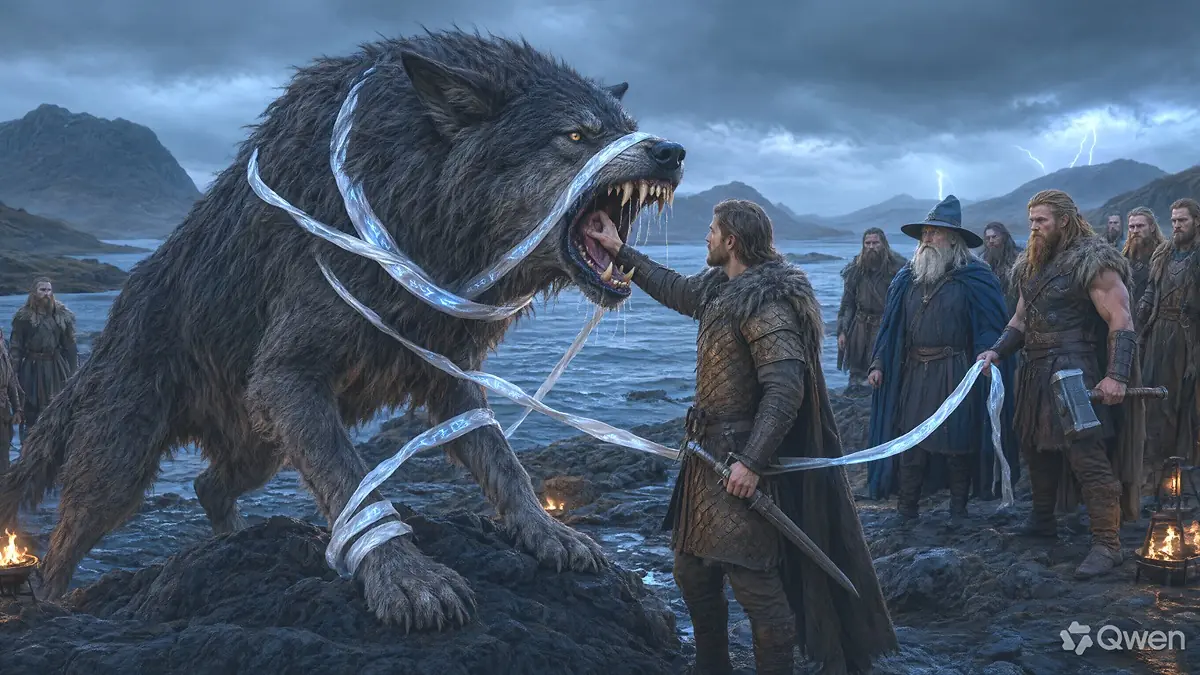
In Norse mythology, the wolf Fenrir was raised among the gods, in Asgard, until they came to fear him and decided to chain him. The episode reaches us mainly through the Prose Edda, which the Icelander Snorri Sturluson wrote around 1220, and it ends with a god missing a hand and a wolf bound until the end of the world.
Snorri was a Christian and wrote more than two centuries after Iceland’s conversion. That is why the myth comes down in versions that do not always agree, and the account below follows his, pointing out where the other great source, the Poetic Edda, says something different.
A cub in Asgard
Fenrir was the son of Loki and the giantess Angrboða, and had two siblings: Jörmungandr, the serpent of Midgard, and Hel, who would rule the realm of the dead. According to Snorri, the gods learned from prophecies that the three would bring disaster. Odin threw the serpent into the sea and sent Hel to Niflheim. The wolf, however, stayed in Asgard.
Only one god had the courage to feed him: Týr, associated with war and oaths. Fenrir grew every day, and the prophecies stayed the same. The gods concluded it would be safer to bind him.
Two chains that break
The gods forged a powerful chain, called Lædingr, and proposed a test of strength to the wolf. Fenrir agreed, let them bind him, stretched his body, and the chain broke.
They then made another, twice as strong, called Drómi. The wolf let himself be bound again, tensed his muscles, shook himself, and the links flew far away. The gods feared they would never manage to hold him.
Gleipnir, the impossible ribbon
Odin turned to the dwarfs. He sent Skírnir, the messenger of the god Freyr, to their lands, and the dwarfs made a ribbon called Gleipnir. According to Snorri, it was made of six things: the sound of a cat’s footsteps, a woman’s beard, the roots of a mountain, a bear’s sinews, a fish’s breath and a bird’s spittle.
That is why, Snorri himself explains, no one sees those things today: they were used up in the ribbon. Gleipnir was smooth and soft as a silken cord, and stronger than any iron chain.
The price of Týr’s hand
The gods brought Gleipnir to the wolf as if it were just another game. Fenrir looked at the thin ribbon and grew suspicious: if it were only a cord, there would be no glory in breaking it, and if it were made by sorcery, he might never get free. He agreed on one condition: one of the gods would put a hand in his mouth, as a pledge that there was no trickery.
The gods looked at each other, and none moved. Then Týr stretched out his hand and put it between the wolf’s teeth. When Fenrir struggled and saw that the ribbon only tightened, he closed his jaws. According to Snorri, all the gods laughed, except Týr, who lost his hand.
Some read the scene as a story about oaths and betrayal: the gods defeat the wolf by lying to him, and the one who pays is the god most tied to the given word.
Bound until Ragnarök
With Fenrir immobilized, the gods fastened the ribbon to a great rock, buried deep in the ground, and thrust a sword into the wolf’s mouth, with the hilt resting on the lower jaw and the point in the roof of the mouth. The drool that ran out formed a river, called Ván. Fenrir would stay there until Ragnarök, the end of the world.
When that day comes, according to Snorri and the Völuspá, he will break loose and kill Odin. His avenger is Víðarr, Odin’s son: in Snorri’s version, he tears the wolf’s jaws apart; in the Völuspá, he drives his sword into the wolf’s heart.
To try binding the wolf yourself, play Gleipnir, the impossible ribbon.
Sources.
- Snorri Sturluson, *Prose Edda*, section Gylfaginning (c. 1220)
- *Poetic Edda*, poem Völuspá (13th-century manuscript)