Freyja and the Brísingamen necklace: what the Norse sources say about the goddess's jewel
Brísingamen is the goddess Freyja's best-known necklace. The sources link it to dwarf smiths, a theft by Loki and a fight between gods in the form of seals.
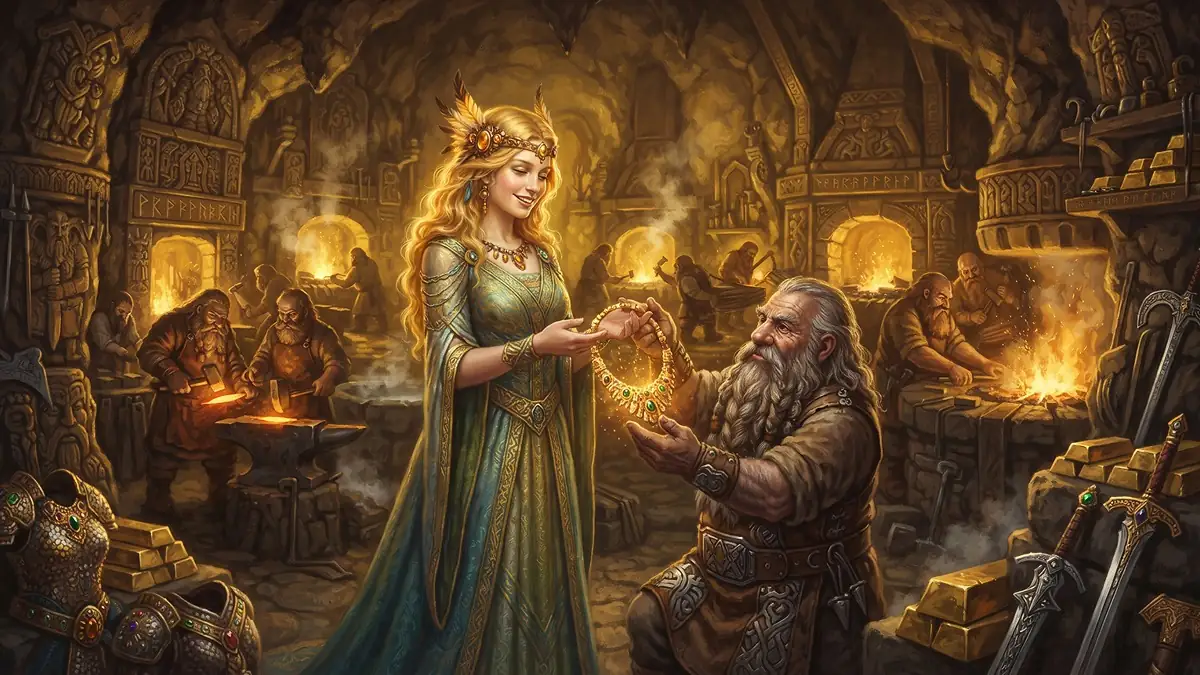
Brísingamen is the name of the necklace of the goddess Freyja, whom Norse mythology associates with love, fertility and also war. There is no single myth about it: what has reached us are fragments from different sources, written in different centuries and languages, that do not always fit together.
The necklace in the oldest sources
The best-known mention is in the Poetic Edda, in the poem Þrymskviða. Thor wakes up without his hammer, and the giant Þrymr (Thrym) has hidden it, demanding Freyja as his bride in exchange. When the gods tell her the plan, Freyja is so furious that the great necklace of the Brísingar breaks. That is where the idea comes from that the necklace was a precious jewel inseparable from the goddess.
The name also appears outside Scandinavia: the Anglo-Saxon poem Beowulf speaks of a “Brosinga mene”, a necklace that the character Hama is said to have carried off. It is not known whether the poet had Freyja’s jewel in mind, but the similarity of the names shows that the story circulated far beyond the north.
The fight of the seals
In the Prose Edda, Snorri Sturluson says, in the Skáldskaparmál, that the god Heimdall and Loki fought over the Brísingamen in the form of seals, at a place called Singasteinn. Snorri cites a poem by the skald Úlfr Uggason, from the 10th century, which suggests the scene is much older than his book. But the text that has reached us is only an allusion, without the full plot.
The story of the four dwarfs
The most detailed version comes from a late source, the Sörla þáttr, preserved in the Flateyjarbók from the late 14th century. In it, Freyja passes a stone where four dwarfs, Alfrigg, Dvalin, Berling and Grer, are forging a necklace. She wants it, and the dwarfs demand a night with each of them in return. Freyja agrees.
Loki, who was watching Freyja on Odin’s orders, tells the god everything. Odin orders him to steal the necklace, and Loki enters her chamber disguised as an insect and takes it. To get it back, Freyja has to go to Odin, who sets a condition: she must stir up an eternal war between two kings, in which the dead rise to fight again every day.
How to read these texts
The Sörla þáttr was written by Christian authors, centuries after the old religion had ended, and its tone is hostile to the goddess. Historians see in it, in part, a moral criticism, and so treat it with caution. The etymology of Brísingamen is debated, and none of the sources describes what the necklace looked like.
To forge the necklace with the four dwarfs, play The dwarfs’ forge.
Sources.
- *Poetic Edda*, poem Þrymskviða (13th-century manuscript)
- Snorri Sturluson, *Prose Edda*, Skáldskaparmál (c. 1220)
- *Sörla þáttr*, in the Flateyjarbók (late 14th century)
- *Beowulf* (manuscript from around the year 1000)