The Jelling stone: what Harald Bluetooth had carved in runes
Around 965, King Harald had a stone carved at Jelling honoring his parents and telling that he united Denmark and made the Danes Christian.
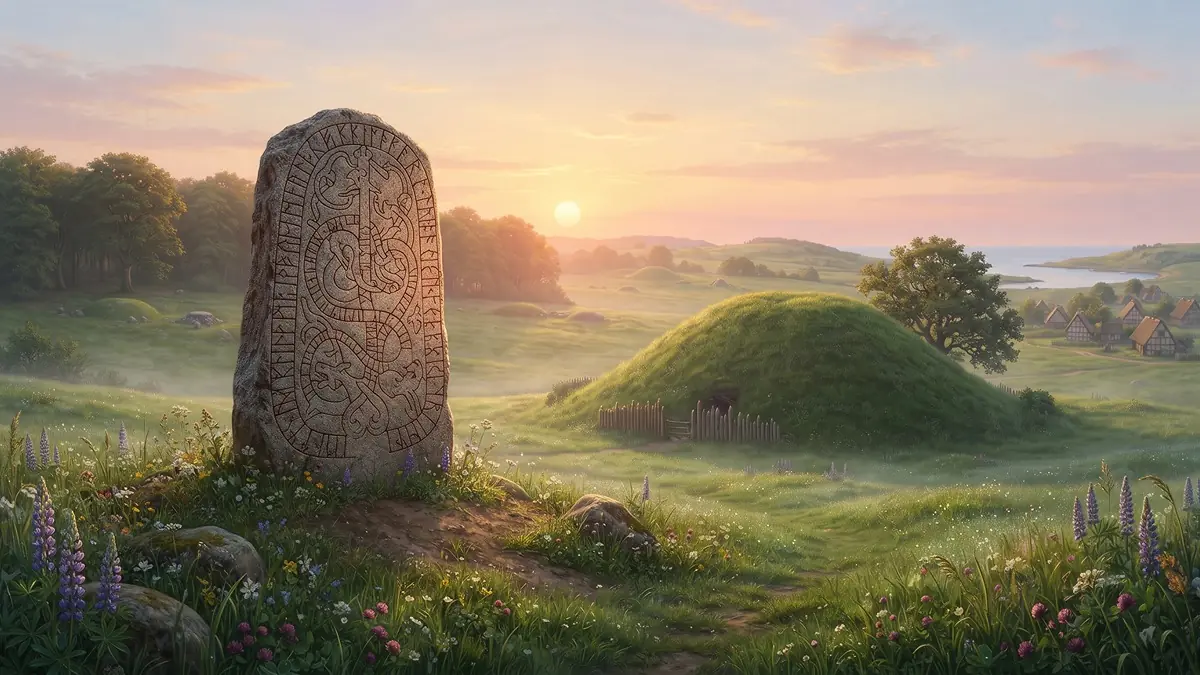
In Jelling, Denmark, two large stones with runes stand beside a church and two monumental burial mounds. The larger one was raised around 965 by King Harald, known as Bluetooth, and is therefore called “Denmark’s birth certificate”: the name of the country appears in it written in stone.
What the inscription says
The text, in runes, is a dedication. In one translation, it says that King Harald ordered the monument made in memory of Gorm, his father, and of Thyra, his mother, that Harald who won for himself all of Denmark and Norway and made the Danes Christian. In a few lines, the king remembers his family, asserts his power over the kingdom and declares the change of religion.
The stone has three carved faces. On one is a figure of an animal entwined by a snake, in traditional Norse style, and on another appears the image of Christ, considered the oldest known in Scandinavia. The stone is believed to have been colored, not bare as we see it today.
Why the stone matters
Among the words carved is the name of the country, and for that reason many historians consider it the oldest record of the name of Denmark. The stone is also a witness to the conversion: it shows a king who presents himself both as the heir of an ancient family and as the ruler of a kingdom that has adopted a new religion. The large stone is about two and a half meters tall.
The mounds and the church
The Jelling complex includes two large mounds, a medieval church between them and a smaller, older stone that Harald’s father, Gorm, had raised in memory of Thyra. In 1994 UNESCO placed the complex on the World Heritage list. Recent research discusses Thyra’s role and whether she had power of her own, and there are also debates about the exact dating of the monuments.
The alphabet of the stones
Jelling uses the Younger Futhark, the 16-letter runic alphabet used in Scandinavia during the Viking Age, simpler than the Elder Futhark, of 24. The runes were carved with straight lines, suited to wood and stone.
From Bluetooth the king to Bluetooth the technology
The origin of the nickname “Bluetooth” is uncertain. The wireless technology Bluetooth was named in honor of Harald, who unified peoples, and its logo merges two runes of the Younger Futhark, the initials H and B, hagall and bjarkan.
Since 2020, the Kongernes Jelling museum has presented the site and the story of the kings who built it.
To carve runes like those on the stones, play Carve the runes.
Sources.
- National Museum of Denmark, page on the Jelling stone
- UNESCO, Jelling Mounds, Runic Stones and Church (World Heritage, 1994)