The mill that still grinds salt at the bottom of the sea: the Norwegian tale and its relative in the Edda
A magic mill grinds whatever it is asked, but no one knows the word to stop it. The Norwegian tale explains why the sea is salty.
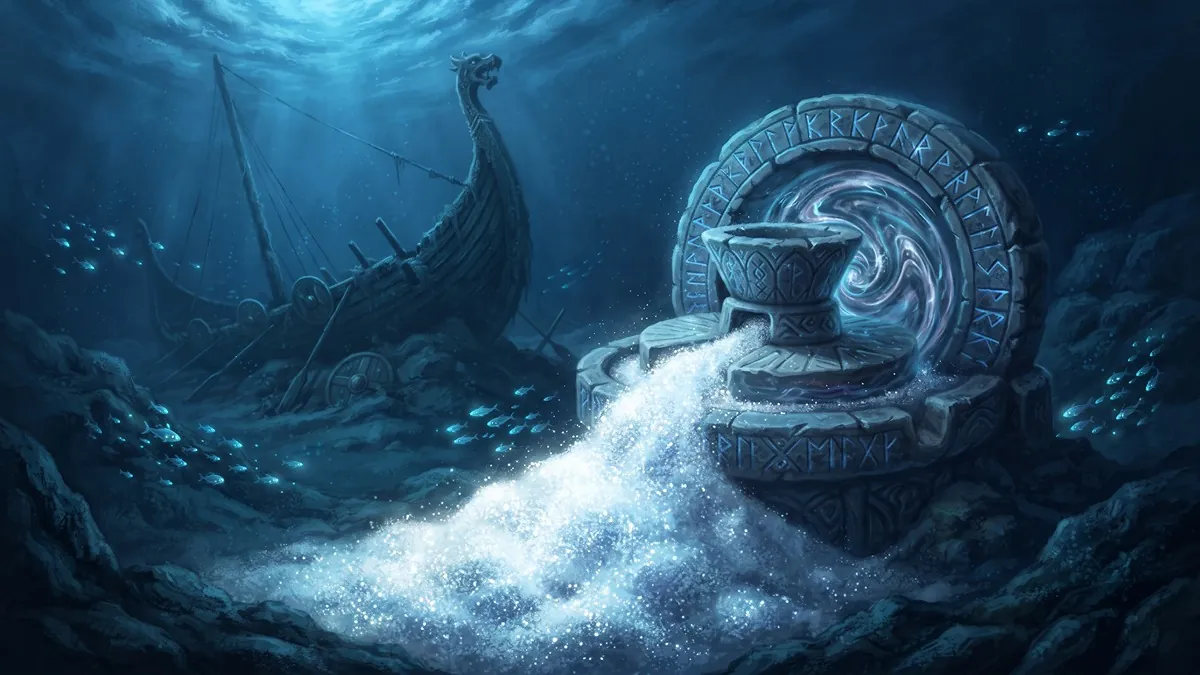
Why is the sea salty? In Norway, a traditional answer comes from a folk tale about a magic mill that grinds anything asked of it, as long as you know the word to stop it. The tale was recorded by the folklorists Peter Christen Asbjørnsen and Jørgen Moe and has a much older relative in Norse literature.
The tale of the salty sea
In the popular version, a poor man gets the mill after an encounter with a stranger, in exchange for a gift. The mill turns and produces whatever its owner asks for, from food to gold, and it stops when the right word is said. The family grows rich, but the mill awakens someone else’s greed.
A ship’s captain buys the mill, or steals it, and takes it aboard. He asks the mill to grind salt, but no one knows the word to stop. The salt fills the ship until it sinks, and the mill keeps turning at the bottom of the sea, producing salt to this day. According to the tale, that is why the sea is salty.
The mill Grotti
The story recalls an episode in the Prose Edda, in the Skáldskaparmál. Snorri Sturluson tells that the Danish king Fróði had an enormous mill, Grotti, that ground gold and peace for its owner. Two giantess slaves, Fenja and Menja, turned the stone.
Later, a sea king named Mýsingr seized the mill and took it onto a ship, ordering it to grind salt. They ground until the ship sank under the weight. Snorri says that, where the water enters the hole of the stone, a whirlpool was born, and that since then the sea has been salty.
A traveling motif
The idea of a magic object that cannot be stopped appears in many cultures. What changes is the object, and the moral. In the Norwegian tale it is greed, which ends up sinking whoever cannot be content. In the old Norse tradition, the mill produces wealth and then destruction, and the poem that sings of it draws attention to the price of unjust wealth.
Literary historians see the two stories as relatives, but there is no proof that one gave rise to the other, and the folk tale was only recorded many centuries after the Edda.
Even without proof of direct kinship, the two accounts share a warning: whoever takes hold of a power they cannot control ends up swallowed by it.
To fill a ship with salt without sinking it, play The mill that grinds salt.
Sources.
- Peter Christen Asbjørnsen and Jørgen Moe, *Norske Folkeeventyr* (1841-1844)
- Snorri Sturluson, *Prose Edda*, Skáldskaparmál, with the poem Grottasöngr (c. 1220)