Caliphate silver, pocket scales: how Arab coins ended up in Viking hoards
Tens of thousands of Islamic coins, the dirhams, have been found in Scandinavia. They show a trade network linking the Baltic to the East, and a money that was weighed rather than counted.
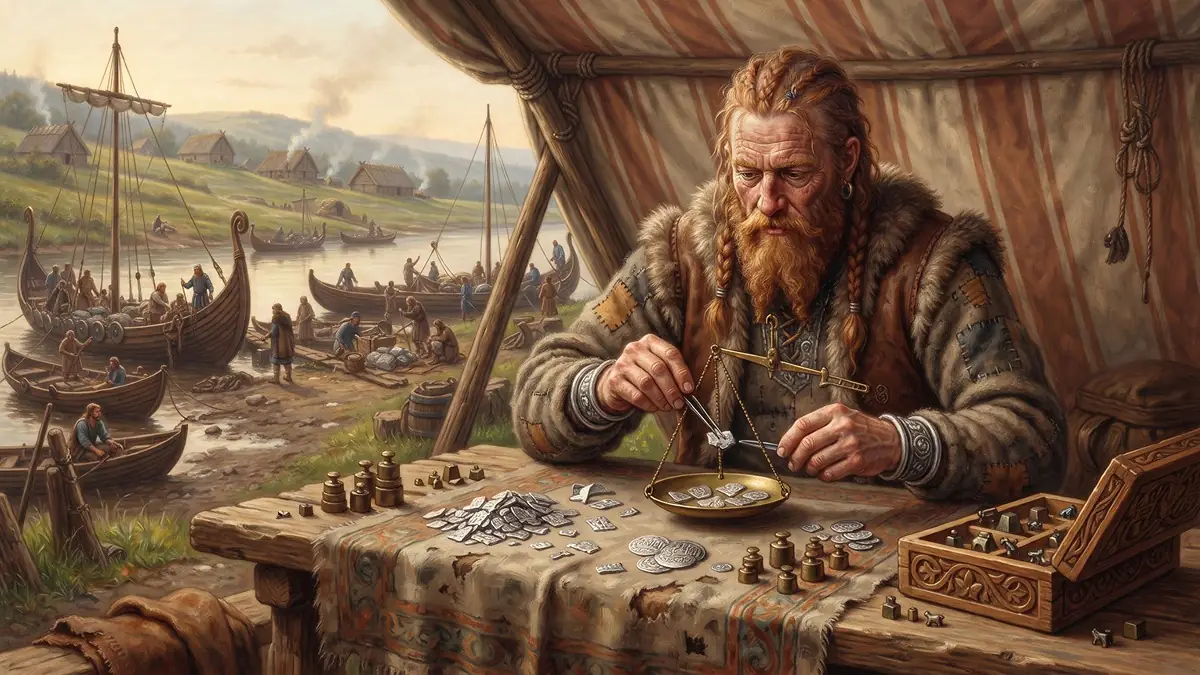
Among the hoards buried in Scandinavia in the 9th and 10th centuries, there is one kind of coin that seems out of place: the dirham, made of silver, struck in cities of the Islamic world, with Arabic inscriptions. The finds add up to tens of thousands of coins, and many are cut into pieces. They tell how Viking money travelled.
A road of rivers
The coins came from mints in Central Asia and the Middle East, such as those of the Samanid dynasty. They reached the North along river routes crossing what is now Russian territory, linking the Caspian Sea and the Volga to the Baltic. The Scandinavians who settled along these rivers, called the Rus in Arabic and Byzantine sources, were part of that bridge. In return, the North offered what the East wanted: furs, slaves, honey, wax and amber.
The Arab traveller Ibn Fadlan, who visited the Volga in 922, left a famous description of the Rus he met there. It was an outsider’s view, written by a Muslim facing customs that shocked him, and historians read it with caution. But it confirms that Northern merchants were there, trading.
Money you weigh
In most of Viking Scandinavia there was no coinage of its own in circulation. Silver was worth its weight. That is why archaeologists find, alongside the hoards, small folding scales and bronze weights. The merchant cut a coin, a bracelet or a piece of jewellery into bits and weighed the exact amount. This chopped metal is called hacksilver.
In this system the origin of the piece mattered little: an Arab dirham, an Anglo-Saxon penny and a local bracelet were, on the scales, just silver. That is also why the coins so often turn up cut.
What the hoards hold
The largest sets of dirhams were found on the Swedish island of Gotland, which holds a huge share of all Viking silver hoards. There are also finds at Birka, on Lake Mälaren, and elsewhere around the Baltic. The figures vary depending on the count, and researchers keep revising the estimates.
In time the silver mines of the East ran dry and, around the end of the 10th century, silver came more from Western Europe, especially England and Germany. The Volga route lost importance.
Many dirhams carry small test nicks, made with the point of a knife to check that the silver was solid right through and not just a skin over another metal. Others have a hole and were worn as pendants. This shows that the buyer was wary, and that a coin could serve as an ornament as well as money.
To feel the pressure of the haggling, play The merchant’s scales.
Sources.
- Finds of 9th and 10th century silver hoards in Scandinavia and the Baltic, studied by numismatists
- Ahmad ibn Fadlan, account of the journey to the Volga (922)
- Nordic museums and collections holding dirham hoards and merchants' scales