The Kraken: from the sea monster of Norwegian fishermen to the giant squid science eventually confirmed
In 1752, Bishop Erik Pontoppidan described a creature that looked like an island and attracted fish. The giant squid, which does exist, was only well documented in the 19th century.
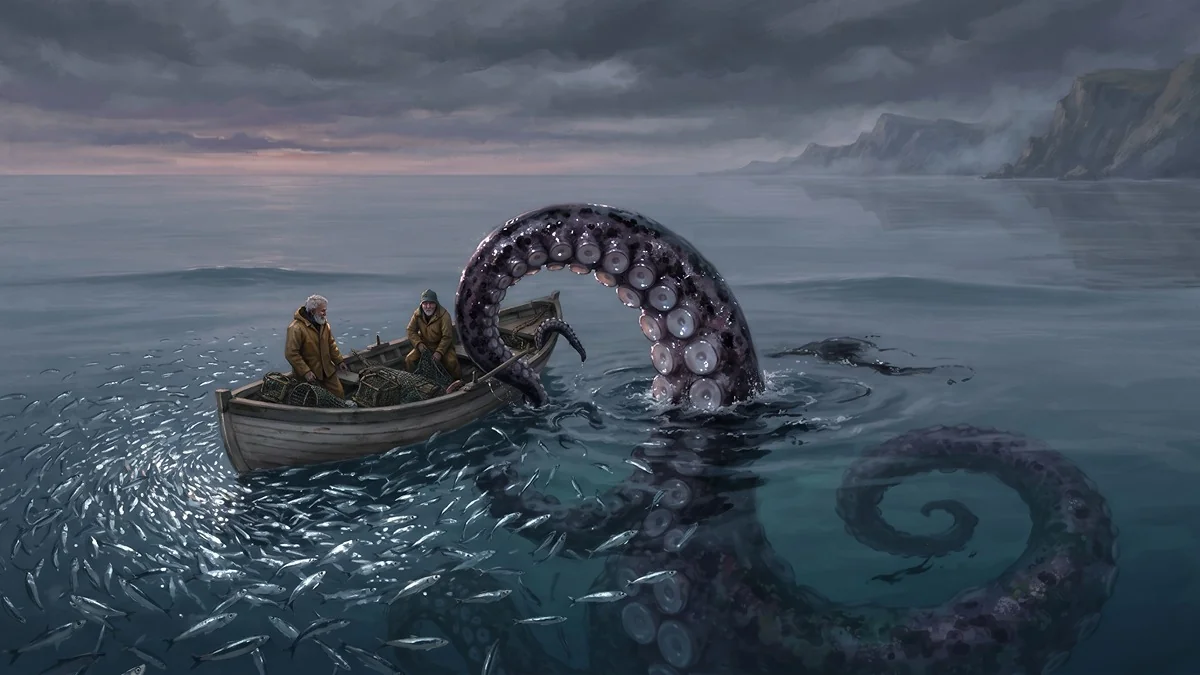
The Kraken is the most famous sea monster of the North Sea: an enormous creature with long arms, able to drag ships to the bottom. The figure was born among Norwegian fishermen and became famous worldwide through the hands of a bishop of Bergen. Only centuries later did science confirm that giant squid do exist, but none the size of an island.
The name
Kraken is the definite form of krake in Norwegian. The old word designated a crooked tree with twisted branches, and later a kind of anchor or fishing grapnel made of spruce branches. A scholar, Finnur Jónsson, proposed in 1920 that the name was an image: the monster would recall those hooks. There is also the name horven, “the harrow”.
The first mentions
The King’s Mirror, a Norwegian text of about 1250, speaks of a gigantic creature in the Greenland Sea, the hafgufa, which many associate with the Kraken. The Örvar-Odds saga, in a version from the late 14th century, also mentions it.
The Kraken, under that name, first appears in a Norwegian glossary of 1646, by Christen Jensøn, as a many-armed monster that drags boats into the abyss. In 1741, the missionary Hans Egede, who had heard fishermen from Nordland, wrote that the beast’s body stretched for miles and that, when it rose, it seemed to cover the sea.
Pontoppidan’s Kraken
It was Erik Pontoppidan, bishop of Bergen, who spread the story. In his Natural History of Norway, of 1752 and 1753, he says that the creature, when it surfaced, could be mistaken for a group of islets, with fish swimming around. Fishing over it was very productive, and the fishermen learned to recognise the sign: the sea became shallower than it should be, and the fish multiplied. But when the monster sank, it created a whirlpool, which Pontoppidan compares to the Maelstrom.
The bishop hesitated about what it might be. First he thought of a giant crab, then of an octopus or a starfish, and finally concluded that it must be “of the polypus kind”. He said its arms could drag down the largest warship. The work was translated into English and made the monster famous in Europe.
From monster to science
In 1801, the French naturalist Pierre Denys de Montfort described colossal octopuses and blamed them for the loss of ten British ships in 1782, a claim later judged false: storms explain the loss better. In 1830, the English poet Alfred Tennyson wrote the sonnet “The Kraken”, about the beast that sleeps at the bottom of the sea until the end of the world.
In the second half of the 19th century, scientists began to document the giant squid, of the genus Architeuthis. A specimen was sighted in 1861 by the French corvette Alecton, and another was studied from a find in Newfoundland, in Canada. The giant squid is real, lives in deep water and can exceed ten metres with its tentacles, but it does not sink ships.
Almost everything supernatural that Pontoppidan told remains unproved. What survives is the question he tried to answer: what the sea hides, beneath the surface where fishermen cast their nets.
To decide when to give up fishing, play Fishing over the Kraken.
Sources.
- Erik Pontoppidan, *Det første Forsøg paa Norges naturlige Historie* (1752–1753)
- Hans Egede, *Det gamle Grønlands nye Perlustration* (18th century)
- *Konungs skuggsjá*, the King's Mirror (c. 1250)
- Alfred Tennyson, poem 'The Kraken' (1830)