Ragnarök: how the Norse poems tell the end of the world, and what comes after
In the Völuspá and in Snorri, the gods die in battle, fire consumes everything and the earth rises green from the sea again. The sources differ on several details.
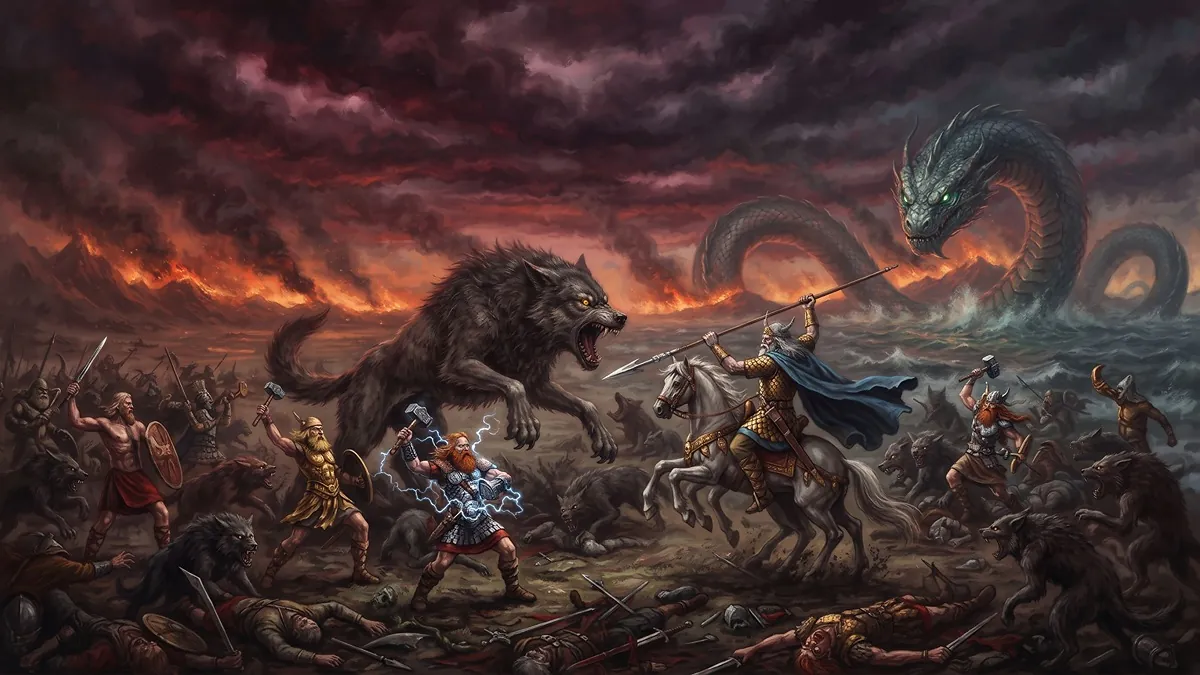
Ragnarök is the end of the world in Norse mythology: a winter with no summer, a battle in which almost all the gods die, and a fire that swallows the earth. But it is not only an ending. The poems also describe a new earth, green, rising from the sea. The story is in the Völuspá, the best-known poem of the Poetic Edda, and in the Prose Edda by Snorri Sturluson.
Both sources were set down in writing in Christian Iceland, long after the old religion had ended, and they do not agree on everything. The account below says where they part ways.
The winter and the signs
According to Snorri, the end begins with the Fimbulvetr, the great winter: three winters in a row with no summer between them, preceded by years of war and broken family ties. The wolves Sköll and Hati catch the Sun and the Moon and swallow them. The stars vanish from the sky, the earth shakes, and every chain and fetter snaps.
The wolf Fenrir breaks loose. The serpent Jörmungandr comes out of the sea and moves toward land. Loki arrives on a ship, Naglfar, which Snorri says is built from the nails of the dead. From the south comes Surt, the fire giant, with the sons of Múspell. Heimdall, the gods’ watchman, blows his horn to summon allies, and the forces gather on the plain of Vígríd.
The battle
The Völuspá and Snorri describe the duels one by one:
- Odin faces Fenrir and is swallowed by the wolf.
- Thor faces Jörmungandr, kills the serpent and takes nine steps before falling, poisoned.
- Freyr fights Surt and falls. Snorri remarks that he misses the sword he gave away to Skírnir.
- Týr and the hound Garm kill each other.
- Heimdall and Loki also die together.
There are two versions of Odin’s vengeance. In the Völuspá, his son Víðarr drives a sword into the wolf’s heart. In Snorri, Víðarr pins the wolf’s lower jaw with his boot and tears the beast’s mouth apart. Then Surt hurls fire over all the worlds, and the earth sinks into the sea.
The earth returns
After the destruction, the Völuspá says the seeress sees the earth rise again, green, with waterfalls and an eagle that hunts fish. Fields yield grain without being sown. The surviving gods gather: Víðarr and Váli, sons of Odin, and Móði and Magni, sons of Thor, who inherit the hammer Mjölnir. Baldr and his brother Höd return from the realm of the dead, and the gods find in the grass the golden pieces they once played with.
The poem Vafþrúðnismál adds that two humans, Líf and Lífthrasir, survive hidden in Hoddmímir’s wood and repopulate the world. The source does not say that this wood is Yggdrasil. That idea comes from modern interpreters.
Snorri also describes a hall roofed with gold, called Gimlé, where the righteous live. The Völuspá ends with the dragon Níðhöggr flying with corpses on its wings, an ending that leaves the future open.
Pagan myth or Christian echo?
The name is usually translated as “fate of the powers” (ragna rök). A variant, Ragnarøkkr, “twilight of the powers”, gave rise to the German tradition’s “twilight of the gods”, which is a slip of meaning.
Scholars debate how much of the idea of a world that is born again already existed before the conversion and how much came from Christianity. The stanza in which “the mighty one comes” to judgment is seen by many as Christian influence. Others argue that the cycle of destruction and renewal is a pagan inheritance. The debate remains open, and the poem does not leave the question settled.
To defend the gods’ hall for one night, play The last battle.
Sources.
- *Völuspá*, poem of the *Poetic Edda* (Codex Regius manuscript, c. 1270)
- *Vafþrúðnismál*, poem of the *Poetic Edda* (13th-century manuscripts)
- Snorri Sturluson, *Prose Edda*, section Gylfaginning (c. 1220)