Freyr and Gerðr: the god who gave away his sword for love
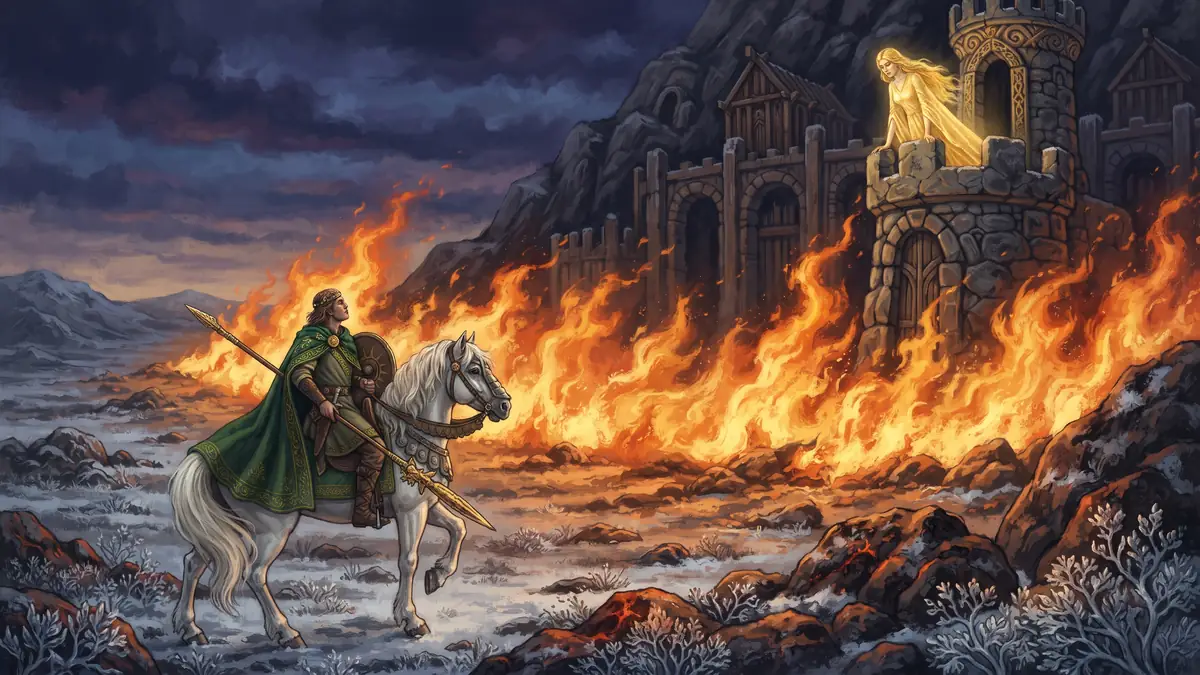
In the poem Skírnismál, the god Freyr sees a giantess from afar and falls sick with love. His servant Skírnir is sent to win her, first with gifts and then with threats.
Freyr is one of the best-loved gods of the Norse pantheon. He rules rain, sun, harvest and peace, and is lord of Álfheimr. But the poem that best tells his story shows a god overcome by a desire, and that makes him more human.
The forbidden throne
The poem Skírnismál, preserved in 13th-century manuscripts and possibly composed in the early 10th century, opens with a curious scene. Freyr sits on Hliðskjálf, Odin’s throne, from which all the worlds can be seen. He was not meant to be there. From the throne he catches sight of Gerðr, a giantess in Jötunheimr, and is seized by a sadness whose cause no one dares ask about.
Freyr comes to suffer from a passion that seems impossible, since gods and giants are enemies. His servant and friend Skírnir offers to try.
The price of the mission
Skírnir asks his lord for two things: a horse able to cross the danger and a sword. Freyr gives them without hesitation. The poem mentions that the road to the hall of the giant Gymir, Gerðr’s father, passes through flames and past hounds, and only a magic horse can manage it.
On arrival, Skírnir first tries offering gifts: golden apples and a magic ring. Gerðr refuses everything. Then he moves to threats. He promises curses and suffering, and the poem carries spell formulas that the audience of the time took seriously. Only then does Gerðr yield and agree to meet Freyr in nine nights.
The lover’s haste
When he returns and reports the result, Freyr complains about the wait. Nine nights seem an eternity to him, and the poem ends there, with the god impatient.
The long-term price
The Prose Edda tells the same story without the threats, which shows there were different versions. It adds a consequence: because Freyr gave the sword to Skírnir, he will reach Ragnarök without it and will have to fight with a stag’s antler. The price of love, then, is left for the end of the world.
How scholars read it
Researchers of the mid-20th century tended to see the union as a sacred marriage tied to the fertility of the land, with Gerðr as the field the god fertilises. Stephen A. Mitchell proposed another reading, that of a model for resolving conflict between opposed groups. More recent studies look at the coercion in Skírnir’s threats, which makes the story uncomfortable for today’s reader. Parallels in other texts, such as a rune charm from Bergen and a curse in Bósa saga, suggest the audience took the formulas seriously.
To help Skírnir’s horse cross the flames, play Leap the wall of fire.
Sources.
- Skírnismál (Poetic Edda)
- Gylfaginning, chapter 37 (Prose Edda, by Snorri Sturluson)
- Academic studies on Skírnismál, by Stephen A. Mitchell and others