Hávamál and Viking hospitality: what the poem asked of those who arrived and those who received
The Hávamál, a poem attributed to Odin, opens with advice for guests and hosts: fire, water, food and good conduct. It shows how a Norse hall received those from outside.
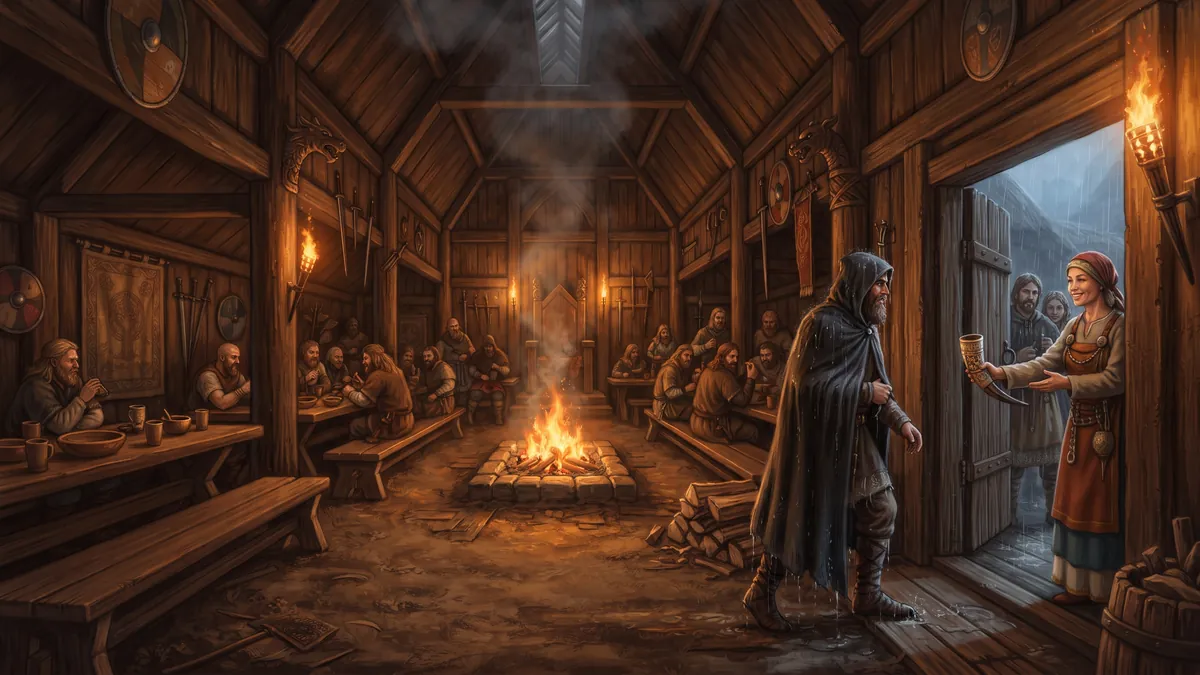
A traveller arrives soaked at a Norse hall, his knees cold, and what he needs most is not conversation. He needs fire. A 13th-century poem attributed to Odin knew that.
The words of the High One
The Hávamál, “The Sayings of the High One”, is part of the Poetic Edda and was preserved in the Codex Regius manuscript, around 1270. It is a collection of stanzas in which Odin gives advice on conduct. Scholars believe it was assembled from pieces of different periods, and its date is debated.
The first stanzas deal with a practical theme: how to behave on arriving at another’s house, and how to receive those who arrive.
What the guest needs
The poem says that whoever comes in needs fire, water and cloth to dry himself, food and clothing, as well as a good welcome. It advises looking carefully around before passing through a door, because one does not know who is on the other side. It also recommends speaking little and listening much.
What the host owes
Hospitality was a social obligation. A chieftain who received well gained a name for generosity, which in a world of alliances and debts was worth a great deal. The poem, however, also notes the other side: the welcome guest can become a burden if he stays too long in another’s house.
The real halls
Archaeology shows the settings of these scenes. The great Norse halls were long buildings, with a central hearth, benches along the walls and a seat of honour. At Borg, in Lofoten, Norway, a building about eighty metres long has been excavated, one of the largest of the Viking Age. There the chieftain received guests, held feasts and handed out gifts.
Fame that does not die
The Hávamál also contains a much-quoted idea: cattle die, kinsmen die, and the man himself dies, but the fame of one who acted well never dies. It is in that spirit that the poem treats hospitality, as a duty that gives a name to whoever fulfils it.
Far beyond courtesy
The Hávamál has about a hundred and sixty-four stanzas, and hospitality is only one part. The poem also contains the stanzas in which Odin says he hung nine nights on a tree, wounded by a spear, to gain the knowledge of the runes, and the episode of the mead of poetry. The advice to the guest appears alongside these passages, which suggests that, for whoever put the collection together, good conduct and wisdom went hand in hand.
To serve every guest before patience runs out, play Guests in the hall.
Sources.
- *Hávamál*, in the Poetic Edda (Codex Regius manuscript, around 1270)
- Archaeological studies of Norse halls, such as the one at Borg, in Lofoten