Hrólf Kraki and the gold scattered on Fyrisvellir: the escape that became poetry
Chased by the Swedish king Aðils, the Danish king Hrólf Kraki, according to Snorri, scattered gold along the road to buy time. The scene even became a poetic phrase.
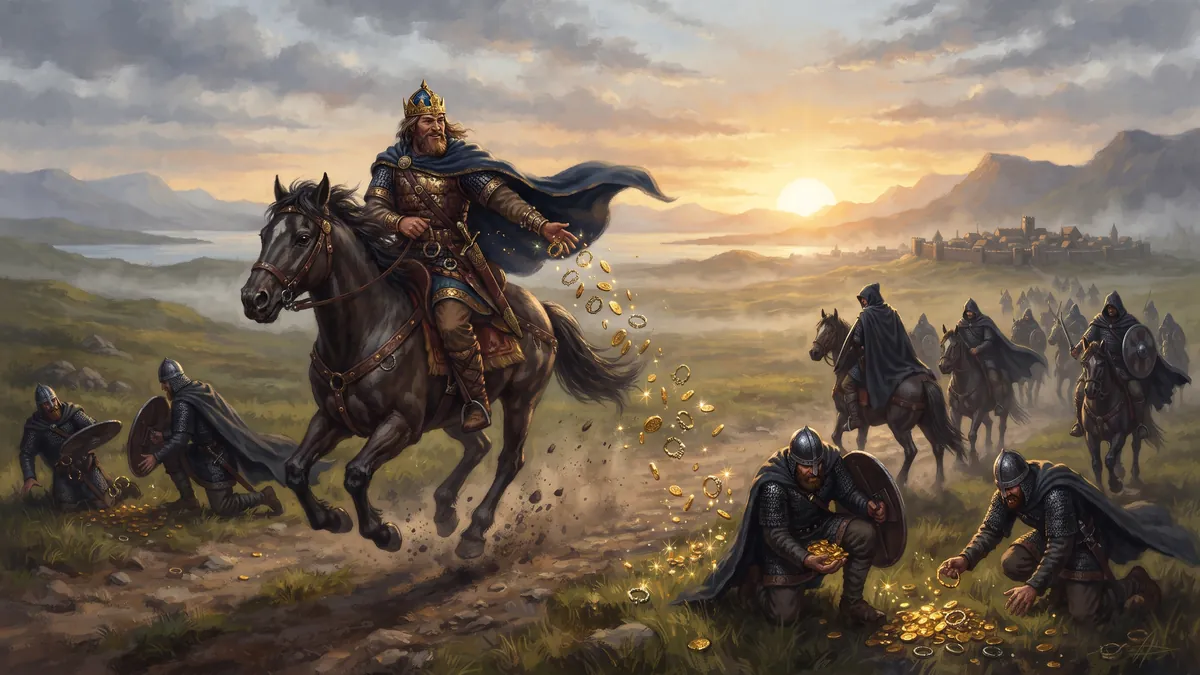
King Hrólf Kraki rides across a Swedish plain with his men, and the horsemen of King Aðils are close behind. Suddenly Hrólf begins to throw gold along the road. According to tradition, that is how the Danes escaped.
Who was Hrólf
Hrólf Kraki is a legendary Danish king, seated at Hleiðra, present-day Lejre. His story is told in Hrólfs saga kraka, written in the 14th century, and in older versions such as those of Snorri Sturluson and Saxo Grammaticus. He also appears, as Hrothulf, in the Anglo-Saxon poem Beowulf. Scholars think someone like him may have lived around the 6th century, but what the saga tells is legend.
The flight and the gold
In the Prose Edda, Snorri says that Hrólf visited the Swedish king Aðils at Uppsala, and that the visit turned into a pursuit. During the flight, Hrólf sowed gold on the plain of Fyrisvellir. Aðils’s men dismounted to pick up the coins. When Aðils himself bent down to take a ring, Hrólf, according to the text, struck him with his sword and said he had made the strongest of the Swedes bend.
The passage is not the same in every source. Each author tells it in his own way, and the late saga adds episodes, such as the twelve champions who accompany the king.
A word for gold
Snorri uses the episode to explain an expression of skaldic poetry. In the language of the poets, gold could be called “Kraki’s seed” or “the sowing of Fyrisvellir”. It is an example of what the Icelanders called a kenning, a phrase that names one thing through another.
This shows why the scene was a success: it fitted in a line of verse and gave poets an image of generosity and cunning at once.
What the specialists say
No one knows whether a real flight took place. What the sources support is that Hrólf’s story was known in several countries, from the Anglo-Saxon poem to the Icelandic sagas, and that the gold scattered on Fyrisvellir was the best-remembered episode.
The bear and the end of the kingdom
The late saga says Hrólf’s most feared champion was Böðvarr Bjarki, whose name means “little bear”. In the final battle at Hleiðra he fights in the shape of a great bear while his body sleeps in the tent. The kingdom falls to King Hjörvarðr and the sorceress Skuld, Hrólf’s half-sister, and the king dies beside his men. Many scholars compare this bear-warrior to the Beowulf of the English poem, whose name may also mean “bee-wolf”, that is, the bear.
To scatter the gold at the right moment and shake off Aðils’s riders, play Hrólf’s gold.
Sources.
- Snorri Sturluson, *Prose Edda*, section *Skáldskaparmál* (around 1220)
- Saxo Grammaticus, *Gesta Danorum* (around 1200)
- *Hrólfs saga kraka* (14th century)
- *Beowulf* (Old English poem, date debated)