Ohthere and the reindeer: an Arctic Norwegian's account to King Alfred
In the 9th century a chieftain from northern Norway told King Alfred of England how he lived among reindeer and collected tribute from the Sámi. The account was copied into a translation from Latin.
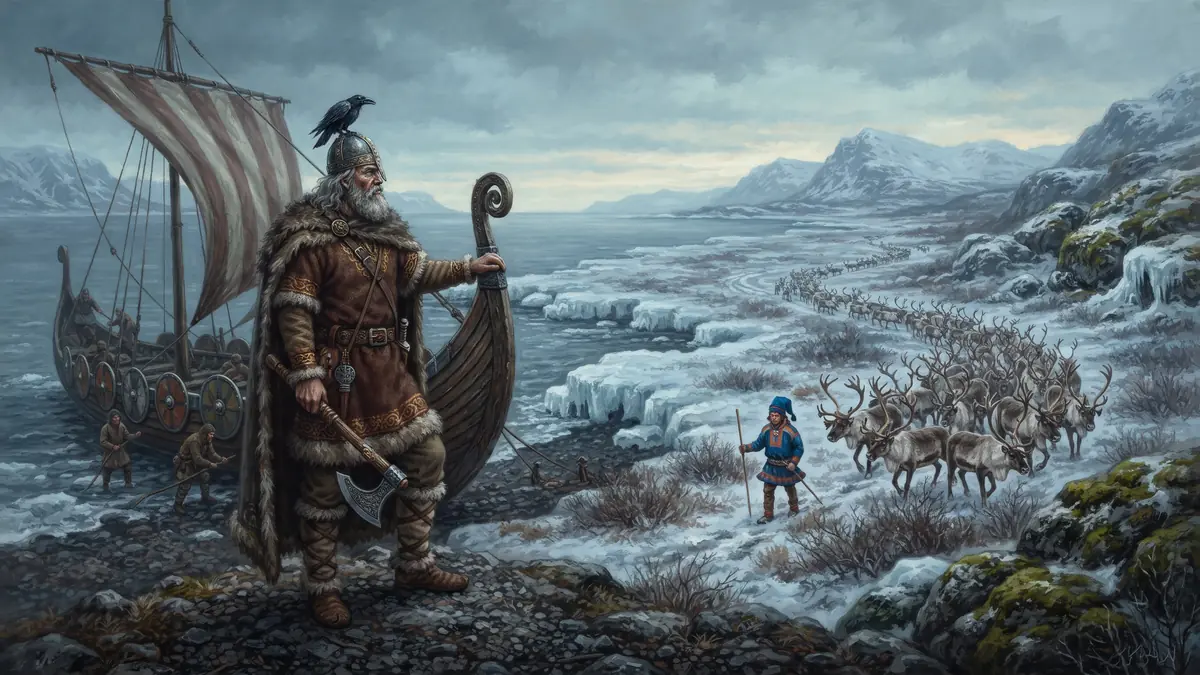
Around the end of the 9th century, a man from the far north of Norway appeared at the court of King Alfred the Great, in Wessex, and told what life was like where he lived. What he said was written down, and it survived.
An account inside another text
King Alfred had a Latin work by the historian Orosius translated into Old English. The translator inserted into it two travel descriptions, that of Ohthere (Óttarr, in Old Norse) and that of Wulfstan. It is one of the few written sources of the period that comes from direct witnesses.
Where Ohthere lived
Ohthere says he lived farther north than any other Norwegian, in the region of Hålogaland. He sailed to the North Cape and went on to the White Sea, where he met peoples who spoke a different language. He also hunted walrus, whose tusks he brought to the king.
The reindeer
The most quoted part of the account is the one describing his possessions. Ohthere says he had six hundred tame reindeer that he had not sold, among them six decoy reindeer, highly valued by the Finnas, the name old texts used for the Sámi. He also had twenty cattle, twenty sheep and twenty pigs, and ploughed a little land with horses.
The tribute
Ohthere says his greatest income came from what the Finnas paid him: skins, bird feathers, whalebone and ropes made of seal and whale hide. Each paid according to his rank. This shows an unequal relationship, one of collection, between Norse chieftains and the Sámi.
Historians debate the reach of that collection, because the account comes only from Ohthere’s side. The Sámi left no texts from the period, and what is known of them comes from archaeology and from sources written by others.
Why it matters
The account is the oldest written description of reindeer husbandry in northern Europe. It shows that the Sámi already had, at that time, a way of life tied to herding, and that the Norse traded with them and collected tribute from them.
Routes and markets
Ohthere also describes the voyage south. According to the text he sailed to Sciringesheal, which archaeologists identify with the market town of Kaupang, in Vestfold, and from there to Hedeby, in southern Jutland. These two ports were trading centres of the Viking Age. Wulfstan’s account, which follows, describes a voyage across the Baltic from Hedeby to Truso, on the coast of present-day Poland, and shows the same network of routes.
To lead the herd into the corral before dark, play Ohthere’s reindeer.
Sources.
- *Old English Orosius*, version associated with the circle of King Alfred the Great (late 9th century), containing the accounts of Ohthere and Wulfstan
- Historical studies on the Sámi and reindeer herding in the Viking Age