Rollo and Normandy: how a Viking chief received lands from the Frankish king in 911
Around 911, the Frankish king Charles the Simple gave Rollo and his men the region of Rouen. Here is what the chronicles say and what legend added.
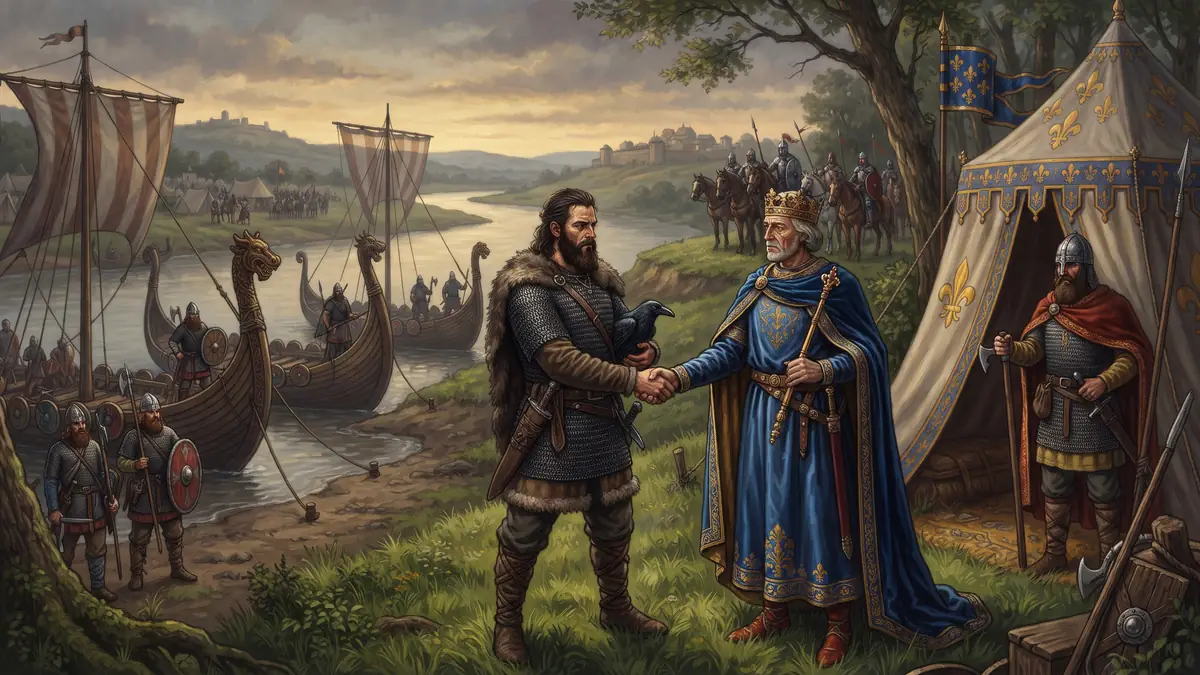
In the early 10th century, after decades of raids along the river Seine, the king of the Franks made an unusual decision: he gave land to the invaders themselves. That is how the region now called Normandy, the “land of the Northmen”, came to be.
The treaty of 911
Around 911, according to tradition, King Charles III, called “the Simple”, made an agreement with a Viking chief named Rollo (Rollon in French, Hrólfr in Old Norse) at Saint-Clair-sur-Epte, near the river Epte. Historians disagree on dates and details. What the sources support is that Rollo and his followers received lands around Rouen, on the lower Seine, and committed to defend the region against new attacks and to accept Christianity.
Who was Rollo?
Rollo’s origin is uncertain. Dudo of Saint-Quentin, a canon who wrote around 1015 at the request of the dukes of Normandy, presents him as Danish. The Norse sagas, written centuries later, call him Göngu-Hrólfr, “Hrólfr the Walker”, and make him the son of a Norwegian noble from Møre. No proof settles the question, and many historians think Dudo’s version was shaped to please his patrons.
According to Dudo, Rollo was baptised with the name Robert. He is said to have died around 930.
The legend of the king’s foot
Dudo tells a famous scene: to seal the pact, Rollo was to kiss the king’s foot. Proud, he ordered one of his men to do it, and the soldier lifted the king’s foot so hard that he toppled him. The scene appears in a text written about a hundred years after the events, and many regard it as an embellished tale, but it shows how the Normans wished to be remembered.
A land of Norsemen
In time, the Norsemen mixed with the local people and adopted French and Christianity. Even so, they left marks: many place names in Normandy end in -tot (from Norse toft, a plot of land), like Yvetot, and in -bec (from bekkr, stream), like Caudebec. Scholars also point to French navigation terms of Norse origin.
More than a century and a half after the treaty, in 1066, William, Duke of Normandy, conquered England. He was a fifth-generation descendant of Rollo. The Normans, born of Norsemen, thus ended up bringing the French language and court to England, and changed English for ever.
A deal, not a conquest
The agreement made sense for both sides. The Frankish king, weak before powerful nobles, gained an ally who blocked the river to other bands. Rollo gained land and legitimacy. The initial territory was small, around Rouen, and was enlarged by his successors: around 933, Rollo’s son, William Longsword, received regions to the west, such as the Cotentin and the Avranchin. Normandy, then, grew in stages, and was not born complete in 911.
To help the river reach the sea again, by connecting the pieces of the Seine up to Rouen, play The course of the Seine.
Sources.
- Dudo of Saint-Quentin, *De moribus et actis primorum Normanniae ducum* (around 1015)
- Flodoard of Reims, *Annales* (10th century)
- Snorri Sturluson, *Heimskringla* (around 1230), and *Orkneyinga saga* (around 1200), for the Norse tradition about Rollo