Up Helly Aa: the fire festival in which Shetland burns a Viking ship, and what is old and what is modern in it
Every January, hundreds of men with torches march through Lerwick and burn a replica Viking ship. The festival dates from the 19th century, but recalls a real Norse past.
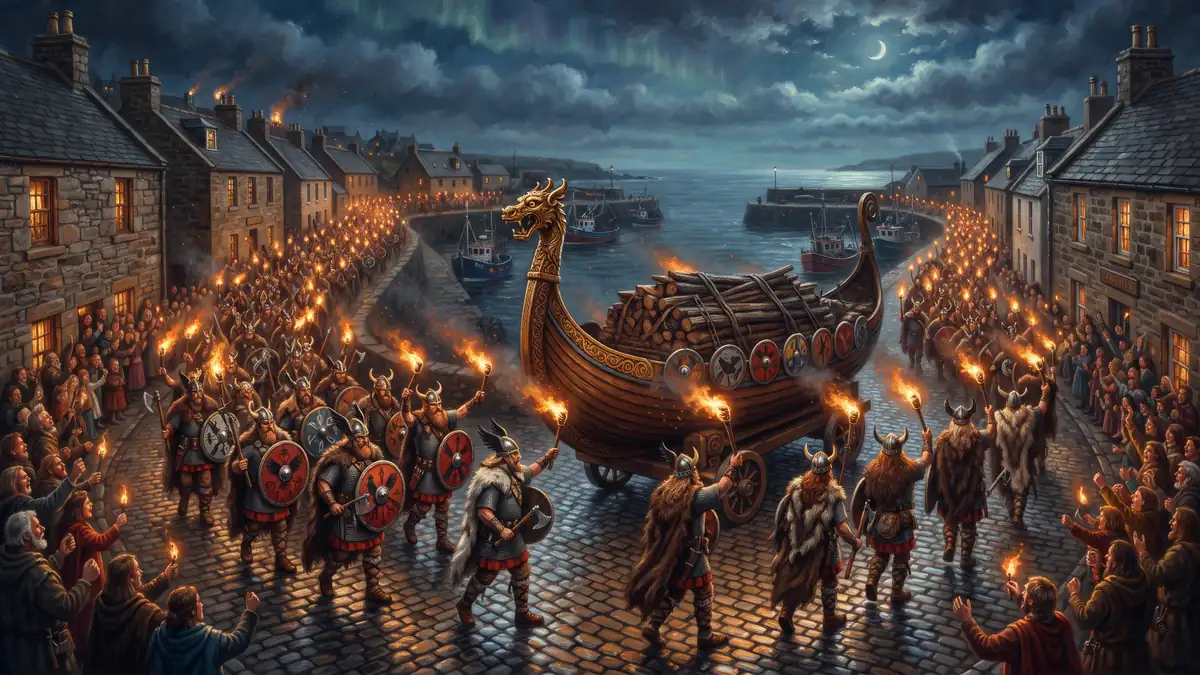
On the last Tuesday of January, the town of Lerwick, in the Shetland Islands, north of Scotland, fills with fire. About a thousand men, with torches and Norse costumes, march through the streets. At the end, they throw the torches into a wooden ship with a dragon head, which burns to ashes.
What the festival is
Up Helly Aa is a fire festival tied to the end of Yule, the midwinter festive season. The name comes from a local expression tied to the end of the holiday, and the exact etymology is debated. The festival is organised in groups, the squads, and the main one is led by a “Guizer Jarl”, the chief of the festival, chosen years in advance. The Jarl and his squad dress as Vikings. Other squads wear costumes of every kind, often comic.
During the day, the Jarl visits schools and places around town. At night comes the torchlit procession, and the finale is the burning of the galley, a replica ship built by volunteers over months. Afterwards, the squads spend the night visiting halls and performing music and comedy.
A modern tradition
The festival is not an ancient Viking rite. According to historians, it grew out of 19th-century customs, when the people of Lerwick celebrated Yule with burning tar barrels, a noisy and dangerous tradition. Around 1870, the celebration became organised, with torches. The first galley burned dates from 1889.
The Norse theme entered at a time when Britain was very interested in Vikings and sagas. That made Up Helly Aa an invented tradition, but not a false one: it is over a hundred and fifty years old and part of local identity.
Why a Viking ship?
Shetland was Norse for centuries. The islands belonged to the Norwegian and Danish world until 1468–1469, when they were given to Scotland as a pledge for the payment of the dowry of Margaret of Denmark, who married King James III. Place names, dialect words and surnames still carry Norse marks.
But the costumes are fantasy. Helmets with wings or horns, for example, do not come from archaeological finds. The burning of the ship also has no Viking proof of a ritual of this kind, although burials in boats did exist in the Viking Age.
Months of preparation
The squads rehearse for months, write satires about local life and prepare their acts and costumes. The galley is built by volunteers, with a dragon head and painted shields. There are smaller festivals in other places on the islands, on different dates between January and March. The contrast between months of work and a few minutes of fire is part of the meaning of the festival. For many residents, the night is a community celebration, and the fire is only its end.
To assemble the galley part by part before time runs out, play The Up Helly Aa galley.
Sources.
- Historical studies of the Up Helly Aa festival in Lerwick, Shetland
- Historical studies of the transfer of the Shetland Islands from Norway to Scotland (1468–1469)