Völund, the smith whom a king held on an island and who escaped by flight
The poem Völundarkviða, in the Poetic Edda, tells how King Níðuðr lamed and enslaved the smith Völund, and how he took revenge and escaped through the air.
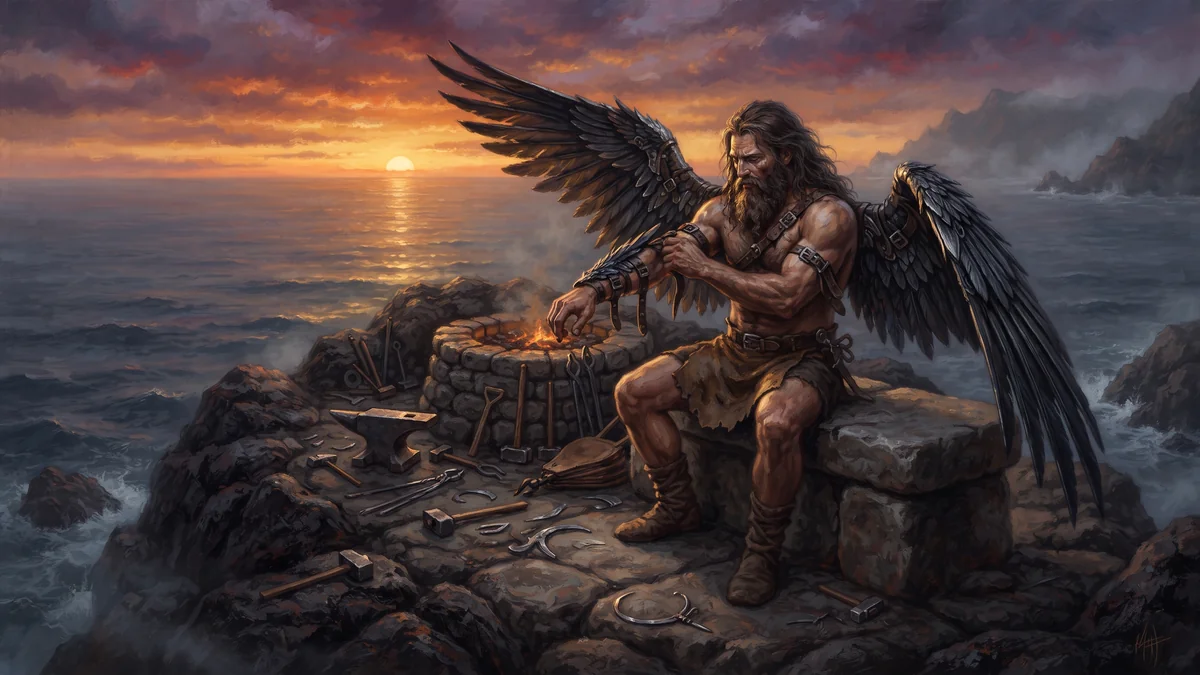
Among the poems of the Poetic Edda, the Völundarkviða is one of the darkest. Its hero is a smith, and its story is one of capture, revenge and flight.
The three brothers
The poem opens with three brothers living beside a lake: Völund, Slagfiðr and Egill. Three swan-women, whom the poem links to the valkyries, arrive and marry them. After seven years, they take wing again and leave. Two brothers go in search of their wives. Völund stays alone, forging rings of red gold, and keeping the ring his wife left him.
The capture
Níðuðr, king of the Njárar, hears of the treasures and sends soldiers to Völund’s house. They find him asleep and bind him. The queen warns that Völund is dangerous and advises cutting the sinews of his knees. Lamed, he is left on a small island, Sævarstaðr, where he must forge for the king.
The revenge
The king’s two sons visit the island, drawn by the gold. Völund kills them, makes cups from their skulls, jewels from their eyes and a brooch from their teeth, and sends the objects to the king and queen. Later, Böðvildr, the king’s daughter, seeks him out to mend a ring. The poem says Völund makes her drunk and gets her with child. It is a violent revenge, and the sources do not present it as an example.
The flight
In the end, Völund rises into the air, laughing, and tells the king what he has done. The poem does not explain how he gains wings. In other texts, such as Þiðreks saga, he makes them of feathers. Böðvildr finally admits to her father that she is expecting a child, and the poem ends without saying what Níðuðr does.
A myth that travelled
The story of Völund (Wayland in modern English, Weland in Old English) did not stay in the North. The English poem Deor names him among those who endured hardship. The Franks Casket, a whalebone box made in Northumbria around the 8th century and now in the British Museum, shows a smith with a headless body and a woman, in a scene many scholars read as Völund and Böðvildr. The Ardre VIII stone on the Swedish island of Gotland has images that seem to draw on the same cycle, with a smith and a flying figure.
In England, a Neolithic tomb in Oxfordshire still bears the smith’s name, Wayland’s Smithy. The name is much later than the tomb, and an Anglo-Saxon document of the 10th century already used it.
Scholars disagree on the origin of the legend: it may have common Germanic roots, before splitting into versions. What the sources show is a character who crossed centuries and countries, the smith nobody managed to keep imprisoned.
To help Völund put the feathers in order before time runs out, play The smith’s feathers.
Sources.
- Unknown author, *Völundarkviða*, in the *Poetic Edda* (poem preserved in a 13th-century manuscript)
- Unknown author, *Deor* (Old English poem, from the *Exeter Book*, 10th century)
- Studies of the Franks Casket and of the Ardre VIII picture stone from the island of Gotland