Gefjon and Zealand: the goddess who ploughed an entire island in one night, with four oxen
According to Snorri Sturluson, a goddess asked the Swedish king for as much land as she could plough in a day and a night, and tore the island of Zealand loose. See what the source says.
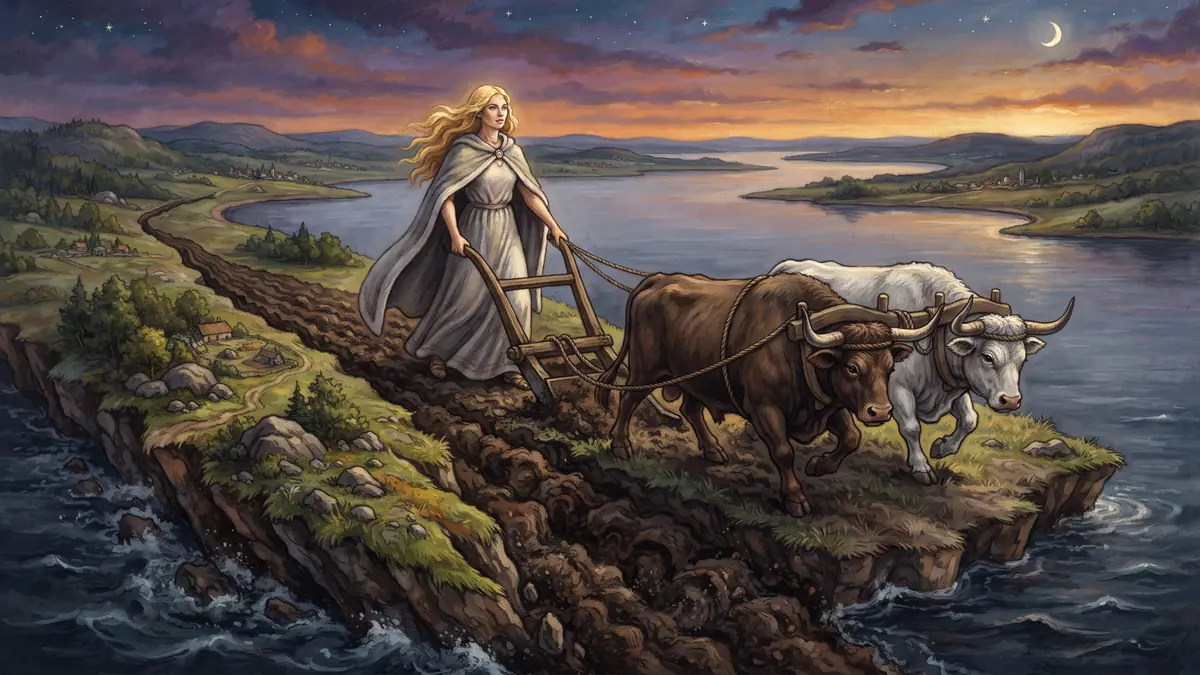
Among the Norse myths, few explain the shape of a landscape as neatly as the one about Gefjon. It is a story about a king who was too generous, a promise badly measured and an island that found its place on the map.
King Gylfi’s promise
The best-known text is the prologue of the Gylfaginning, in Snorri Sturluson’s Prose Edda, written around 1220. According to it, Gylfi, king of the region that is now Sweden, was visited by a wandering woman who amused him with her tales. As a reward, the king promised her as much land as four oxen could plough in a day and a night.
The woman was Gefjon, one of the Æsir, the main gods of Norse mythology. She went north, to the land of the giants, and had four sons there with a giant. She turned them into oxen and hitched them to a plough.
The plough that cut the land
The plough bit so deep into the ground, Snorri says, that it loosened the piece of land and dragged it out to sea, westward. Gefjon fixed it in the strait and gave the new island the name Selund, the Danish Zealand. Where the land had been torn away a lake remained, the Lögr, which Snorri identifies with Lake Mälaren in Sweden. The bays of the lake, he says, match the bays of Zealand.
Gefjon later married Skjöldr, a son of Odin, and they went to live at Hleiðra, today called Lejre, on Zealand. The Ynglinga saga, part of the Heimskringla, repeats the story with small differences.
A myth to explain a map
Scholars classify this kind of narrative as an aetiological myth: a story that explains the origin of something the listener can see. Anyone looking at a map of Scandinavia might notice that Mälaren and Zealand have similar outlines, and the myth offered a reason. In reality, the geology of the region is quite different, and there is no connection between the lake and the island.
The goddess appears in one more source. In the Lokasenna, a poem of the Poetic Edda, Loki accuses her of a conduct the poem does not explain, and Odin says she knows the fates of men as well as he does. The poem gives no further detail, and scholars debate what the stanza means.
What is known about Lejre
Lejre exists, and the archaeology there is real. Excavations have found large timber halls from the 6th to the 10th centuries, which points to an important centre of power in ancient Denmark. The medieval tradition that tied the place to legendary kings probably leaned on that importance. But no excavation confirms the existence of Skjöldr or Gefjon, and the story should be read as myth.
It is also unknown how much of Snorri’s account comes from old oral tradition and how much he rewrote, a Christian Icelander of the 13th century who wanted to preserve the poetry of his ancestors. What we do know is that in his version the goddess beats a king through cunning, turning the king’s own generosity against his measure.
To try cutting the land into the right pieces, as the goddess did, play Gefjon’s land.
Sources.
- Snorri Sturluson, *Prose Edda* (*Gylfaginning*, prologue of the first part, c. 1220)
- Snorri Sturluson, *Ynglinga saga*, in *Heimskringla* (c. 1230)
- Unknown author, *Poetic Edda* (*Lokasenna*, stanza about Gefjon, 13th-century manuscripts)