Hjaðningavíg, the eternal battle: Hild, Heðinn and Högni, the fight that restarts every night until the end of the world
According to Snorri, two kings fight without end because Hild raises the dead every night. See how the legend appears in the sources, from a 9th-century poem to Saxo's account.
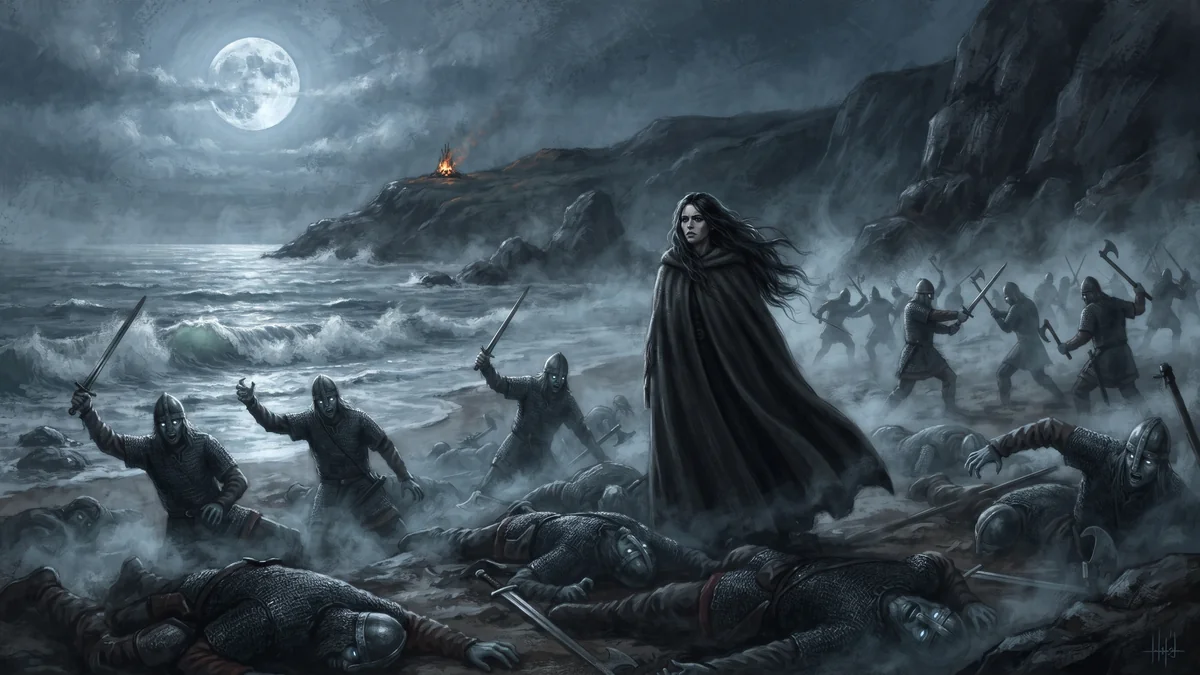
Few Norse legends seem as heavy as the one about the battle that never ends. It is called Hjaðningavíg, “the fight of the Hjaðningar”, and it appears in sources from the 9th to the 14th century.
The oldest source
The legend is cited by Snorri Sturluson in the Skáldskaparmál, part of the Prose Edda written around 1220. Snorri leans on a much older poem, the Ragnarsdrápa, by the skald Bragi Boddason, who lived in the 9th century and describes scenes on a shield. It is that poem that preserves the oldest verses of the story.
According to Snorri, a king called Högni had a daughter, Hild. King Heðinn Hjarrandason, while Högni was away, abducted the girl and carried her off. Högni pursued him and caught up on an island called Hoy, in Orkney.
An offer that did not help
Before the fight, says Snorri, Hild went to speak to her father on Heðinn’s behalf. She offered a necklace as the price of peace, according to the account, but assured her father that Heðinn was ready to fight. Högni answered that it was too late for peace, for he had already drawn the sword Dáinsleif, which, once out of its scabbard, did not return without killing.
The two armies fought all day. At night, says Snorri, Hild went to the dead and made them rise, and the next morning all returned to the fight. The battle, according to the account, would continue until the end of the world, Ragnarök.
Saxo’s version
Saxo Grammaticus, who wrote in Latin around 1200, tells a similar version with the names latinised: Hithinus, Hogno and Hilda. The details change from one source to another, and scholars see the two as variants of one tradition, which shows that the story circulated in different forms.
A late Icelandic text, the Sörla þáttr, from the 14th century, tells that the curse was broken in the time of King Olaf Tryggvason, when a baptised man killed the fighters. It is a Christian version, which seeks to end a pagan enchantment.
What it means
Scholars see in the legend a theme that recurs in many cultures, that of a conflict without end, in which vengeance feeds vengeance. Others point to the role of Hild, who, like a valkyrie, sustains the fight rather than calming it. There is no consensus on the origin of the legend, and no source proves that the characters existed.
A name and an image
The name of the fight, Hjaðningavíg, comes from Hjaðningar, the followers or descendants of Heðinn. The word shows that the legend was identified by the abductor’s side, and scholars do not explain why. The Ragnarsdrápa, for its part, describes the scene as painted on a shield, which indicates that the story circulated in verse and in images already in the 9th century.
To help one side win the endless fight by parrying the blow before it lands, play The battle without end.
Sources.
- Snorri Sturluson, *Prose Edda* (*Skáldskaparmál*, c. 1220, quoting the *Ragnarsdrápa* of Bragi Boddason)
- Saxo Grammaticus, *Gesta Danorum* (book 5, c. 1200)
- *Sörla þáttr* (Icelandic tale of the 14th century, preserved in the *Flateyjarbók*)