Jórvík: Viking York and the Coppergate excavation that found houses, crafts and even what the residents ate
In 866 the Great Heathen Army took York, which the Vikings called Jórvík. Excavations at Coppergate in the 1970s revealed well-preserved houses and workshops. See what archaeology showed.
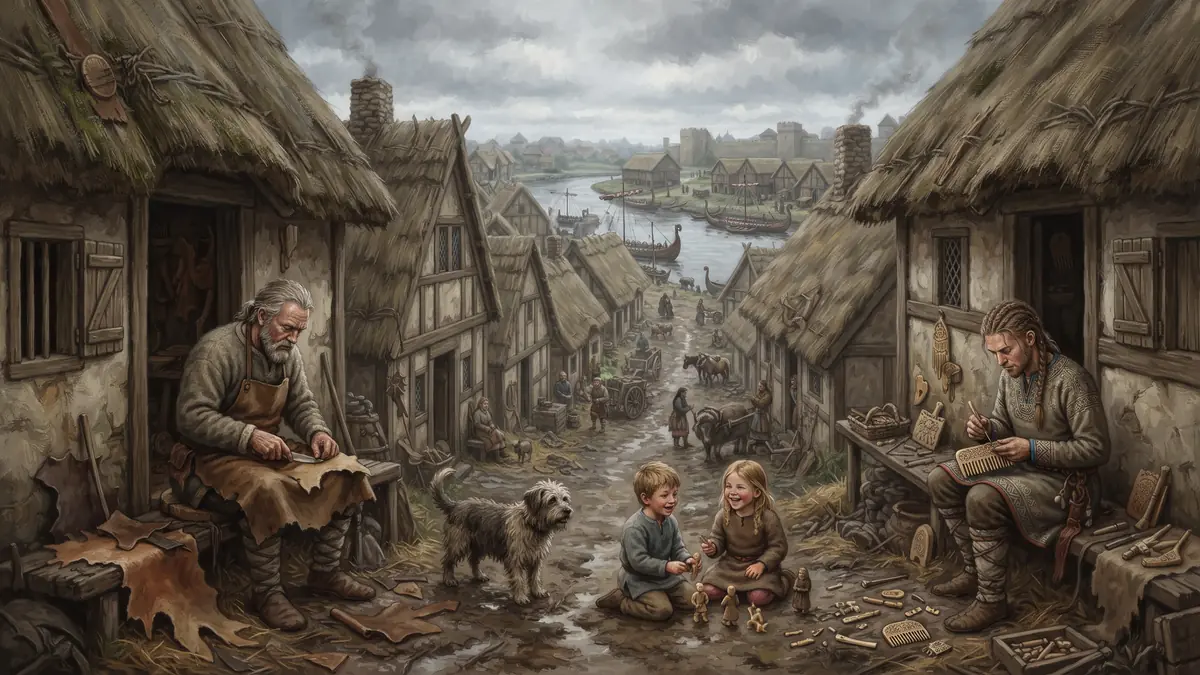
The English city of York was, for nearly a century, the capital of a Viking kingdom. The Norse called it Jórvík, an adaptation of the Anglo-Saxon name Eoforwic. What is known of that time comes from chronicles written by enemies of the invaders and from recent excavations.
The capture of the city
The Anglo-Saxon Chronicle records that the Great Heathen Army reached Northumbria in the autumn of 866 and took York. The following spring the Northumbrian kings Ælla and Osberht attacked the city, but both died. The kingdom of Northumbria fell under Norse rule. The English chroniclers, who were clerics, described the Vikings as violent pagans, and historians use their accounts with caution.
In the following decades York became a centre of power of Norse kings and was part of what was later called the Danelaw, the region of England where Norse law applied. Tradition says the last Viking king of the city was Eiríkr, who lost it in 954.
The Coppergate excavation
What changed knowledge of the city most came from archaeology. From 1976 to 1981 the York Archaeological Trust excavated the Coppergate site ahead of building work. The soil there is wet and low in oxygen, which preserved materials that normally vanish, such as wood, leather and cloth.
Archaeologists found the remains of 10th-century wood and wattle-and-daub houses on narrow plots facing the street. Posts, wicker walls, floors, pits and workshops survived. Traces were found of work in leather, weaving, iron, amber and bone, as well as antler combs. This shows a city of craftsmen and traders, not only of warriors.
A striking find was the Coppergate helmet, found in 1982. It is Anglo-Saxon, of the 8th century, and carries an engraved Latin prayer, which is a reminder that the city had an English life before and after the Vikings.
What they ate
Another discovery, on a bank site in Pavement in 1972, was a human coprolite, fossilised faeces, which scientists analysed to study diet. It gave signs of a diet rich in cereals and of the eggs of intestinal parasites. It is one of the most direct proofs of how ordinary people lived.
Memory
The Jorvik Viking Centre, opened in 1984, rebuilt the Coppergate street on the basis of these finds. Like any reconstruction, it mixes data and hypotheses, and the archaeologists themselves debate the interpretation of some details.
Distant links
The finds also show ties with distant regions: amber working, fragments of silk and coins minted in the city itself with the names of Norse kings. York was connected to a trade network that reached far beyond the North Sea. Such preservation is rare, which is why Coppergate matters so much for the study of everyday urban life.
To dig carefully, avoiding the fragile layers, play The layers of Jórvík.
Sources.
- *Anglo-Saxon Chronicle* (entries for the years 866 and 867, on the capture of York)
- York Archaeological Trust, excavation reports from Coppergate (1976–1981) and *Anglo-Scandinavian Finds from Lloyds Bank, Pavement, and Other Sites*
- Studies of the Norse presence in England and the Danelaw