Kaupang: the Viking market of Skiringssal, in Norway, and what scales, silver and graves reveal
Near Larvik, in Norway, excavations found Kaupang, one of the first Norse market towns, founded around 800. See what archaeology shows and how the name appears in Ohthere.
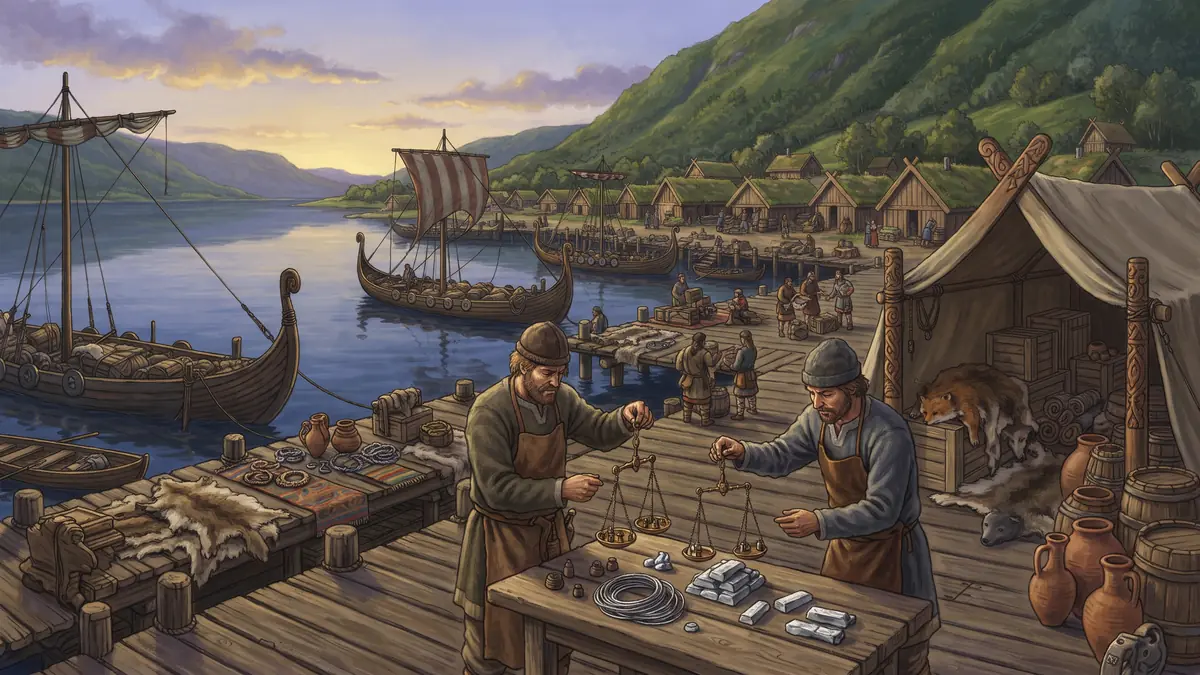
Long before Norway had cities, there was on the coast of Vestfold a place where merchants from many lands met to buy, sell and trade. Today it is called Kaupang, which in Old Norse means “market”. Ancient sources knew it as Skiringssal.
A place that appears in an old account
The name Skiringssal appears in the account of Ohthere, the Norwegian seafarer who told King Alfred of England about his voyages. The text records it in Old English as Sciringes heal and says that Ohthere sailed there from the north, a journey of about a month, in good wind. It is one of the few written references from the time.
For a long time scholars debated where the place lay. Excavations from 1950, led by Charlotte Blindheim, and a large project from 2000 to 2003 by the University of Oslo, under Dagfinn Skre, indicated that Kaupang, near Larvik, was the same site.
What the excavations showed
Dating of timber by growth rings, dendrochronology, indicates that the settlement arose around the year 800. It covered a few hectares by the edge of a bay, with narrow plots facing the water, and operated until perhaps the first decades of the 10th century.
Archaeologists found workshops where metals, glass, amber and stone were worked. There were moulds, crucibles and remains of glass beads. They also found scales and weights for measuring silver, pieces of cut silver for payments and coins, among them Arabic dirhams and coins of European kingdoms. This shows that trade was done by weight of metal, not with coin minted there.
There were objects from afar: glass and pottery from the continent, jewellery from Ireland and the British Isles, whetstones from Norway. In the cemeteries around, the graves reveal that people of different origins lived there, and some burials hold objects of foreign style.
Why it vanished
It is not known for certain why Kaupang was abandoned. One hypothesis is that trade routes changed, with new towns rising, such as Hedeby, farther south, which grew a great deal in the same period. Another is political instability in the surroundings. Researchers consider both, and neither is definitive.
The site shows that Norse trade was not only plunder: there were organised markets, with rules, weights and people who lived from them.
Who lived there
The cemeteries of Kaupang also show who lived in the place: there are graves of men, women and children, with personal objects. This points to a stable community, not only passing visitors. Researchers debate who controlled the settlement, and the link to local chiefs or to neighbouring kings remains under discussion.
To help a merchant arrange the goods without repeating any in each row, play Kaupang’s market.
Sources.
- Dagfinn Skre (ed.), *Kaupang in Skiringssal* (results of the 2000–2003 excavations, University of Oslo)
- Account of Ohthere, included c. 890 in the Old English translation of Orosius's *Histories against the Pagans*
- Charlotte Blindheim, Kaupang excavations (1950–1974)