Hervör and the sword Tyrfing: the woman who woke her dead father to take his sword
In the Hervarar saga, Hervör, raised as a warrior, goes to the island of Samsey at night and wakes her dead father to demand the cursed sword Tyrfing. Here is what the text tells.
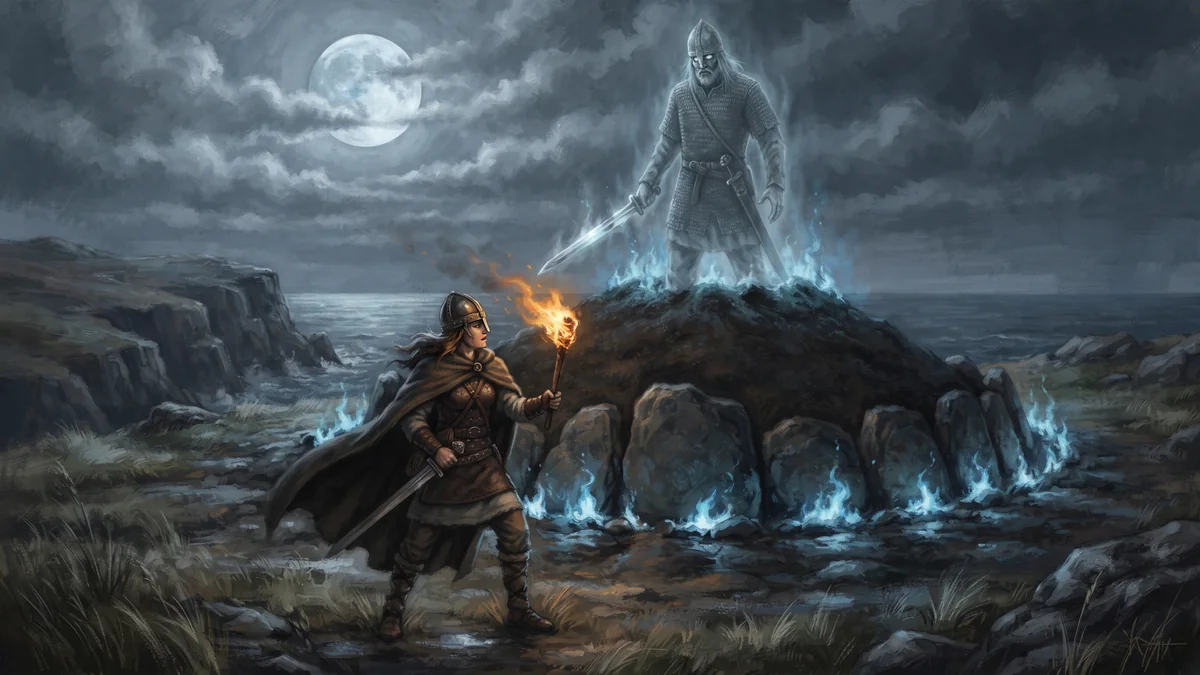
Few scenes in Old Norse literature are as striking as this one: a young woman walks alone, at night, among burning burial mounds and speaks with the dead. The scene belongs to the Hervarar saga ok Heiðreks, a 13th-century Icelandic saga that mixes history, legend and poetry.
Svafrlami’s sword
The saga begins with a sword. Tyrfing was forged by the dwarves Dvalinn and Dulinn for King Svafrlami, who forced them to make it. Before handing it over, the dwarves cursed it: it would cut stone and iron as if they were cloth, but it would kill a man each time it was drawn, and would bring misfortune to whoever owned it. The sword passed through several owners. In the next generation it belonged to Angantýr, a berserker warrior.
On Samsey, an island, Angantýr and his brothers fought the hero Hjálmarr and his companion Örvar-Oddr. The twelve brothers died, and were buried with their weapons in mounds on the island. Tyrfing stayed with Angantýr.
Hervör goes to the island
Hervör, daughter of Angantýr, grew up without knowing him. The saga says she preferred weapons to sewing, and that, as she grew, she dressed as a man, under the name Hervarðr, and led bands of warriors. When she learned where she came from, she went to Samsey.
She reached the island at dusk. A shepherd, seeing her, fled, because at night the place filled with fire and ghosts. Hervör pressed on, crossed the flames and went to the mounds. There she recited, in the poem Hervararkviða, verses in which she calls her father by name and demands the sword.
Bargaining with the dead
Angantýr answers from inside the mound. First he tries to dissuade her. He says the sword is under his head, ringed by fire, and that no one can touch it without burning. Hervör says she does not fear fire. He warns that Tyrfing is cursed and will end in disaster for her line. She insists. In the end, he hands over the sword.
The saga continues with Hervör’s son, Heiðrekr, who becomes a wise king and is remembered in a contest of riddles. The contest, known as the riddles of Gestumblindi, is one of the best-known parts of the text.
It is worth remembering that the saga is a late work, written centuries after the events it narrates, which are not historical. The Hervör scene is a powerful legend, but not a record.
The scene also shows what the saga’s society expected of a woman: Hervör breaks that role by living as a warrior, and the saga does not condemn her for it. The figure of the woman warrior appears in other sources, such as the skjaldmeyjar, the “shield-maidens” of Saxo Grammaticus, but scholars remind us that these texts are literary and do not say how many women, if any, actually fought.
To repeat the exact order of the flames and runes Hervör saw at the mounds, play Hervör’s flames.
Sources.
- Unknown author, *Hervarar saga ok Heiðreks* (13th-century Icelandic saga, preserved in several versions)
- Christopher Tolkien (ed. and trans.), *The Saga of King Heidrek the Wise* (Nelson, 1960)
- Unknown author, *Hervararkviða*, "The Waking of Angantýr" (poem included in the *Hervarar saga*)