Jólakötturinn, the Yule Cat of Iceland: whoever got no new clothes might become its dinner
In Icelandic folklore, the Yule Cat threatened to eat anyone who got no new clothes before Christmas. Many scholars link it to wool work. Here is what the sources say.
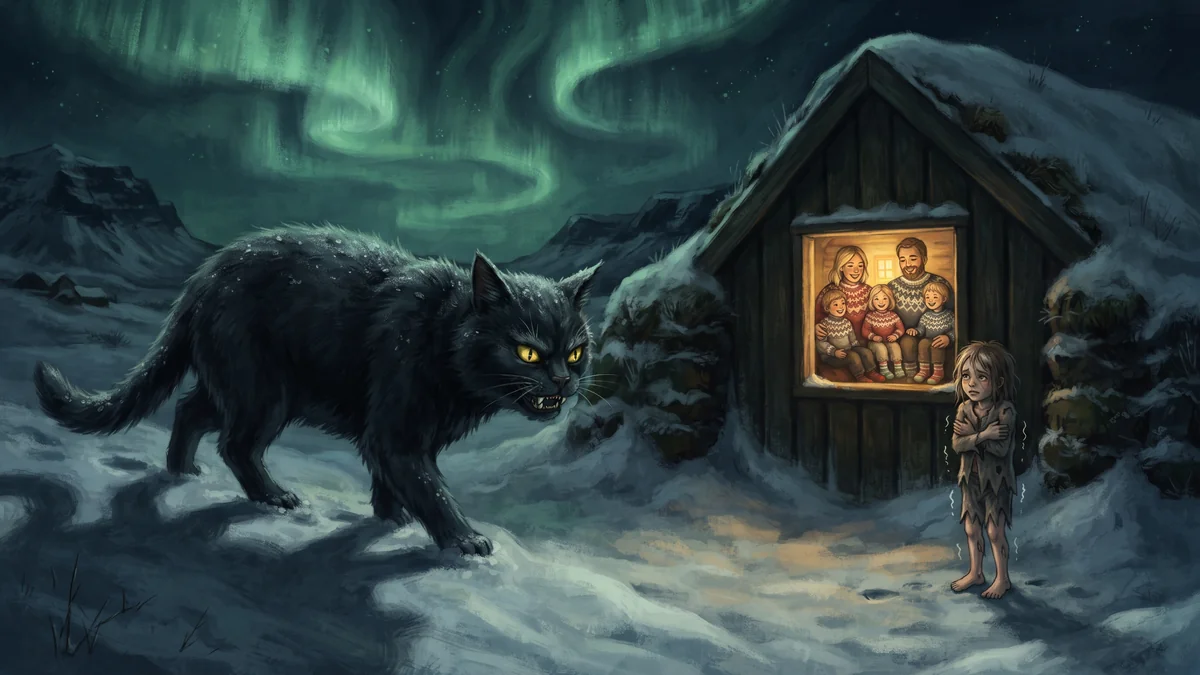
In Iceland, Christmas has characters that appear nowhere else. The best known are the Yule Lads, the thirteen sons of Grýla. But there is also an animal that belongs to her household: the Jólakötturinn, the Yule Cat.
The cat that ate those without new clothes
Tradition says the Yule Cat prowled the farms on Christmas Eve, looking for anyone who had not received a new piece of clothing. Whoever had one was safe. Whoever did not might be devoured. The collection of Jón Árnason, published between 1862 and 1864, records Icelandic folklore, and in it the cat appears as the beast of Grýla, the giantess who took children. The cat’s fame was reinforced in 1932 by the poet Jóhannes úr Kötlum, in Jólin koma, with a poem that describes a huge animal with glowing eyes.
There is an Icelandic saying still in use: fara í jólaköttinn, “to go to the Yule Cat”. It means to be left without new clothes at Christmas, and is said of someone who got nothing.
Wool and work
The explanation scholars usually give is practical. Iceland’s rural economy depended on wool. During autumn and winter, the family and the farm workers spun, wove and knitted. Whoever finished their share of the work before Christmas got a new piece of clothing as a reward, and whoever did not work, did not. The cat would then serve as an incentive to finish the wool in time.
According to this reading, fear of the cat was a way of pressing the lazy: the new clothes were a sign that one had worked, and the threat of being eaten was a strong image of the risk of having nothing. It is a common interpretation among scholars of Icelandic customs, and a reasonable one, but not the only one, and the sources do not confirm it directly.
A tradition that changed
Today the Jólakötturinn appears in children’s stories and Christmas decorations, and the idea of giving a new piece of clothing at Christmas continues, but without the fear. The tradition has moved from threat to gift, and many Icelanders still receive some garment on Christmas Eve.
The cat does not have the same presence in the sources as Grýla and the Yule Lads, and we do not know since when it has been told of. The earliest record we have is from the 19th century.
The cat’s threat also helps us understand rural life at the time: winter was long, woollen clothing was essential against the cold, and a practical gift had real value. Receiving a new garment was not a luxury, and fear of the cat was, behind the image of the monster, fear of getting through the winter without warm clothes.
To collect the balls of wool and knit before the cat arrives, without letting the thread tangle on itself, play Wool before the cat.
Sources.
- Jón Árnason (ed.), *Íslenzkar þjóðsögur og æfintýri* (1862–1864)
- Árni Björnsson, *Saga daganna* (Mál og menning, 1993)
- Jóhannes úr Kötlum, *Jólin koma* (poem "Jólakötturinn", 1932)