Ribe: the Danish market town that existed before the age of Viking raids
Excavations at Ribe show a seasonal market from about 704, with glass beads, imported pottery and coins. In the 9th century the monk Ansgar received permission there to build a church.
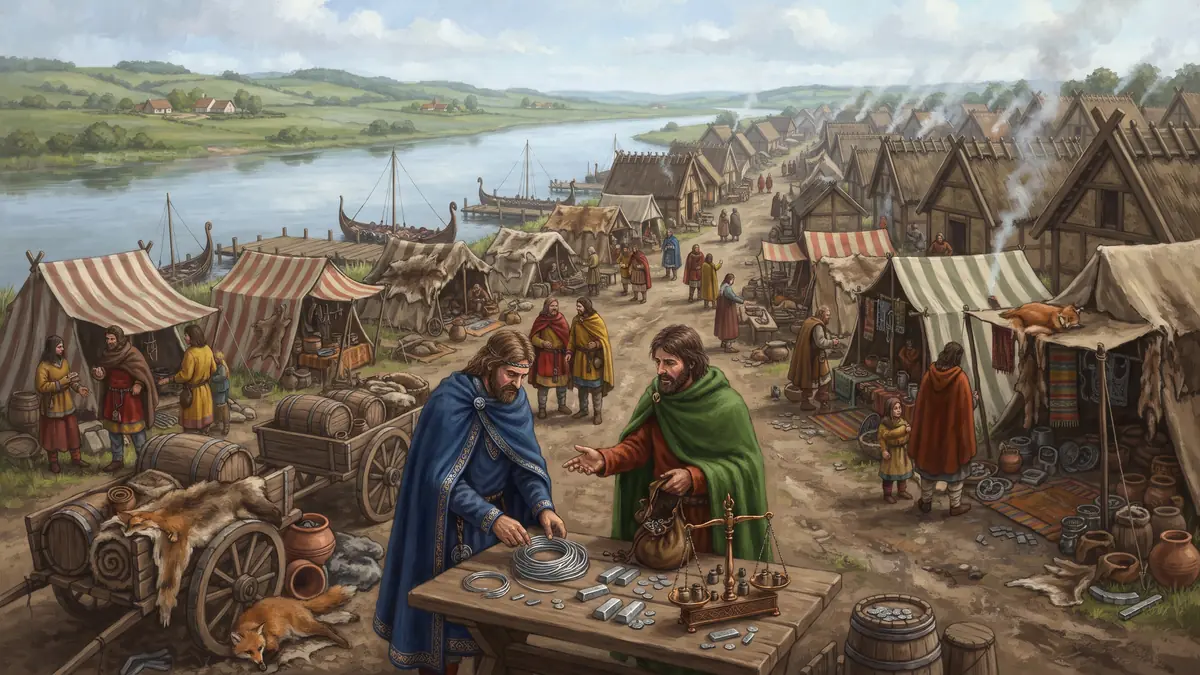
Talk of the Viking Age often brings ships and raids to mind. But the people who crossed the North Sea also traded, and one of the clearest proofs of this is at Ribe, a small town on the west coast of Denmark.
A market before the raids
Excavations at Ribe show that the place was a market from the beginning of the 8th century. Measurements of tree-ring patterns in timber indicate that the first plots were laid out around 704. It was not a walled town: it was a flat area beside the river Ribe, divided into aligned plots, and reorganised several times.
This type of market, on coasts and rivers, drew merchants from various regions. Ribe was a short distance from the North Sea, which eased exchange with Frisia, the Rhineland and England. Scholars describe these markets as seasonal places, used at certain times of the year, before they became permanent towns.
What archaeology has found
The finds at Ribe tell of trade with the continent. There is wheel-turned pottery, imported from the Rhine region, and glass beads, some of them made in the town itself. There are combs of bone and antler, made in workshops, and small weights used to weigh silver. Silver coins, known as sceattas, circulated there. The work also shows local crafts: smiths, amber workers and comb-makers.
These remains do not say whose houses they were. Specialists debate how much of the population was local and how much came from elsewhere, and who controlled the market. The likeliest answer is that it was a mix of several origins.
The arrival of the church
At Ribe, in the 9th century, we see the market meeting religion. The monk Ansgar, who worked on converting the Scandinavians, was in Denmark. Rimbert, his biographer and successor, tells in the Vita Anskarii that King Horik II allowed Ansgar to build a church at Ribe, around the year 860. The source is Christian and interested in showing the success of the mission, but it fits with the presence of an already active town.
Ribe remained a centre. Today it is a small town, with a medieval cathedral and a museum that presents the finds. The market of Ribe is a reminder that, in Scandinavia, the lives of merchants and craftsmen went on alongside armed ships.
Archaeologists note that the sediment at Ribe is rich because the place was occupied continuously for centuries. Each new layer of earth brings objects that show changes in the town: houses, workshops, wells and graves. For those who dig, the town is like a book with many pages stacked together, and each centimetre of sediment corresponds to years of everyday life of ordinary people.
To unblock the street full of carts and clear a way to the quay, as on a market day in Ribe, play Carts at the Ribe market.
Sources.
- Claus Feveile (ed.), *Ribe Studier: Det ældste Ribe* (Jysk Arkæologisk Selskab, 2006)
- Rimbert, *Vita Anskarii* (Life of Ansgar, 9th century)
- Ribes Vikinger museum (archaeological information and collections, Ribe, Denmark)