Tynwald: the Isle of Man assembly whose name comes from Norse and which still meets on a hill
The name Tynwald comes from the Norse *þingvöllr*, "assembly field". Every year, on 5 July, new laws are read from a four-tiered hill on the Isle of Man.
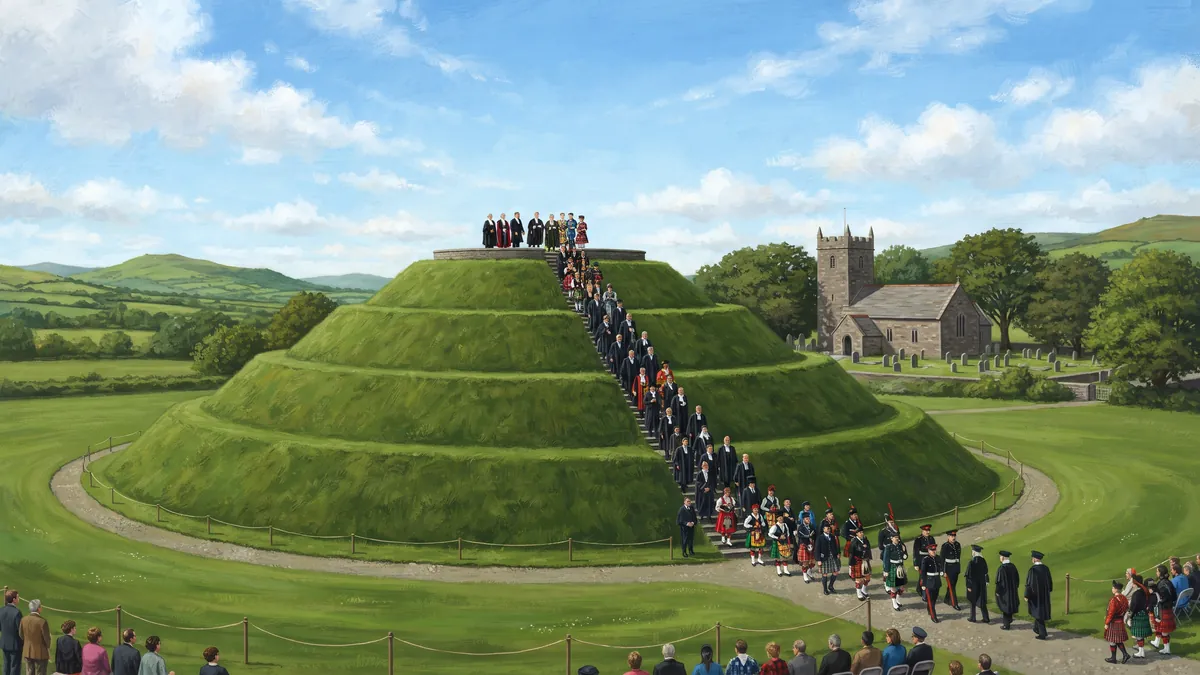
Few parliaments have a name as old as the Tynwald of the Isle of Man, in the Irish Sea. The word is of Norse origin, and the ceremony that bears the name still takes place every year on a hill.
A Norse name
Tynwald comes from Old Norse þingvöllr, “assembly field”, the word that also named Þingvellir in Iceland, where the Althing met. Wherever the Norse settled, they tended to organise assemblies of free men, the things, which made laws and settled disputes. The Isle of Man was part of a Norse realm, the Kingdom of Mann and the Isles, which lasted from the late 11th century until 1266, when it was ceded to Scotland by the Treaty of Perth.
Tradition says the Tynwald was founded in 979, and the Isle of Man celebrated its millennium in 1979. But the date is not documented, and the first written mentions come from the Middle Ages, centuries later. The Tynwald is therefore of Norse origin, and the date is a tradition.
The four-tiered hill
The Tynwald meets on an artificial hill, at St John’s, in the centre of the island. The hill has four levels in the form of steps, and tradition links this to the hierarchy of those who climbed it. For a long time the island was ruled by kings and then by lords, and the assembly served to announce the laws to the population.
The ceremony takes place on 5 July, which in other periods was 24 June. Members of parliament and other officials go in procession to a nearby chapel and then climb the hill. There the laws passed during the year are read, in Manx and in English, to the public. According to tradition, a law was valid only after this reading.
What continues
The Isle of Man today has a parliament of two chambers. The House of Keys is elected, and the Legislative Council is the second chamber. Together the two form the Tynwald. The hill and the public reading are the visible part of a tradition that still has a function.
We do not know whether today’s ceremonial resembles that of Norse times. What can be said is that the name, the idea of an assembly in the open and the public reading of the law are of Scandinavian origin, and that no one on the island has stopped doing it.
The Isle of Man also shows the mixing of cultures in the Irish Sea. Stone crosses with runes, which survive in various parts of the island, and place names reveal that Norse, Celts and Christians lived side by side there. Manx, the island’s Celtic language, is still used in the ceremony, even after centuries of rule by Norse kings and then by Scottish and English lords.
To climb the four steps of the hill, moving discs from one post to another without putting any larger one on a smaller, play The steps of the hill.
Sources.
- *Chronicle of Man and the Isles* (medieval chronicle, 13th century)
- David M. Wilson, *The Vikings in the Isle of Man* (Aarhus University Press, 2008)
- Tynwald, Parliament of the Isle of Man (official information on Tynwald Day and the hill)