The northern lights in the old North: the King's Mirror, the fire fox and the silence of the Sámi
More than seven hundred years ago, a Norwegian text tried to explain the northern lights, and peoples of the north tied them to foxes, souls and prohibitions. See what the sources say and what science adds.
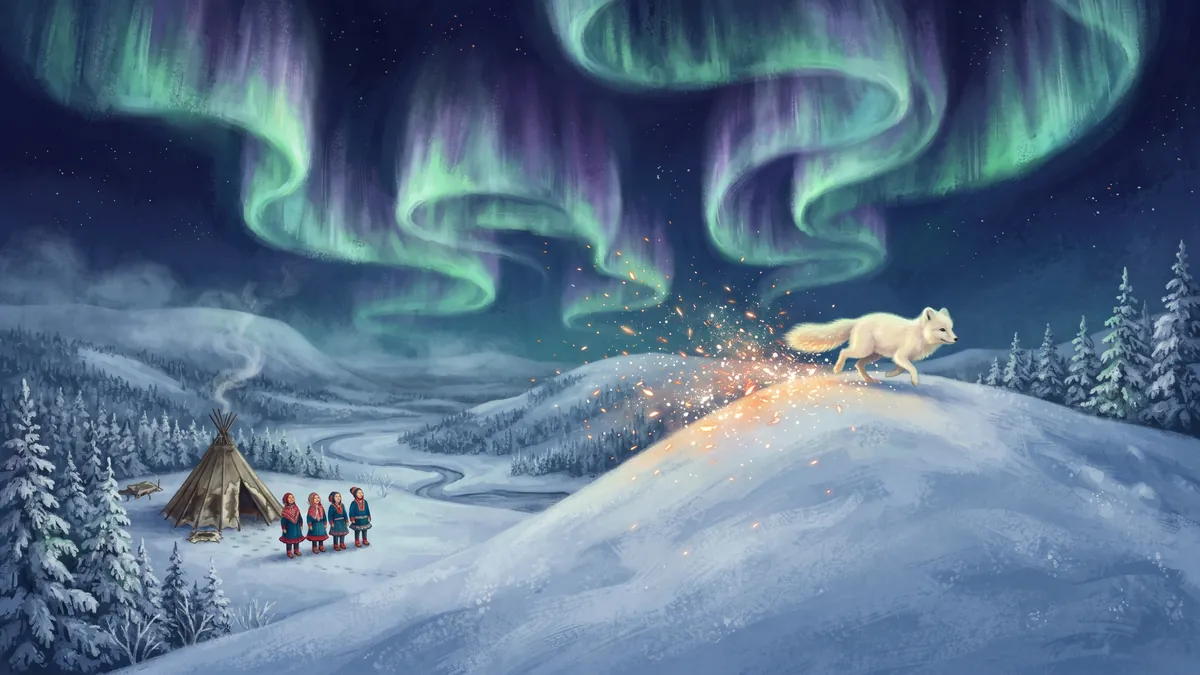
The northern lights are one of the images most associated with the North, and also one of the oldest questions of the peoples who lived beneath them. The answers given over the centuries are of two kinds: those that try to explain the phenomenon, and those that say how to behave before it.
The King’s Mirror
Around 1250, an anonymous Norwegian author wrote the Konungs skuggsjá, “the king’s mirror”, a didactic work in the form of a dialogue between a father and a son, dealing with trade, court life and nature. In a section on the wonders of the Greenland sea, the text speaks of the aurora, which it calls norðrljós, “northern lights”.
The author says it is a phenomenon seen at night, and discusses three possible explanations, without settling on any. According to the translations, one links the lights to a fire said to exist at the edges of the ocean, another to the reflection of the light of the sun, and another to ice and glaciers. Today we know that none of the three is right, but the interest of the text lies in its method: the author sets out the hypotheses and admits that he does not know.
The fire fox
In Finland, the aurora is called revontulet, usually translated as “fox fires”. The popular explanation says that a fox runs across the snow-covered hills, and that its tail, touching the ground, throws sparks into the sky. Folklorists note that this etymology may be a later explanation of the name, and not necessarily its origin.
Among the Sámi, who live in northern Norway, Sweden, Finland and Russia, the aurora is called guovssahas. Accounts gathered by researchers say that one should not make noise, whistle or sing a joik at the lights, so as not to attract them. Some traditions link the lights to the souls of the dead, while others see them as a sign that asks for respect.
What is not known
It is common to find modern texts that tie the aurora to the valkyries or to the Bifröst bridge, but no medieval Norse source makes this link directly. It is a later association, and one should be careful with it.
Science today explains the phenomenon as the result of charged particles from the Sun hitting the atmosphere near the poles and making gases glow. The old traditions, even without getting the cause right, show how people looked at a sky that changed every night.
The Konungs skuggsjá is also useful because it shows an interest in observation. The author describes where and when the lights usually appear, and notes that they are most visible on dark nights. This kind of description, common in medieval didactic texts, is one of the reasons the book is cited in histories of science in the North. Even without the right explanation, he recorded what he saw with clarity.
To switch off, one by one, the lights of the sky that turn on and off, play The lights of the sky.
Sources.
- Unknown author, *Konungs skuggsjá* (*The King's Mirror*, Norway, c. 1250; English translation by Laurence M. Larson, 1917)
- Juha Pentikäinen, *Shamanism and Culture* (Ethnographica, 1984)
- Finnish Literature Society (SKS), folklore archives, entries on *revontulet*