Wood Quay: the excavation that revealed Viking Dublin and the protest that tried to save it
From the 1960s to the 1980s, excavations at Wood Quay, in Dublin, brought to light houses, plots and objects of the Viking town. See what was found and how the project provoked one of the country's biggest protests.
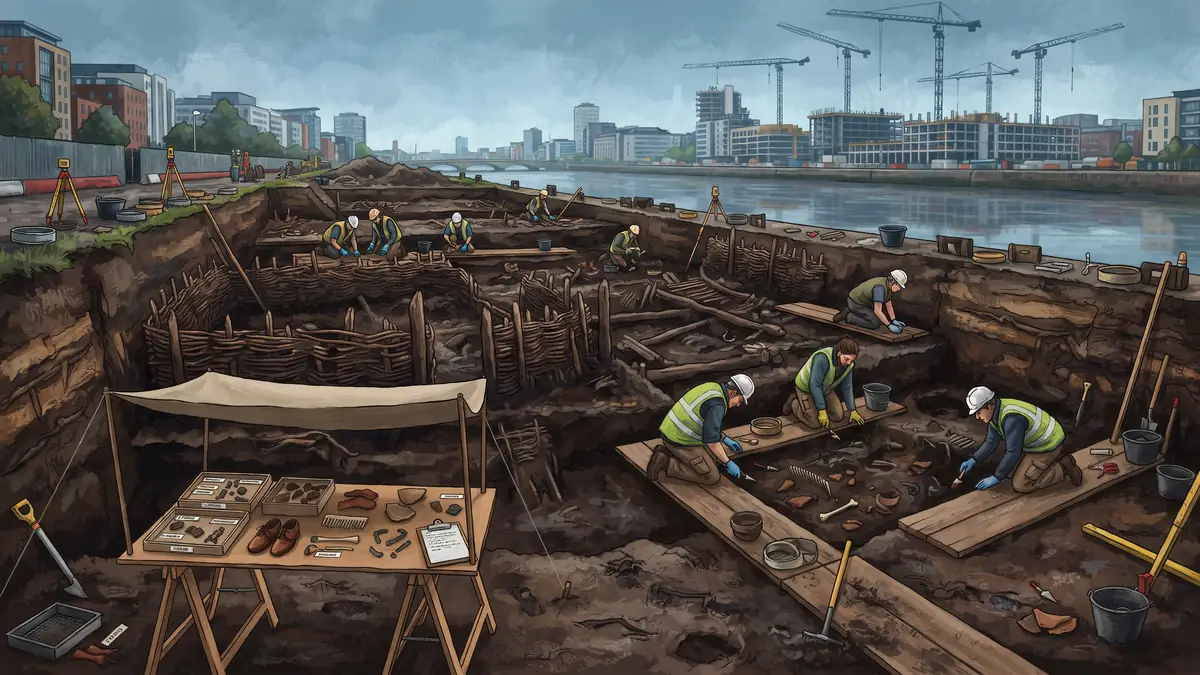
Dublin has one of the oldest histories among Viking towns. Irish chronicles record the presence of Norsemen in the Dublin area from the 9th century, and the Norse name of the city, Dyflin, comes from the Irish Duiblinn, “black pool”. But much of what is known about the daily life of its inhabitants comes from archaeology, in particular from a place called Wood Quay.
A site full of layers
Between the 1960s and the early 1980s, teams from the National Museum of Ireland excavated areas of the old town, near Christ Church Cathedral. The work was first directed by Breandán Ó Ríordáin, and later by Patrick Wallace. They found the remains of houses with wattle walls, surrounded by yards and ditches. The buildings were rebuilt several times, in layers, over generations.
One important discovery was that the plots, that is, the ground belonging to each house, kept the same boundaries for a long time. This suggests a planned town, with clear rules about who owned each piece of ground. Researchers also recorded workshops, and the damp soil preserved materials that are usually lost, such as leather and wood.
What the earth kept
Among the finds are leather shoes, bone combs, metal pins, wooden bowls, amber and scraps of cloth. These objects show active trade and an organised urban life. They also indicate that the people of Dublin, Norse and Irish, lived together and exchanged techniques.
Historians use these data to answer questions the chronicles do not answer, such as the size of the houses, the diet and the trades. It is worth remembering that the site shows one neighbourhood, and not the whole city.
The protest
The excavation also became known because of a dispute. Dublin Corporation intended to build a complex of municipal offices there, and many archaeologists, historians and citizens defended the preservation of the site. In 1978, a large march brought thousands of people together in defence of the site. The matter reached the courts, and the final decision allowed the works to go ahead, so that the buildings were constructed, partly over the excavated area.
The episode is remembered as a landmark of public interest in Irish archaeological heritage. The results of the excavations, for their part, were recorded in publications and collections, and help tell the story of the city.
The results also helped correct an old idea. For a long time, the Vikings were seen mainly as raiders, and the town showed another side: craftsmen, merchants and families who lived from trades. Researchers observe that craft waste, such as scraps of amber and leather, points to local work, and not only to products brought from afar.
Today, part of this collection can be seen in Dublin museums, and the subject is still discussed by those interested in urban memory. The lesson many draw from the case is that buried heritage can be studied only once, and that a well-documented excavation is often the only chance to preserve the information.
To take over the map of the town, plot by plot, until it is painted a single colour, play Dublin’s plots.
Sources.
- Patrick F. Wallace, *The Viking Age Buildings of Dublin* (Royal Irish Academy, 1992)
- Breandán Ó Ríordáin, excavation reports from High Street and Winetavern Street (National Museum of Ireland, 1962–1976)
- Clare Downham, *Viking Kings of Britain and Ireland: The Dynasty of Ívarr to A.D. 1014* (Dunedin Academic Press, 2007)