The Gosforth Cross: a Christian monument in England with scenes from Norse myths
The Gosforth Cross, in Cumbria, is about four metres tall and mixes Christian images with scenes that many scholars link to Norse myths. See what the stone shows and what is still debated.
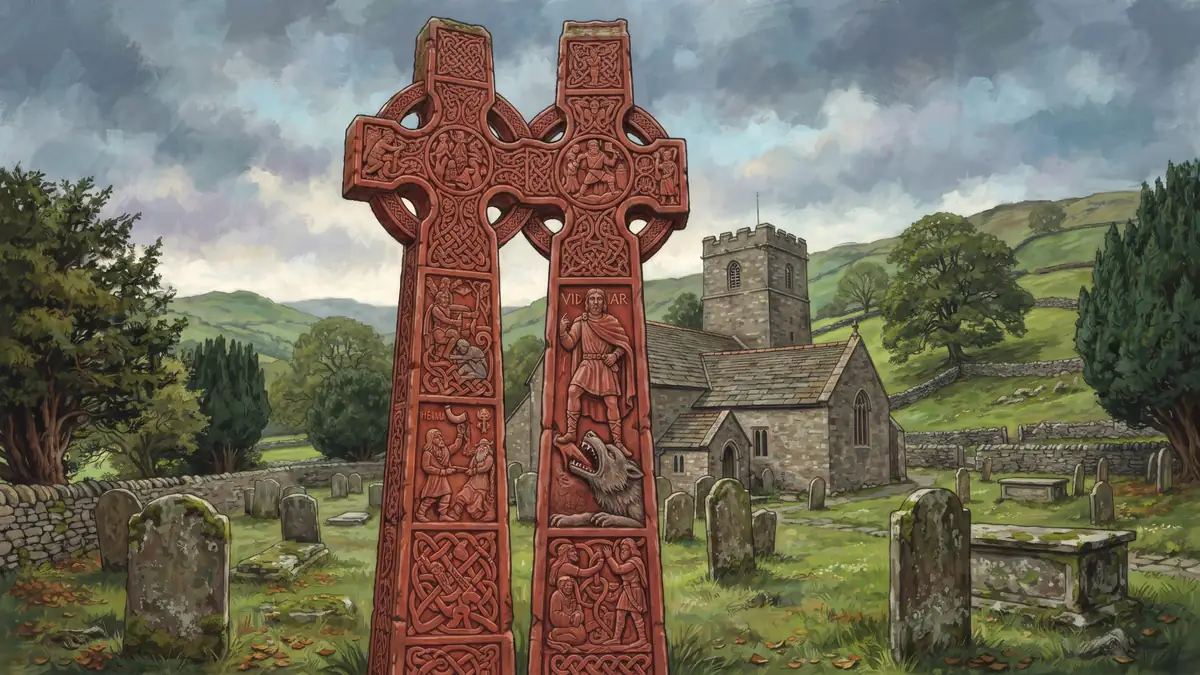
In the churchyard of St Mary’s church, in the village of Gosforth, in Cumbria, in north-west England, stands a stone cross about four metres tall. It was carved in red sandstone, and most scholars date it to the first half of the 10th century, when the region had a population of Scandinavian origin. The cross is one of the most discussed monuments of Viking Age sculpture in England.
One cross, several worlds
The shape of the piece is Christian, and one of the faces carries a scene that many identify as the Crucifixion. But other faces show scenes that researchers have associated with Norse myths. Among the most discussed are that of a man with the mouth of a wolf under his feet, which may recall the fight of Víðarr with the wolf Fenrir at Ragnarök, and that of a bound figure, which some link to Loki.
These readings come from comparisons with texts such as the Prose Edda. It is worth remembering that those texts were written centuries later, in Iceland, and that the cross comes from another region. For this reason, many specialists treat the identifications with caution, and some still propose Christian readings for the same images.
The interlace
A good part of the surface is covered in interlaced motifs, knots of lines that cross and fold with no visible end. This kind of ornament is common in the art of northern Europe, both in the British Isles and in Scandinavia. The piece combines the local repertoire with forms brought by Norse settlers, which shows a mixed culture, and not a simple replacement of one by the other.
Other stones in the same church reinforce this idea. Among them are blocks known as hogbacks, long slabs shaped like a roof, and a fragment, called the Fishing Stone, which some scholars associate with Thor’s fishing, while others see in it a different episode.
Why it matters
The value of the cross lies in showing a moment of contact. The Scandinavians who settled in the region lived alongside Christians, and some of them, or their descendants, commissioned monuments that blend the two traditions. The stone does not prove a specific belief, but it shows that whoever commissioned it knew both worlds.
The cross also helps us understand how art circulated. The style of the figures and the interlace has parallels in sculptures from other parts of northern England and from the Irish Sea region, and specialists speak of a regional school of sculptors. We do not know who these craftsmen were or who paid them, but the quality of the work points to experienced workshops.
Another point is the choice of red sandstone, a local stone that lets itself be carved in detail. The height of the cross demanded careful transport, fitting and installation, which suggests the monument was designed to be seen from afar, in a gathering place of the community. Today it still stands in the same churchyard where it was probably raised, and is visited by those who study the relations between Christians and Scandinavians in England.
To complete the interlace, turning each piece until the thread links the source to the end, like a knot carved in stone, play The cross’s interlace.
Sources.
- Richard N. Bailey, *Viking Age Sculpture in Northern England* (Collins, 1980)
- Richard N. Bailey and Rosemary Cramp, *Corpus of Anglo-Saxon Stone Sculpture, vol. II: Cumberland, Westmorland and Lancashire North-of-the-Sands* (Oxford University Press, 1988)
- Rudolf Simek, *Dictionary of Northern Mythology* (D. S. Brewer, 1993, entries on Norse figurative art abroad)