The Jomsvikings: the fortress of warriors with strict rules and the battle of Hjörungavágr
The *Jómsvíkinga saga* tells of a fortress of mercenaries with harsh laws and of a naval battle against Jarl Haakon in 986. See what the saga says and what historians doubt.
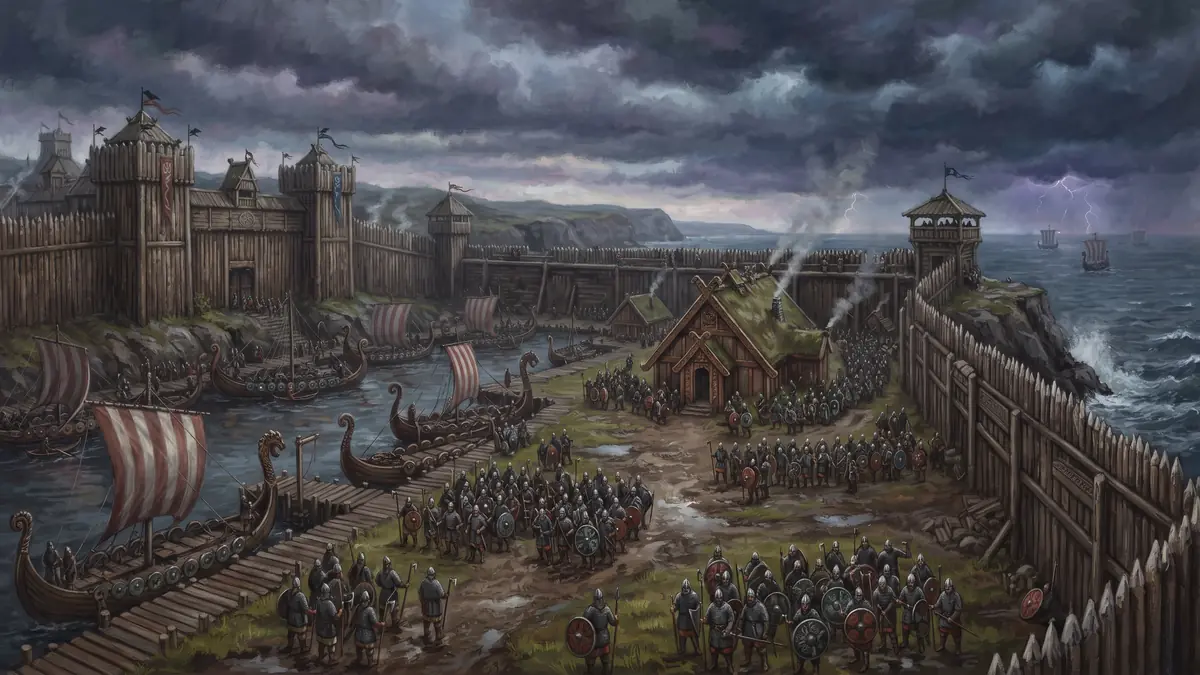
Few groups of warriors in the Norse world have entered the imagination as much as the Jomsvikings. According to the Jómsvíkinga saga, they formed a brotherhood of mercenaries, owners of a fortress on the southern Baltic, with very harsh rules. The saga was written in Iceland, around the 13th century, and mixes old memories with a great deal of literary addition.
The fortress and its rules
The saga places the fortress, called Jomsborg, on the coast of the Slavs, in a region that many scholars associate with the island of Wolin, at the mouth of the Oder. The exact location is debated, and excavations have so far found no structure that matches the saga’s description in full. That does not stop the name from being cited in works of history.
According to the text, only men of a certain age, around eighteen to fifty, could join, and each had to show courage. No one could show fear, or flee before an opponent of equal strength. The plunder was shared among all, and women could not stay in the fortress. The saga names the chief Palnatoki as a prominent figure, and later Sigvaldi, who leads the group in the final part.
The feast and the vow
One of the best-known episodes is the feast in memory of the Danish king Harald Bluetooth. According to the saga, his son, Sweyn Forkbeard, made a solemn vow before everyone, and the Jomsvikings made vows of the same kind, among them one to attack Jarl Haakon, in Norway. Historians see in this episode an embellished account, but within the saga it explains the reason for the expedition.
The battle of Hjörungavágr
The clash took place in the bay of Hjörungavágr, on the west coast of Norway, and is usually dated to 986. The saga says that the Jomsvikings’ ships were more numerous and that Jarl Haakon, at a disadvantage, appealed to a deity by sacrificing something of great value. A storm then fell on the enemy. The same account says that Sigvaldi fled with part of the fleet, and that some Jomsvikings were captured and executed.
Historians distrust the supernatural details, but accept that the battle probably happened. Skaldic poems by authors linked to the jarl mention it, and these texts are closer to the events than the saga. The fortress, for its part, remains uncertain: it may have been real, it may have gathered memories of several Scandinavian bases on the Baltic, and it may have been in part an invention of the Icelanders.
Another point of debate is the name itself. The Jomsvikings entered the memory of several Baltic countries, and each tradition tells of them in its own way. Some historians think the group reflects memories of warriors who served Danish kings, and that the saga, written much later, gathered these traits into a single brotherhood with well-defined rules. The idea of such a rigid code, with a minimum and maximum age, recalls a literary rule more than a real regulation.
To break down, brick by brick, the walls of Jomsborg, play The walls of Jomsborg.
Sources.
- Unknown author, *Jómsvíkinga saga* (Icelandic saga, 13th- and 14th-century manuscripts)
- N. F. Blake (ed. and trans.), *The Saga of the Jomsvikings* (Thomas Nelson, 1962)
- Adam of Bremen, *Gesta Hammaburgensis ecclesiae pontificum* (c. 1075, passages on the Slavs of the Baltic)