Lokasenna: the feast of Ægir where Loki insulted the gods one by one
In the poem *Lokasenna*, from the Poetic Edda, Loki enters a banquet and insults each god and goddess present, until Thor arrives with his hammer. See what the text says and what scholars debate.
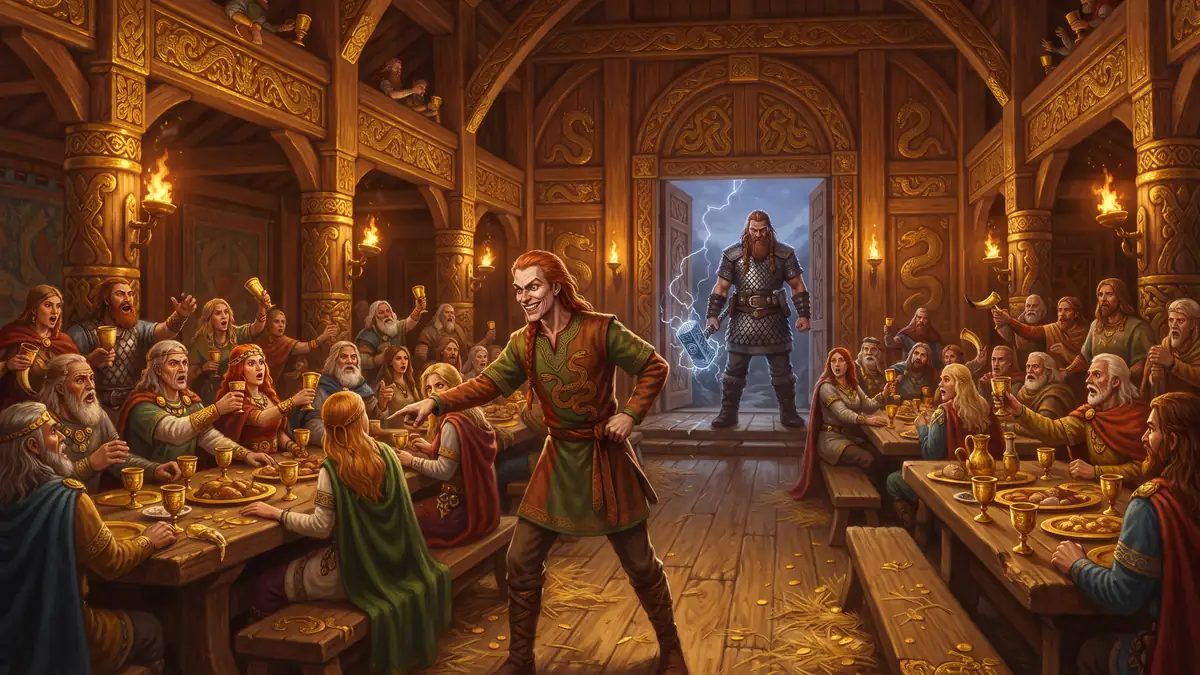
Among the mythological poems of the Poetic Edda, few are as acid as the Lokasenna, “Loki’s quarrel”. At a single banquet, the trickster god insults almost everyone present. The poem is short but widely read, because it shows the Norse gods failing in public.
The banquet
The text begins with a short introduction in prose. Ægir, a being linked to the sea, has brewed ale for the gods, and the hall where they gather is a place of peace, where no one should fight. Snorri, in the Skáldskaparmál, adds that the hall was lit by shining gold, and so needed no fire. Ægir’s servants look after the guests very well, and the gods praise the service.
Loki, who was not invited, kills one of the servants, called Fimafeng. The gods drive him out, but he returns and asks for a place at the table. Odin recalls that the two swore a blood oath in ancient times, and so orders Loki to be served. From there begins the senna, the Norse term for a contest of insults in verse.
The insults
Loki accuses each god, one by one. He speaks of cowardice, of betrayals and of secrets the others would rather hide. Bragi, god of poetry, is called a coward, Freyja is accused of having many lovers, and Odin is reminded of having practised magic thought improper for a man. Some gods reply, others try to calm the mood, and those who speak in defence of others often end up attacked as well.
The poem does not say that all this is true. Many scholars note that Loki exaggerates, and that the accusations are part of the genre. A contest of insults, in the Norse tradition, was also a competition of verbal skill, and not only a quarrel.
Thor arrives
The scene ends only when Thor returns from his journeys against giants. He threatens Loki with the hammer Mjölnir, and Loki finally withdraws. Before leaving, he casts a curse on the hall and on Ægir, wishing that flames devour it.
In the closing prose, the poem says that Loki hid in a river in the shape of a salmon, and that the gods caught him with a net. They then bound him, and his punishment is one of the themes tied to Ragnarök. Scholars debate when the poem was composed: some see in it an ancient text, and others read it as a late work, of the 13th century, that looks with irony at the old religion.
It is worth noting that the Lokasenna is preserved in the Codex Regius, the Icelandic manuscript that gathers the poems of the Poetic Edda, and that the poem has little action. Almost everything is speech, and the effect comes from the rhythm of the replies. Some readers think the poet enjoyed making the gods look all too human, and the work remains one of the best examples of medieval Norse humour.
To face Loki in a match where every move is a cup served in Ægir’s hall, play Ægir’s cups.
Sources.
- Unknown author, *Poetic Edda* (*Lokasenna*, Codex Regius, Icelandic manuscript of c. 1270)
- Snorri Sturluson, *Prose Edda* (*Skáldskaparmál*, passage on Ægir's banquet, c. 1220)
- Carolyne Larrington (trans.), *The Poetic Edda* (Oxford University Press, 1996)