Sif: the golden-haired goddess, wife of Thor, who barely appears in the myths
Sif, wife of Thor, is remembered for the golden hair that Loki cut and the dwarfs remade. See the little the sources say about her and what scholars try to infer.
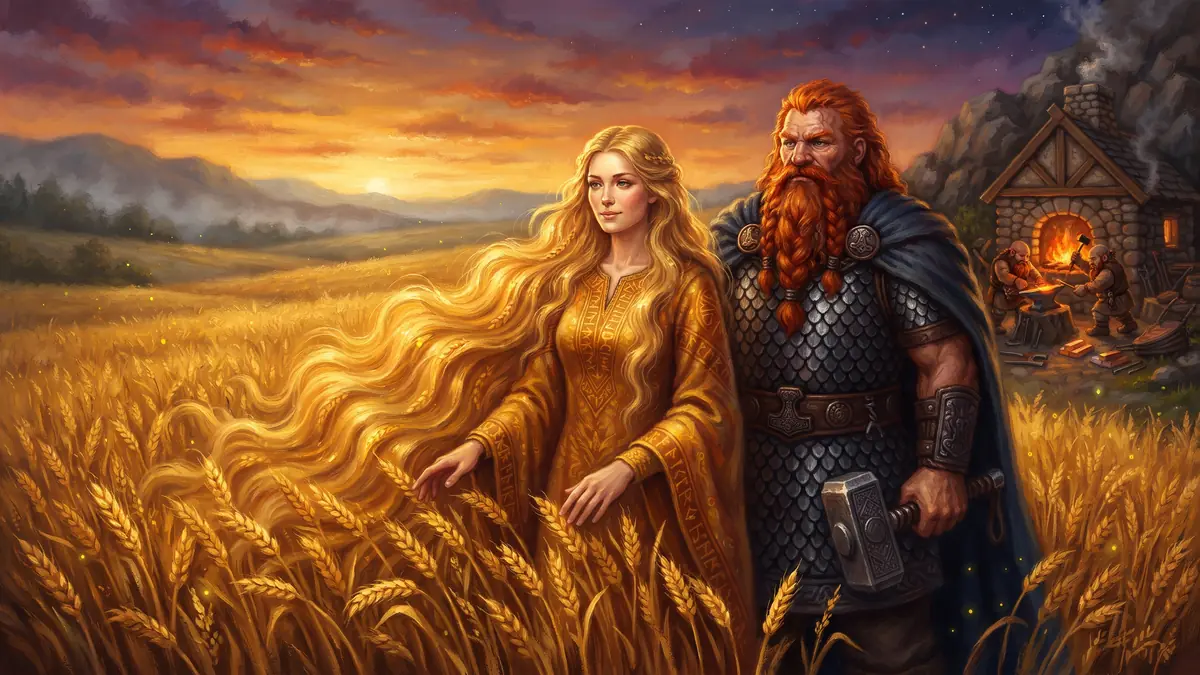
Sif is one of the goddesses best known by name and least known by deeds. She is the wife of Thor, and her most famous trait is her golden hair. Almost everything the sources say about her fits in a few lines, which makes the subject interesting for anyone who likes to see how scholars deal with scant data.
What the sources say
The main episode appears in the Skáldskaparmál of Snorri Sturluson. Loki, out of malice or mischief, cuts off all of Sif’s hair. Thor seizes him and threatens to break every bone in his body. To escape, Loki swears that he will get the dwarfs, skilled smiths, to make hair of gold that will grow like real hair. He seeks out the sons of Ívaldi, who do the work and, as a bonus, also produce the ship Skíðblaðnir and Odin’s spear, Gungnir. The story goes on with other treasures and a wager, but the central theme of the episode is the repair of the hair.
Apart from Snorri, Sif appears in few places. In the Lokasenna, she offers a cup to Loki, and he answers her with an insult, claiming he lay with her. In the Hárbarðsljóð, Hárbarðr, whom many identify with Odin, taunts Thor by saying that Sif has a lover at home. In both cases the words come from a provoker, not from a reliable narrator.
Family and name
Snorri says that Thor and Sif had a daughter, Þrúðr, and that Sif already had a son, Ullr, from an earlier marriage. Ullr is described as an excellent archer and skier, and the text calls him Thor’s stepson. Ullr’s father is not named in the sources that survive.
The name Sif, in Old Norse, means something like “kinship by marriage” or “relative by alliance”. Some scholars think the name suggests a link with the idea of bonds between families, but that is only one possible reading.
What scholars propose
A much-cited explanation is that the golden hair recalls a field of ripe wheat. According to this hypothesis, Sif would be a figure tied to the harvest, and the cutting of her hair would stand for a harvest, or a loss of the crop. Others point out that the myth appears only in Snorri, who was writing in the 13th century, and that there is no proof this agricultural meaning was known before then.
The hypothesis is attractive, but it is a hypothesis. It is worth remembering that the sources do not call Sif a goddess of the harvest, and that the comparison with wheat comes from modern readings. What can be said with confidence is little: Sif was Thor’s wife, had remarkable hair and appeared in stories told by Icelanders centuries after the Viking Age.
It is also useful to remember that the surviving sources are few and come from the 13th century. Much may have been lost before then, and there may have been stories about Sif that were never written down. For this reason, researchers avoid strong claims and prefer to speak of what the text says, and not of what the text might have said.
To remake, piece by piece, the golden hair of Sif, play Sif’s hair.
Sources.
- Snorri Sturluson, *Prose Edda* (*Skáldskaparmál* and *Gylfaginning*, passages on Sif and her children, c. 1220)
- Unknown author, *Poetic Edda* (*Lokasenna* and *Hárbarðsljóð*, 13th-century manuscripts)
- Rudolf Simek, *Dictionary of Northern Mythology* (D. S. Brewer, 1993, entry "Sif")