Sól and Máni: the siblings who pull the sun and the moon with wolves at their heels
In Norse myth, Sól drives the sun and her brother Máni steers the moon, and both are chased by wolves. See what Snorri and the Poetic Edda say, and what remains uncertain.
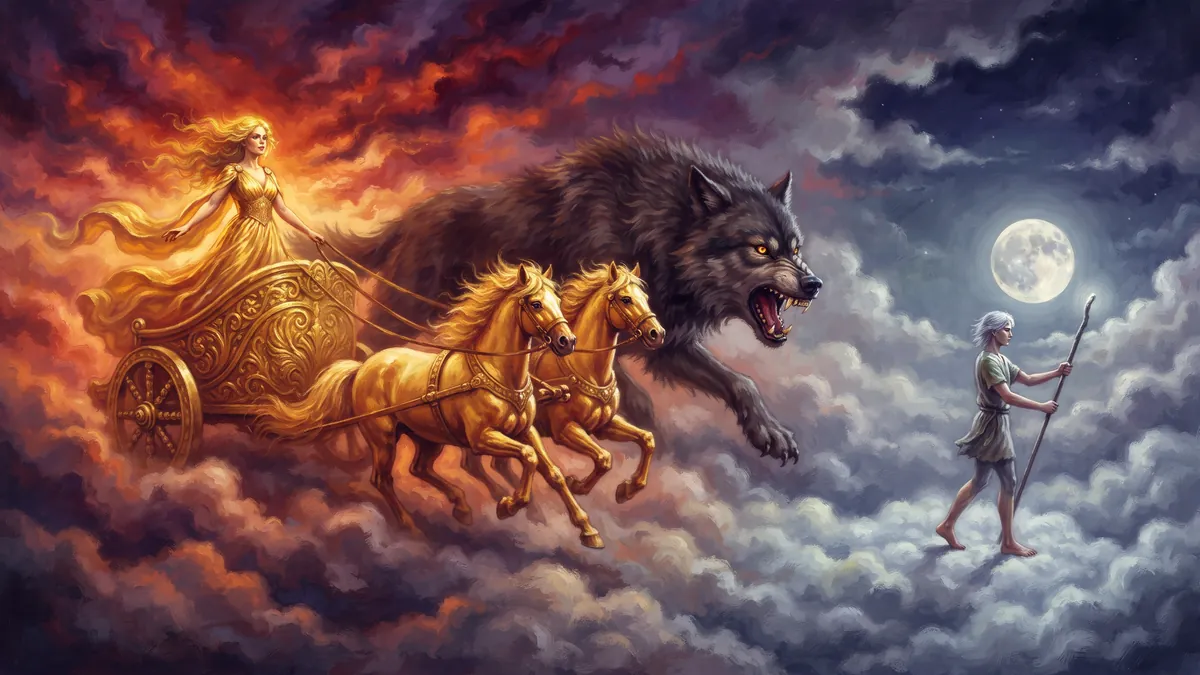
In Norse mythology the sun and the moon are not just heavenly bodies: they are two figures running across the sky, and each has a wolf behind it. The story appears in two main sources, the Prose Edda of Snorri Sturluson and the poems of the Poetic Edda, and the two do not always say the same thing.
Two siblings in the sky
According to the Gylfaginning, there was a man called Mundilfari who had two children so beautiful that he named them Sól, “sun”, and Máni, “moon”. The gods were angered by the father’s pride and took the two into the sky. Sól came to drive the horses that pull the chariot of the sun, and Máni came to steer the moon and govern its phases. The father’s name also appears in the poem Vafþrúðnismál, which suggests the idea was old.
The Grímnismál adds a curious detail. The horses of the sun are called Árvakr and Alsviðr, and in front of them the gods placed a shield called Svalinn, “the cool one”. According to the poem, without the shield the heat of the sun would burn up the sea and the mountains. It is a poetic explanation for why the sun warms the world without destroying it.
The wolves that give chase
Snorri says that Sól runs fast because she is being pursued, and that the wolf Sköll follows her. Máni, in turn, is followed by Hati, son of Hróðvitnir. The sources link the wolves to a giantess who lived in the forest of Járnviðr, “iron wood”. When the end of the world comes, at Ragnarök, the wolves will finally catch the two bodies, and the sky will go dark. Snorri says that the wolf called Mánagarmr will gorge on the flesh of the dead and stain the sky with blood.
The same text mentions two children, Bil and Hjúki, whom Máni is said to have taken from the earth as they carried a bucket on a pole. Many scholars think this image may be tied to the markings on the moon, but the link is a hypothesis, and Snorri does not state it.
What is known and what is not
The Vafþrúðnismál says that, before she is swallowed, Sól will have a daughter, and that the daughter will follow the same road as her mother when the gods die. The passage is one of the few that speak of a world continuing after Ragnarök, and it is often cited by those who study the Norse view of time.
It is worth remembering that in Old Norse sól is feminine and máni is masculine. This is the reverse of what happens in many languages of southern Europe, and some researchers see in it a trait of the Germanic tradition. It is also worth remembering that Snorri was a 13th-century Christian writing to preserve old poetry. His explanations may have been arranged by him, and may not come from a belief everyone shared.
To keep the sun in the sky, knocking it back before the wolf can catch it, play The sun and the wolf.
Sources.
- Snorri Sturluson, *Prose Edda* (*Gylfaginning*, chapters on the sun, the moon and the wolves, c. 1220)
- Unknown author, *Poetic Edda* (*Grímnismál* and *Vafþrúðnismál*, 13th-century manuscripts)
- Rudolf Simek, *Dictionary of Northern Mythology* (D. S. Brewer, 1993, entries "Sól", "Máni" and "Sköll")