Tapio, lord of the Finnish forest, and the spell of getting lost among the trees
In Finnish tradition, Tapio is the lord of the forest, and whoever gets lost in it is under the *metsänpeitto*, "the cover of the woods". See what the *Kalevala*, Agricola and folklore say.
Finland is a country of forests, and popular tradition gave them a lord. He is called Tapio, and his wife is called Mielikki. Before entering the woods, hunters asked them, in sung prayers, for a good hunt. The best written sources on this come from a 16th-century priest and a 19th-century collector of poems.
What the sources say
In 1551, the reformer Mikael Agricola published the first book of psalms in Finnish and, in the preface, listed the gods that, according to him, the ancient inhabitants of Finland worshipped. Tapio appears among them, as god of the forest. The list must be read with care, because Agricola was a Christian writing to combat these beliefs.
In the 19th century, Elias Lönnrot gathered oral poems and put together the Kalevala, the Finnish national epic. Tapio and Mielikki appear in passages about hunts, as in canto 14, in which Lemminkäinen needs help to hunt the elk. The verses ask the family of the forest to open the paths and keep the prey. The Kalevala is a work of compilation, and Lönnrot joined and adjusted the material, so it is not an exact record of an ancient religion.
The cover of the woods
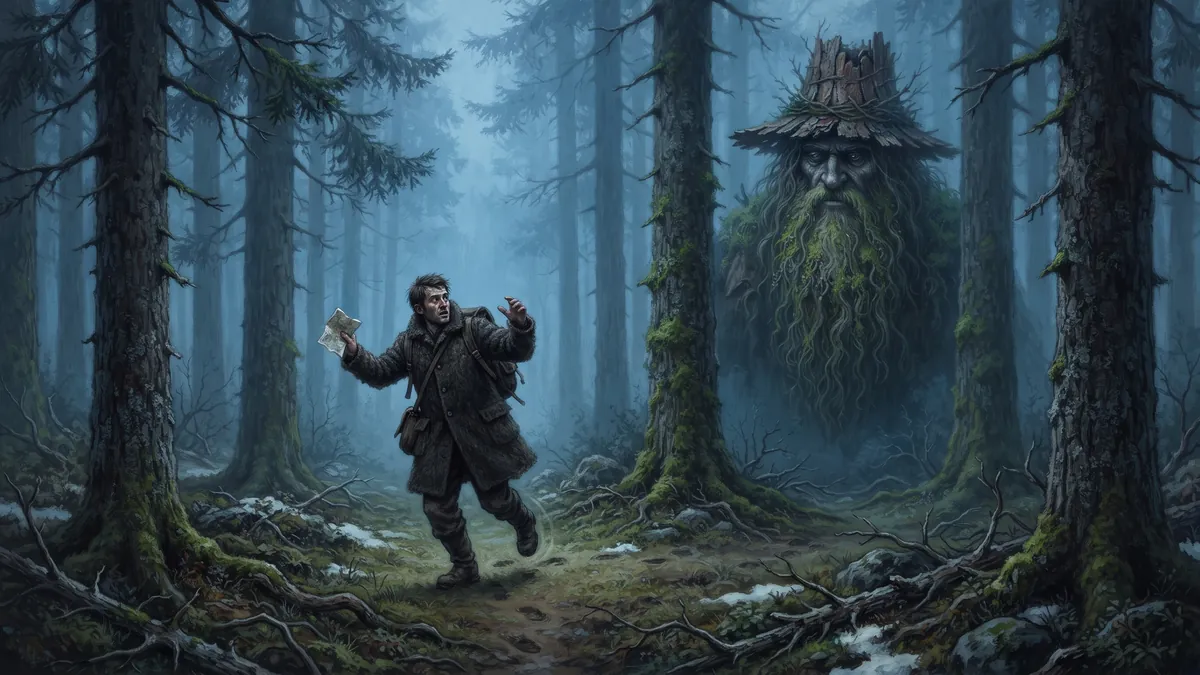
Popular tradition also knows an idea called metsänpeitto, which can be translated as “the cover of the forest”. According to the accounts, those under the cover became disoriented, did not recognise familiar places and walked in circles, even close to home. To break the effect, the person had to put their clothes on inside out, or perform some other symbolic act, and calm down.
Folklore scholars see in this belief an explanation for a real fact: getting lost in a dense forest, without landmarks, is easy and dangerous. Instead of saying that the person took the wrong path, the tradition said that the woods had wrapped them, and that one had to respect their lord.
The lord and the visitor
What repeats in the sources is the idea of reciprocity. Whoever enters the forest is a visitor, and must behave as one: ask permission, not hunt beyond need and give thanks. This kind of relationship with nature appears among other northern peoples, and many researchers link it to the life of hunters.
It is worth remembering that the image of Tapio as a well-defined figure, with a family, a moss beard and a bark hat, is in part the fruit of the literature and painting of the 19th and 20th centuries.
Today, the image of the forest as a place of respect remains strong in Finland, where the right of public access to nature allows people to walk and pick wild berries on land that is not their own. There is no proof that this right comes from the old beliefs, and scholars avoid that direct link. But it can be noted that Finnish culture still treats the woods as a place to be known, and not merely used.
To cross Tapio’s forest without getting lost, reading the signs around every step, play Tapio’s forest.
Sources.
- Elias Lönnrot, *Kalevala* (1849 edition, cantos on hunts and on Tapio and Mielikki)
- Mikael Agricola, preface to the *Dauidin Psaltari* (1551, list of gods of the ancient Finns)
- Juha Pentikäinen, *Shamanism and Culture* (Ethnographica, 1984)