The Ynglinga saga: the king who drowned in a vat of mead and the kings of Uppsala
Snorri Sturluson's *Ynglinga saga* opens the *Heimskringla* with the first Swedish kings, among them Fjölnir, who drowned in mead. See what the text says and what archaeology adds.
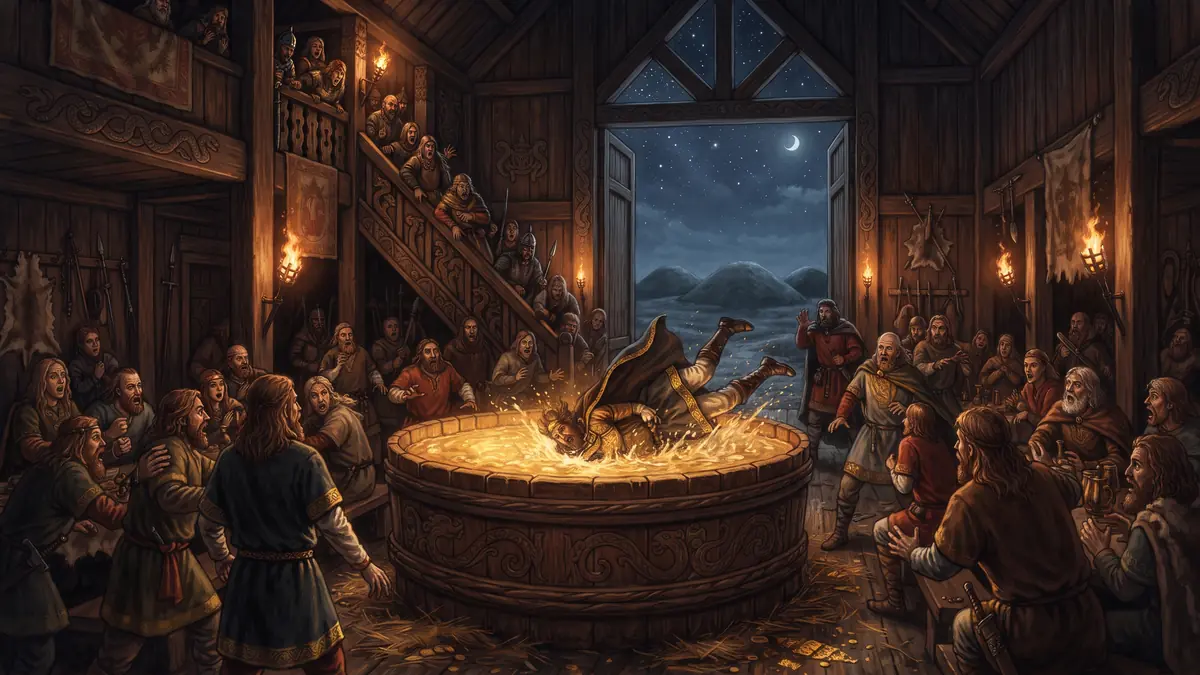
The Heimskringla, the great collection of kings’ sagas written by Snorri Sturluson around 1230, begins with the Ynglinga saga. It deals with a line of kings linked to Uppsala, in Sweden, and mixes myths, legends and names that may have been real. Among the most commented stories is the death of a king in a most unheroic place.
A line descended from a god
Snorri presents the Ynglings, the dynasty, as descendants of Yngvi-Freyr, whom he describes as a king and later a god. Before him, Odin is said to have come from the east with his companions and settled in northern lands. This account, in which the Norse gods appear as powerful men, is a way of explaining the old religion in an already Christian world.
Snorri draws on a poem, the Ynglingatal, attributed to Þjóðólfr of Hvinir, a Norwegian poet of the late 9th century. The poem names the death of each king, and Snorri adds stories in prose. For this reason, the Ynglinga saga is a mixture of poetic memory and later arrangement.
The vat of mead
Fjölnir, son of Yngvi-Freyr, ruled during a time of plenty and peace. According to Snorri, he visited King Fróði, in Denmark, in the region now called Lejre. At night, after drinking heavily, Fjölnir went looking for a place to relieve himself and, in the dark, fell into an enormous vat of mead, where he drowned. The Ynglingatal also speaks of a death tied to mead.
The scene is strange and almost comic, and some scholars read it as a kind of death proper to a sacred king, linked to a liquid of ritual value. Others see it as a popular anecdote. The sources do not allow a decision.
Sacrifices and mounds
The saga also records, in a sombre tone, that in a time of famine the Swedes made ever larger sacrifices and, in the end, sacrificed their own king, Dómaldi. Historians find this passage hard to confirm, and many see it as a tradition reflecting the idea that the king answered for the harvest.
At Gamla Uppsala, near present-day Uppsala, there are three large burial mounds, and excavations have shown that they hold burnt remains of wealthy people, from around the 5th and 6th centuries. Some researchers have linked them to the kings of the poem, but the connection is only a hypothesis. It is worth remembering that Snorri wrote centuries later.
The Ynglinga saga also shows how Snorri worked. He chose what to tell, arranged the names in a sequence and added explanations so that the Christian reader would understand the old customs. For this reason, historians use the text with caution, as testimony of how Icelanders of the 13th century imagined the past, and not as a reliable list of real Swedish kings.
To put the vats of Fróði’s hall in order, pouring the mead from one barrel to another until each holds a single colour, play Fróði’s vats.
Sources.
- Snorri Sturluson, *Heimskringla* (*Ynglinga saga*, c. 1230)
- Þjóðólfr of Hvinir, *Ynglingatal* (skaldic poem of the late 9th century, quoted by Snorri)
- Peter Sawyer, *Kings and Vikings: Scandinavia and Europe AD 700–1100* (Methuen, 1982)