Borg, in the Lofoten: the 83-metre longhouse of a chieftain of the far north
On the island of Vestvågøy, in the Lofoten, archaeologists excavated a longhouse about 83 metres long. See what it reveals about the chieftains of northern Norway.
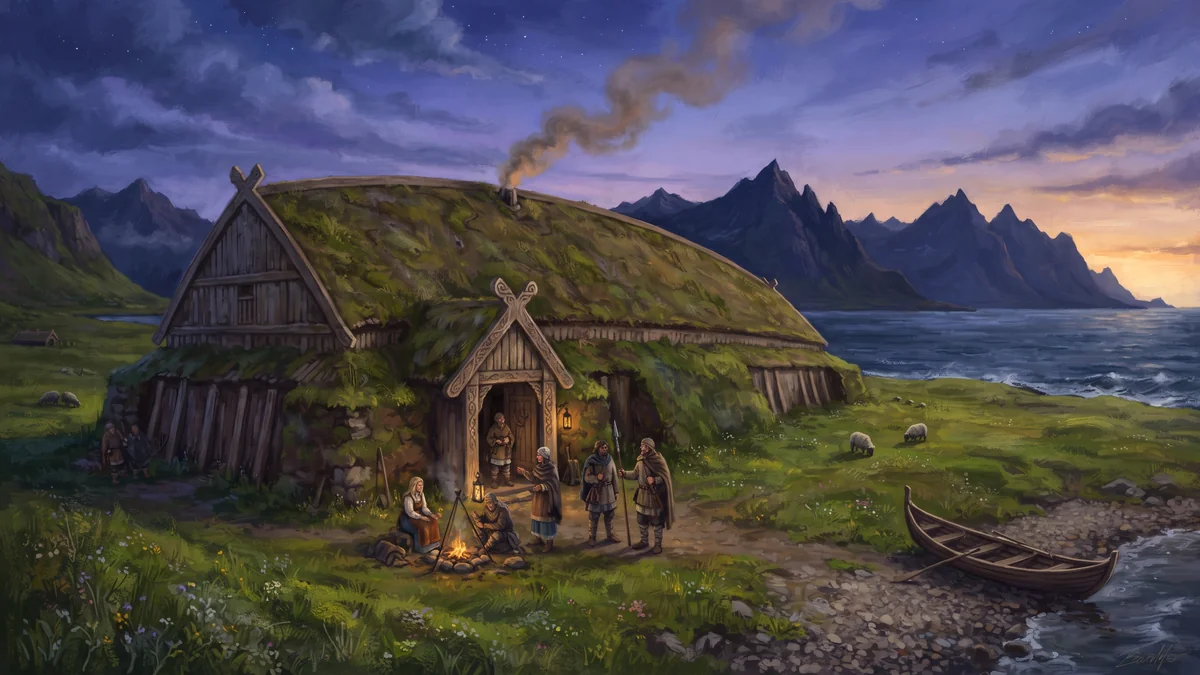
On the island of Vestvågøy, in the Lofoten, far north of the Arctic Circle, archaeologists excavated a chieftain’s farm. The place is called Borg, and the longhouse found there was about 83 metres long, one of the largest known in Scandinavia. The find shows that, even in remote regions, there were powerful men able to organise the building of great halls.
The excavation
The site was identified in the early 1980s, and excavations took place between 1983 and 1989, with a team from the Tromsø Museum, under the direction of Gerd Stamsø Munch. The researchers found the remains of a structure of timber and turf, which had been enlarged in several phases. The largest of them belongs to the Viking Age, and occupation of the site began earlier.
One part of the house served for living and receiving guests, and another probably stored goods or sheltered animals. Archaeologists discuss the exact use of each area, because the remains of timber and earth allow only a plan to be reconstructed, and not the habits of those who lived there. The datings are also discussed, and so the time ranges that books give for each phase vary a little from one work to another.
What the finds tell
Among the objects found are small figures of gold foil, the gullgubber, which appear at several sites in Scandinavia and may have had a ritual use. Fragments of glass and pottery imported from the continent and the British Isles also turned up, which shows that the chieftain of Borg was linked to long-distance exchange networks.
This picture fits with what is known from the account of Ohthere, a chieftain from northern Norway who, at the end of the 9th century, visited King Alfred of England. He described a region where people lived from hunting, herding and the trade in furs, feathers and walrus tusks. It cannot be said that Ohthere had anything to do with Borg, but the text helps to imagine the world in which the house existed.
A rebuilt house
Near the site, the Lofotr Viking Museum opened its doors in 1995, with a full-size reconstruction of the longhouse. It was raised according to the excavated plans, and visitors can enter it, see the fire in the centre and learn about the crafts of the period. The reconstruction is a hypothesis, and the archaeologists themselves note that details such as the height of the roof and the internal division were decided on the basis of comparisons, not direct proof.
What Borg shows, in short, is that the far north was not on the margins of the Viking world, and that an eighty-metre hall gave its owner a power visible for kilometres.
To share out, house by house, the grain of the chieftain’s harvest among the stores of the great hall, play The chief’s grain.
Sources.
- Gerd Stamsø Munch, Olav Sverre Johansen and Else Roesdahl (eds.), *Borg in Lofoten* (Tapir Academic Press, 2003)
- Lofotr Vikingmuseum, documentation on the excavations and the reconstruction of the longhouse
- Else Roesdahl, *The Vikings* (Penguin, 1991, revised edition 1998)