Rán, lady of the Norse sea, and the net that caught the drowned
In the Norse sources, Rán is Ægir's wife and the owner of a net that catches those who drown. See what Snorri, the *Poetic Edda* and a poem by Egill say.
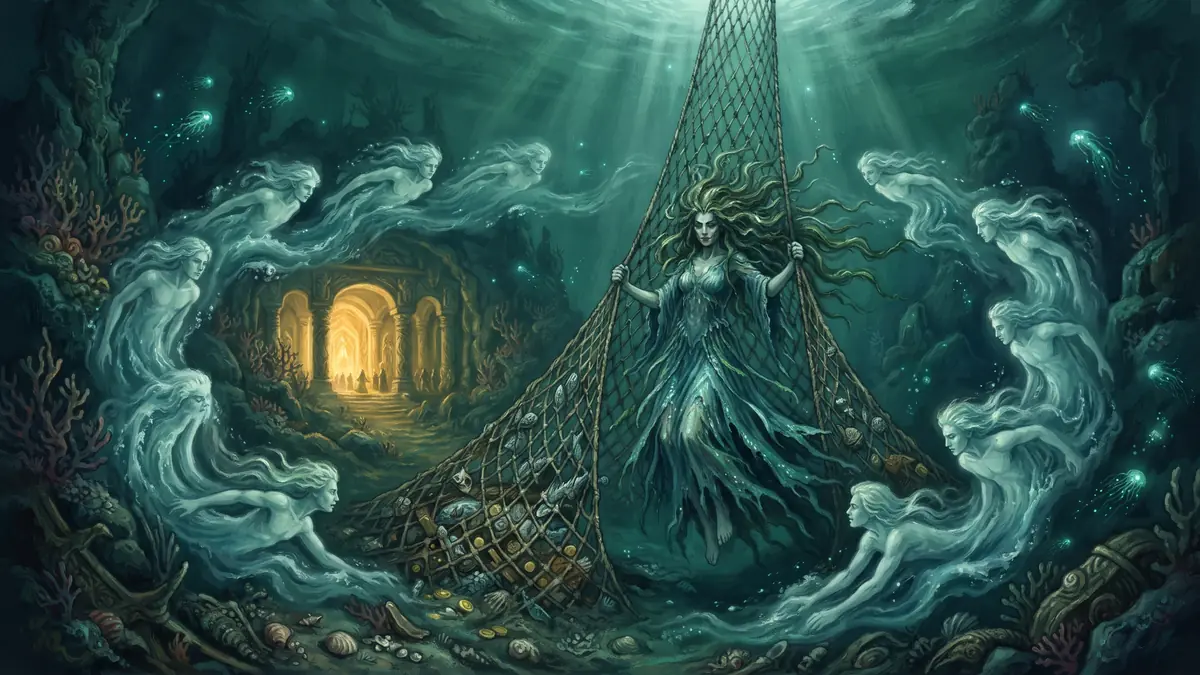
At the bottom of the Norse sea lives, according to the sources, a figure called Rán. She is the wife of the giant Ægir and stands out for a net, which she uses to catch those who drown. What we know of her comes from a few texts, almost all Icelandic, written between the 12th and 13th centuries, and each must be read with the caution of someone reading memories recorded long after the end of paganism.
What the sources say
Snorri Sturluson, in the Skáldskaparmál, presents Rán as the wife of Ægir and says that the couple have nine daughters, who represent the waves. Their names appear in a list, among them Himinglæva, Dúfa, Blóðughadda and Hrönn. Poets used these names in metaphors, and the sea could be called “the road of Rán”. Snorri also explains why gold was called “Ægir’s fire” in verse: in the story he tells, Ægir’s hall was lit by shining gold, not by flames.
In the Poetic Edda, the prose introduction to the Reginsmál says that Loki borrowed Rán’s net to capture the dwarf Andvari, who lived as a fish in a waterfall and guarded a treasure. It is the scene in which the net appears most clearly, and in it the goddess is merely the owner of the object.
The net and grief
The Icelandic poet Egill Skallagrímsson is remembered as the author of the Sonatorrek, “The Loss of Sons”, which the saga bearing his name preserves. In it, the poet complains that Rán has plundered him, by taking a son who drowned. Scholars see in the poem an example of how the image of the goddess served to give a name to the grief of those who lost relatives at sea. It is important to remember that the poem reached us in 13th-century manuscripts, and that its attribution to Egill is debated.
The Eyrbyggja saga, for its part, tells of drowned men who appeared, dripping wet, on a farm and sat by the fire. The living understood the event as a sign that Rán had welcomed them well. There is a curious idea here: the drowned would have a home of their own, different from Odin’s hall and the realm of Hel. But the sources do not form a single system, and other beliefs about the fate of the dead lived alongside this one.
A sea with a face
What the sources show is that Scandinavians gave a face to the sea, which gave them fish and routes, but also death. Calling a wave a daughter of Rán, or the sea the home of Ægir, was a way of speaking with respect of a force that could not be controlled. Researchers point out that there is no secure record of an organised cult of Rán. What exists are metaphors and stories, and many of them belong to the poetry of the skalds rather than to rituals.
It is also worth noting that Rán’s net appears in only a few passages, and that the image of a goddess who “fishes” for sailors is, in part, a synthesis by modern authors. The ancient sources are more sober than the popular illustrations.
To close, line by line, the meshes of Rán’s net and end up with more squares than she has, play Rán’s meshes.
Sources.
- Snorri Sturluson, *Skáldskaparmál* (c. 1220, chapters on Ægir, Rán and their daughters)
- *Poetic Edda*, prose of *Reginsmál* (Codex Regius, c. 1270)
- Rudolf Simek, *Dictionary of Northern Mythology* (D. S. Brewer, 1993), entries "Rán" and "Ægir"