Grímnismál: Odin between two fires, speaking about the world
In the poem, Odin disguises himself, is tortured by a king and, seated between flames, describes the worlds and tells many of his names. See what the *Poetic Edda* says.
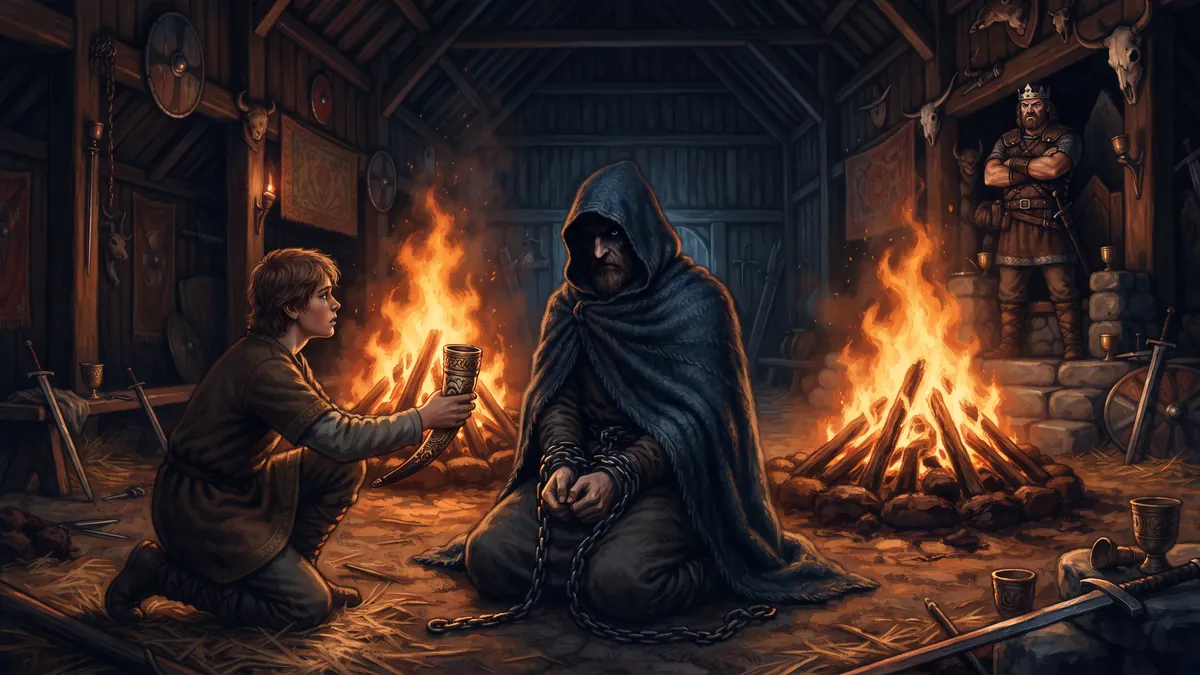
The Grímnismál is one of the richest poems of the Poetic Edda for anyone who wants to know how the Norse imagined the cosmos. It speaks of dwellings of gods, of rivers, of animals living in the great tree and of the hall of dead warriors. But all this is said by someone who, at the beginning, is a prisoner, burning between two fires. The prose frame is an important part of the story.
The prose frame
According to the prose text that opens the poem, a king called Hrauðungr had two sons, Agnarr and Geirröðr. Once they went out fishing, the boat was carried by the wind to an island, and an old peasant couple took them in for the winter. The couple were Odin and his wife, Frigg, in disguise. Odin raised Geirröðr, and Frigg raised Agnarr. In spring, the two were given a boat to return.
When the boat reached the coast of the kingdom, Geirröðr, who was at the bow, leapt ashore, pushed the boat back out to sea with his brother in it and told him to go wherever the evil spirits pleased. The boat drifted away, and Geirröðr went up to the hall alone. His father had died, and he ended up becoming king. After some years, Odin and Frigg sat in Hliðskjálf, the seat from which all the worlds can be seen, and made a bet about who had raised their protégé better.
The disguise and the torture
Odin said Geirröðr was a prosperous king, but Frigg accused him of being stingy and of mistreating guests. To prove what she said, she sent word to the king that a sorcerer would come to court, and that he could be recognised by the dogs not attacking him. The king, credulous, ordered the first stranger the dogs did not attack to be seized. It was Odin, wearing a blue cloak and saying he was called Grímnir, “The Masked One”.
Grímnir did not answer the questions and was placed between two fires, where he stayed eight nights. The king’s son, ten years old, who was also called Agnarr, took pity and brought him a horn full of drink. It was then that the prisoner began to speak.
What he says
In the following stanzas, Grímnir describes twelve dwellings of gods, Valhalla with its doors and its rafters made of spears, the tree Yggdrasill with its animals, and rivers that run in the worlds. He lists stags, a goat that gives mead, and a boar that feeds the warriors every day. These details are one of the main sources of information about Norse mythical geography.
At the end he reveals that he is Odin and recites a long list of names he uses. The king rises to free him, but the sword slips from his hand and he falls upon it and dies. The son, Agnarr, becomes king.
How to read the poem
The poem is a good sample of the style of passing on knowledge through lists, which helped memorisation. Many scholars consider it an old text, but there is no agreement on the date. The prose frame may be more recent than the verses, and it is possible that it was written to give a context to what were before only loose stanzas.
Either way, the poem shows an idea that appears in other texts: Odin likes to disguise himself and to learn among men, and his wisdom is sometimes won through suffering.
To guide a spark around the hall and collect, one by one, the names of Odin, without bumping into the flames or into itself, play Odin’s names.
Sources.
- *Poetic Edda*, *Grímnismál* (Codex Regius, c. 1270)
- Carolyne Larrington (trans.), *The Poetic Edda* (Oxford World's Classics, 1996)
- Rudolf Simek, *Dictionary of Northern Mythology* (D. S. Brewer, 1993), entries "Grímnismál" and "Óðinn"