Largs, 1263: King Haakon and the last great Norse expedition to Scotland
In 1263 the king of Norway sailed with a large fleet to Scotland to defend his rule over the islands. A storm and a fight at Largs ended the campaign.
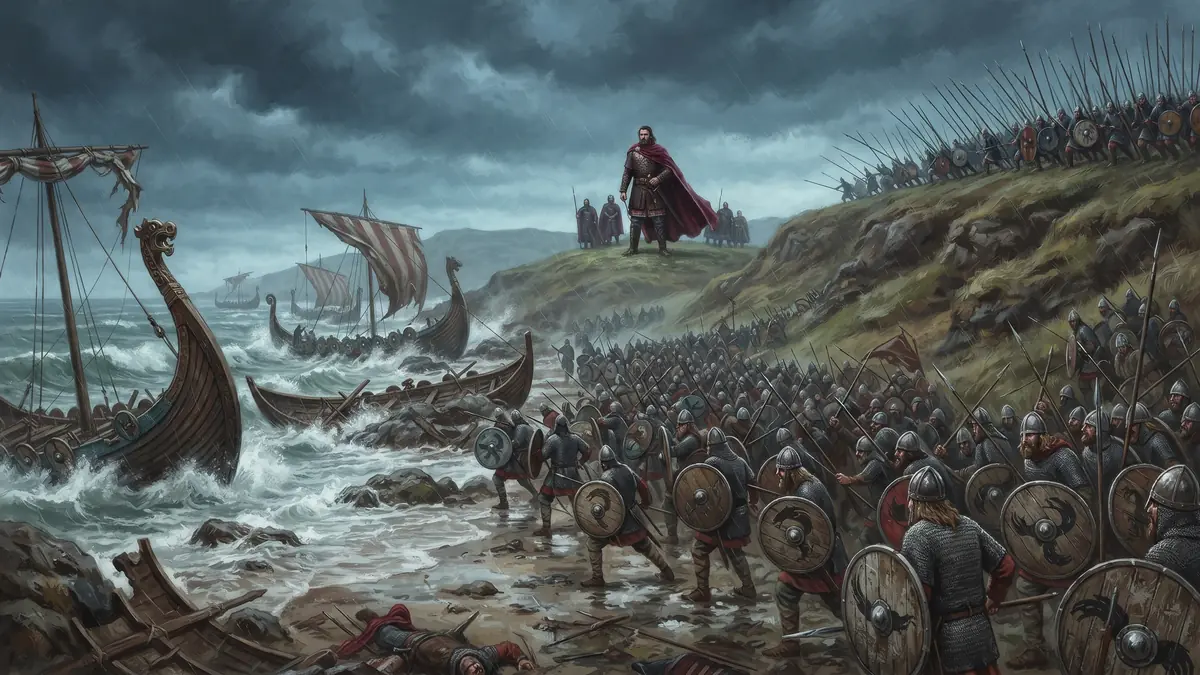
In 1263, a Norwegian fleet of rare size arrived in Scottish waters. At its head was King Haakon IV, already old, and the aim was to defend what the Norwegian crown considered its own: the western isles, the Hebrides, and the Isle of Man. The expedition lasted a few months, ended without a great victory and marked the end of Norse rule in that region.
A conflict over the islands
Since the Viking Age, the islands to the west of Scotland had been under the control of chiefs linked to Norway. In the 13th century, however, the Scottish king Alexander III wanted to extend his authority westward. He tried to buy the islands, without success, and began to pressure the local chiefs. In 1262 there were attacks on the isle of Skye, and Haakon decided to act.
The main source is the Hákonar saga Hákonarsonar, written by Sturla Þórðarson soon after the events, at the request of the king’s son. Being a text close to the events, it is very valuable, but it also has an interest in showing the king in a favourable light.
The fleet and the negotiations
According to the saga, Haakon left Norway in July 1263, with a large fleet, which some scholars estimate at more than a hundred ships, and gathered support in Orkney and the Hebrides. In August the ships were on the west coast of Scotland, and the king began negotiations with Alexander, who prolonged them, which, it seems, was the intention. Autumn was approaching, and a fleet far from home depended on the weather.
When the talks failed, Haakon sent part of the ships into the Firth of Clyde. On 30 September a strong storm struck the region. Some ships were dragged to the coast, near Largs, and others were damaged.
The fight at Largs
What happened next is described by the saga in some detail. The Norse landed to protect the stranded ships, and Scottish troops arrived. There was fighting, on 2 October, in which both sides suffered losses. The saga presents the result as favourable to the Norwegians, who managed to recover the ships. Later Scottish sources speak of a great victory. Modern historians consider that it was a local fight, of little military weight, but with political consequences.
Haakon withdrew. He spent the winter in Orkney, where he fell ill and died, in December 1263, in Kirkwall. With his death, his son Magnus VI took the throne and chose negotiation.
The Treaty of Perth
In 1266, by the Treaty of Perth, Norway ceded to Scotland the Hebrides and the Isle of Man, in exchange for an initial payment of four thousand marks and an annual income. Orkney and Shetland remained Norwegian, and passed to Scotland only more than two centuries later, in the 15th century.
Largs, therefore, did not settle the question by arms. What settled it was the exhaustion of an expedition that lost the initiative, the death of the king and the will of a new ruler to avoid another war. For the Scots, the episode remained as the memory of a threat driven off. For the Norwegians, it was the end of an era.
To beat back, from the beach, the waves of attackers coming down on the stranded ships, before they reach the line of boats, play The beach at Largs.
Sources.
- Sturla Þórðarson, *Hákonar saga Hákonarsonar* (c. 1265), trans. G. W. Dasent, *Icelandic Sagas*, vol. IV (Rolls Series, 1894)
- Barbara E. Crawford, *Scandinavian Scotland* (Leicester University Press, 1987)
- A. A. M. Duncan, *Scotland: The Making of the Kingdom* (Oliver & Boyd, 1975)