Repton, 873: the winter camp of the Great Army
In 873 the Great Army spent the winter at Repton, in England. Excavations found a fortified enclosure, a mass grave and a warrior with a Thor's hammer.
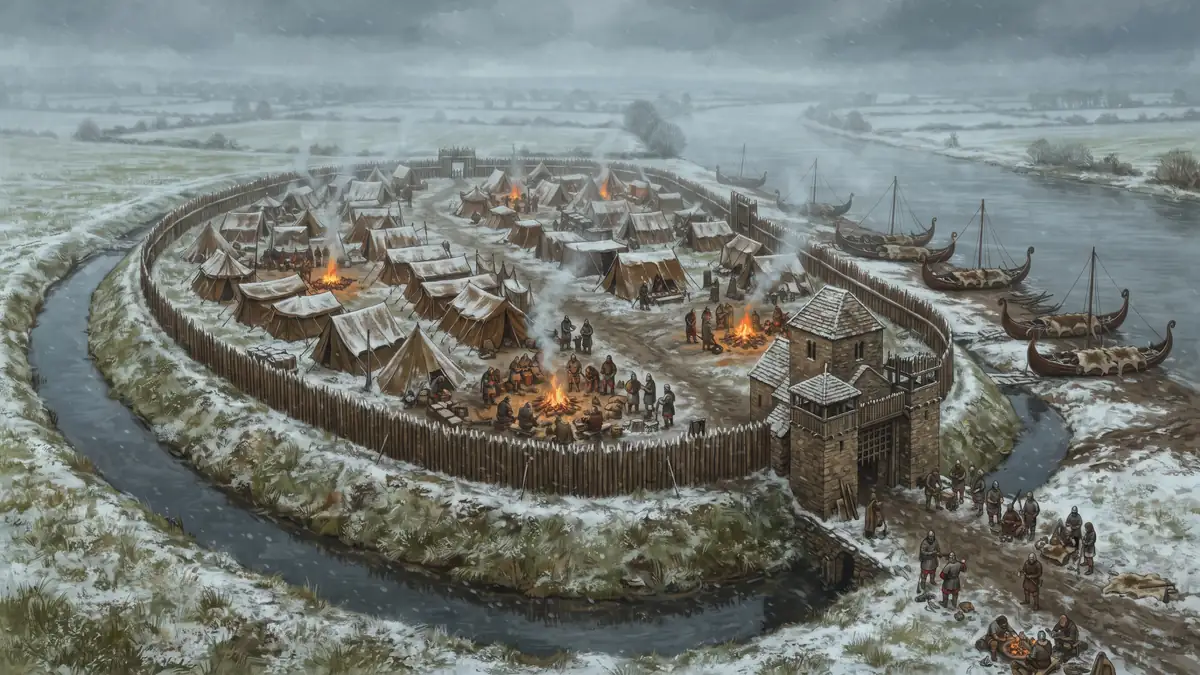
In Repton, a small town in Derbyshire, England, there is an old stone church beside a river. It was there, in the winter of 873 to 874, that a Scandinavian army set up camp, according to the Anglo-Saxon Chronicle. Excavations carried out in the 1970s and 1980s found traces of this camp, and the finds are among the most concrete proofs we have of the presence of the so-called Great Army.
What the chronicle says
The Anglo-Saxon Chronicle notes, in the year 873, that the army “took winter quarters” at Repton and that it drove King Burgred of Mercia out of the country, and he fled abroad. The invaders placed on the throne a man called Ceolwulf, who, according to the text, swore to hand over the kingdom whenever asked. The following year, the army split: one part went north, and the other, south, with the chiefs Guthrum and others. This division gave rise to the Scandinavian settlements in England.
The chronicle’s text is short, but says the essential. It was written by English authors, so the point of view is that of the defeated, and that is why the excavations are important.
The D-shaped enclosure
Between 1974 and 1988, Martin Biddle and Birthe Kjølbye-Biddle excavated the area around the church of St Wystan. They found a ditch and an earth bank, in the shape of a D, of about three and a half hectares, that used the river Trent as its straight side. The church, which already existed, was incorporated in the defence as a sort of gateway. Boats could be drawn up on the bank, within the protection of the enclosure.
This type of fortification, made quickly, fits with what the sources say about the army: a large, mobile group, which could create a safe camp wherever it wintered.
The mass grave and the warrior
Near the church, the archaeologists found an old building, which had been a crypt, and inside it, an enormous quantity of bones. They were the remains of about two hundred and fifty people, most of them young men, gathered in a mass grave. The datings suggest that the deposit belongs to the period of the camp, but whether the dead were all Scandinavian is an open question. Some isotope studies indicate varied origins.
Beside it there was an individual grave of a strong man, over six feet tall, who had been wounded by blows, one of them near the thigh bone. He was buried with a sword, a knife, a pendant in the form of a hammer, which is linked to Thor, and a boar’s tusk. The excavators concluded that he was a Norse warrior of high standing, but that, too, is interpretation.
What Repton shows
The site shows that the Great Army was an organisation capable of building defences, controlling a region and installing a king of its choice. It also shows the limits of archaeology: the dead do not say who they were, and each hypothesis must be treated with caution.
To place, on a four-by-four grid, each type of troop exactly once in every row and column of the camp, play Repton’s grid.
Sources.
- Martin Biddle and Birthe Kjølbye-Biddle, "Repton and the Vikings", *Antiquity* 66 (1992)
- *Anglo-Saxon Chronicle*, annals for 873 and 874 (trans. Michael Swanton, Phoenix, 2000)
- Julian D. Richards, *Viking Age England* (Tempus, 2000)