Ridgeway Hill: the Dorset mass grave and what the teeth tell
In 2009, roadworks in Dorset revealed the remains of 51 young men, killed around the year 1000. The isotopes in their teeth point to a Scandinavian origin.
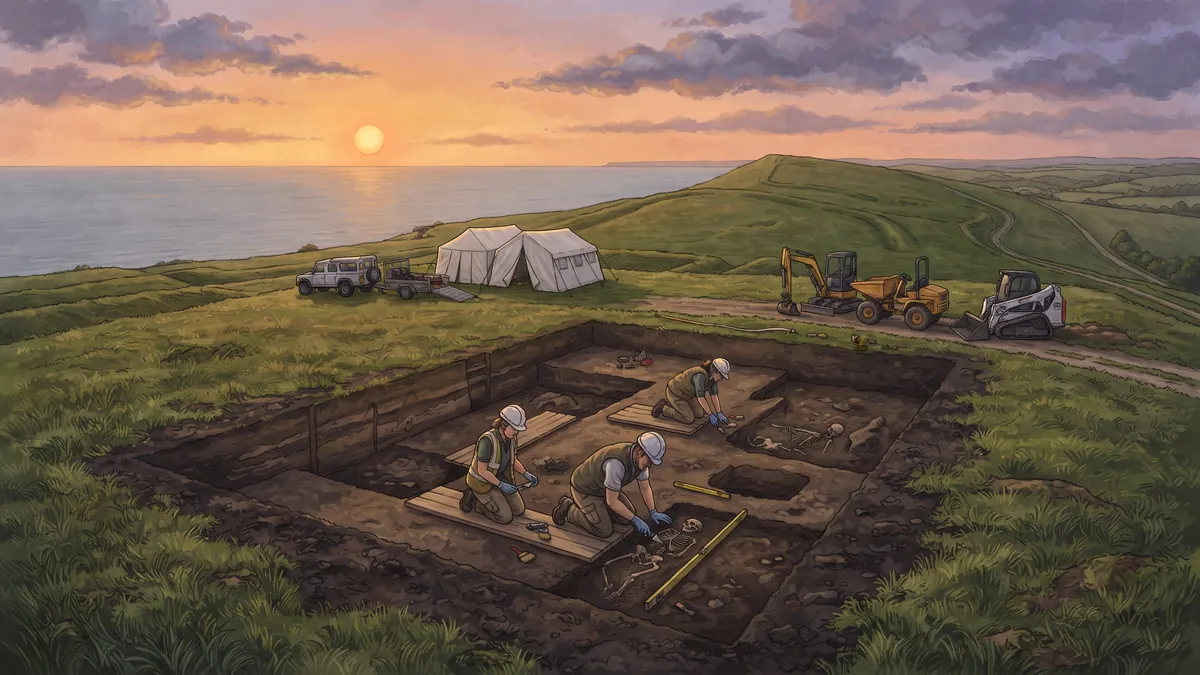
In 2009, during the construction of a bypass near Weymouth, in the county of Dorset, England, workers found bones in an old quarry. The team of archaeologists that was called discovered a pit with the remains of fifty-one men, buried without care, and, in one corner, fifty-one heads separated from the bodies. The datings indicated the period between about 970 and 1025. The find, known as Ridgeway Hill, is one of the clearest examples of violence recorded in the bones of Viking-Age England.
What was found
The dead were mostly young men, between eighteen and twenty-five, and some were a little older. All had been beheaded, and the marks on the vertebrae indicate blows of a sharp blade, coming from the front and from the side. The bodies were thrown into a pit, and the heads were placed in a pile, apart. There were no clothes or personal objects, which suggests they were removed beforehand.
The bones show few defensive injuries, such as blows on the arms, and this led specialists to think that the men were killed when already unable to fight, perhaps with their hands tied, and not in a battle. The interpretation, however, depends on a careful reading, and is still discussed.
What the teeth say
Teeth keep, in the enamel layer, a chemical signature of the region where a person spent childhood. The strontium and oxygen isotope analyses, made by British research teams, indicated that many of the men came from outside England. The values match regions of Scandinavia and the Baltic, and some point to colder areas, in northern Scandinavia. As in the case of other sites, the conclusions are based on comparisons with isotope maps and have a margin of error.
The data indicate that the group was not uniform. They were men of different origins, brought together perhaps for some common reason, such as a raiding expedition or war service.
Who killed them
There is no direct proof of who was responsible. The most accepted hypothesis is that the dead were a group of invaders, captured and executed by local inhabitants, perhaps on the order of an English authority. The date coincides with the years of Æthelred’s reign, in which Scandinavian attacks were frequent, and the violence against the captured may reflect the fear and anger of that period.
Other researchers recall that the location, on top of a hill, near an old road, may have given the act a public character, of warning. But no chronicle mentions this episode, and no hypothesis is proven.
A lesson from the find
The value of the find lies in showing the other side of the story. The Viking is often imagined as the attacker, and here he appears as the victim. It also shows how archaeology combines bones, chemistry and documents to reconstruct people who left no name. The remains were treated with respect and studied with modern methods, and are a reminder that each number, in this case, was a person.
To fill, cell by cell, a six-by-six table with two marks, without putting more than two equal ones in a row and with the same number in each line, play Ridgeway’s table.
Sources.
- Louise Loe and others, *"Given to the Ground": A Viking Age Mass Grave on Ridgeway Hill, Weymouth* (Dorset Natural History and Archaeological Society, 2014)
- Oxford Archaeology, report on the Weymouth Relief Road excavations (2009 to 2010)
- Julian D. Richards, *Viking Age England* (Tempus, 2000)