Salme: two ships buried with warriors, before the Viking Age
On the Estonian island of Saaremaa, two ships of about 750 held dozens of men with their weapons. See what archaeology and isotope analyses reveal.
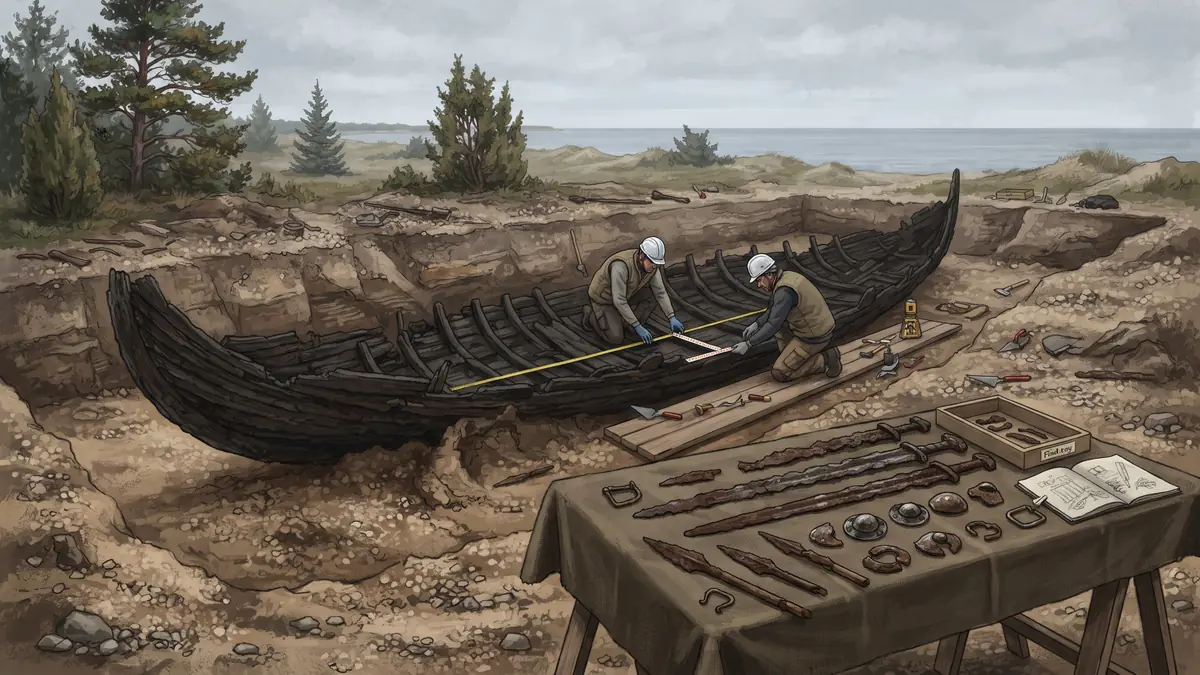
In 2008, workers digging a trench for electric cables in a village on the island of Saaremaa, in Estonia, found human bones and pieces of wood. It was the beginning of one of the most discussed discoveries in Baltic archaeology. Under the sandy soil there were two ships, buried with the dead and their weapons, and the dates indicate that they were placed there around 750, a few decades before what tradition calls the start of the Viking Age.
Two burials in the same place
The first ship, called Salme I, was a smaller boat, with the remains of seven men. The second, Salme II, was excavated between 2010 and 2012. It was a ship of about seventeen metres, and contained the remains of approximately thirty-four men, laid in layers, one over another. The dead had swords, spears, shields and other objects, and there were animal bones, among them dogs and a hunting bird.
The wood of the hulls had almost completely disappeared, but the iron rivets that held it kept the shape of the ships in the soil. The archaeologists could thus measure the outline and reconstruct part of the structure.
Men killed in combat
The skeletons show many marks of blade blows. This makes researchers think that the men died in a battle, and that the survivors, or the winners, buried them with their weapons. But nobody knows who the attackers were, nor the reason for the fight. The hypotheses include an attack on a local settlement or a raiding expedition, and none of them is proven.
The form of the burial, with warriors carefully lined up inside a ship, indicates a ritual carried out by people who respected the dead. This mixture of combat and ceremony is what makes the site so interesting.
Where they came from
In 2016, a team led by T. Douglas Price published an analysis of strontium, oxygen and other isotopes in the teeth of the dead. These elements record the region where a person spent childhood. The result suggests that many of the men came from the area of Lake Mälaren, in central Sweden. At least one of those buried had a different origin. This does not prove, by itself, that all came from there, but it is the most accepted explanation today.
If the ships really came from Sweden, the find suggests that armed expeditions were already crossing the Baltic before 800, and that the sea, for these people, was a road of known use. Some specialists see in this a proof that the Viking Age did not begin out of nothing in 793, when Lindisfarne was attacked.
What remains open
There are many unanswered questions. Who were the dead? What language did they speak? Did the ship have a sail? The remains of rivets and wood allow discussions, and some research suggests that the well-made hulls could have supported the use of a sail, but the question is still debated.
What can be affirmed is that Salme widened the picture we had of the period before the Viking Age. It showed large ships, well-armed warriors and contacts between Sweden and the east coast of the Baltic, all around 750.
To line up three matching pieces, such as swords, spears and shields, and empty the board of finds from the site, play The finds of Salme.
Sources.
- T. Douglas Price and others, "Isotopes and the origin of the Salme ship burials", *Antiquity* 90 (2016)
- Jüri Peets and others, "Research results of ship burials at Salme, Saaremaa", *Archaeological Fieldwork in Estonia* (Muinsuskaitseamet, 2013)
- Neil Price, *Children of Ash and Elm: A History of the Vikings* (Allen Lane, 2020)