Staraya Ladoga: the trading post on the Volkhov where glass beads were made
Ladoga, which the sagas call Aldeigjuborg, was one of the first trading centres on the road that led east. See what the excavations and the chronicles reveal.
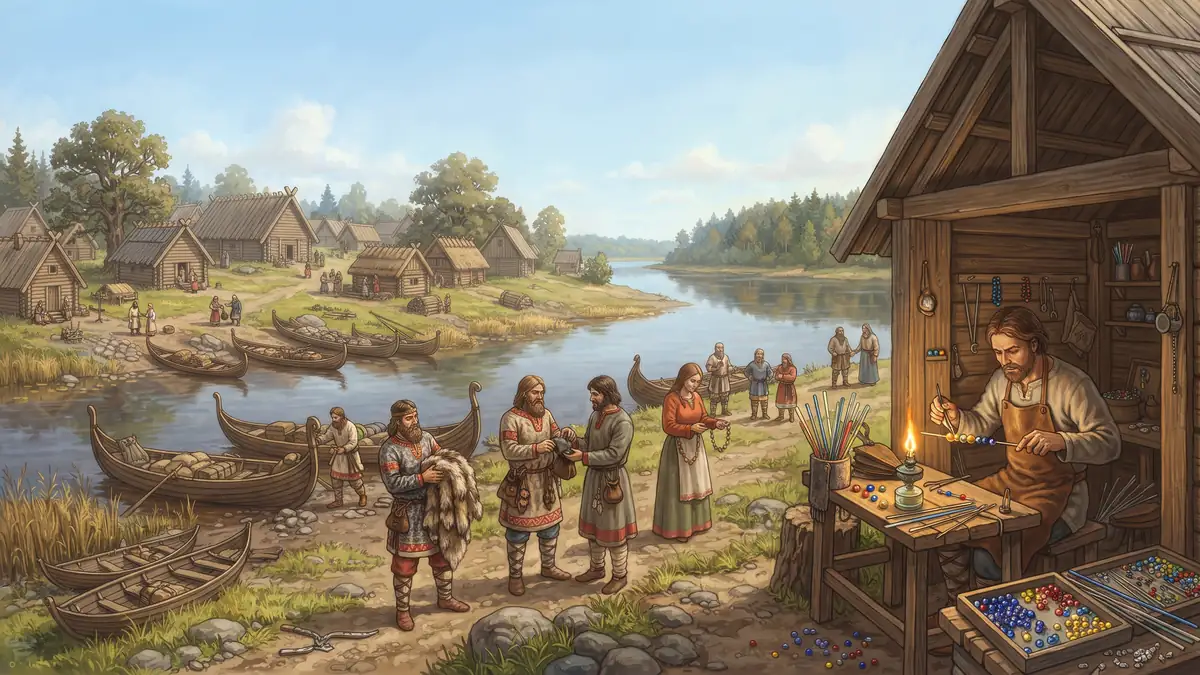
On the bank of the river Volkhov, in north-western Russia, a few kilometres from the great Lake Ladoga, there is today a small village called Staraya Ladoga, “Old Ladoga”. In the Icelandic sagas the place appears as Aldeigjuborg. Excavations showed that there was there, from the middle of the 8th century, a centre of trade and crafts, where peoples of different origins met. It is one of the most important sites for understanding the origin of the Rus and the routes that linked the Baltic to the Islamic world.
A very old settlement
The Russian archaeologists who studied Ladoga, from the 1930s, found layers of occupation going back to the 8th century. A tree-ring dating, made on house timbers, indicates the 750s for the oldest constructions. This makes Ladoga one of the oldest urban settlements of the region, earlier than the foundation of other centres that would become important later.
Among the finds there are objects of Scandinavian origin, such as bone combs, jewellery and weapons, and also objects of Slavic and Finnic origin. The mixture shows that the settlement was multi-ethnic from early on. Ladoga also gathered Arab silver coins, the dirhams, which indicates trade contacts with very distant regions.
The glass beads
One of the most famous discoveries is a workshop that made glass beads. At Ladoga, remains were found of the production of coloured glass beads and of beads made of stone. These pieces served as adornment and also as currency, and were used in necklaces and clothes. Composition analyses suggest that part of the glass was imported, and that the craftsmen melted and shaped it on the spot.
The presence of such a workshop shows that the settlement was not only a point of passage. It was a place where things were produced, and where trade joined craft.
What the written sources say
The Russian Primary Chronicle, written much later, in the early 12th century, says that the chief Rurik settled in Ladoga when he was called to rule the region, and that he afterwards moved to Novgorod. Historians discuss the value of this narrative. Some consider it a legend, and others see in it a memory of real events, and the debate continues. The Norse sagas cite Aldeigjuborg as a stop on the journey east, but they, too, were written much later.
What remains
Ladoga shows a history that the traditional image of the Vikings tends to forget. There, the Scandinavians not only attacked, but also traded, worked and lived beside other peoples. The glass beads, found by the thousands, are a reminder that the Viking Age was also a time of trade and crafts.
To line up five beads of the same colour in a row, before your rival, on the board of the Ladoga workshop, play The beads of Ladoga.
Sources.
- Jonathan Shepard and Simon Franklin, *The Emergence of Rus, 750–1200* (Longman, 1996)
- Neil Price, *Children of Ash and Elm: A History of the Vikings* (Allen Lane, 2020)
- *Russian Primary Chronicle* (trans. S. H. Cross and O. P. Sherbowitz-Wetzor, Medieval Academy of America, 1953)