The Cuerdale Hoard: the largest Viking silver hoard ever found in Britain
In 1840 workmen repairing an embankment of the River Ribble, in Lancashire, found a lead chest with thousands of coins and pieces of silver. See what was inside and what remains unexplained.
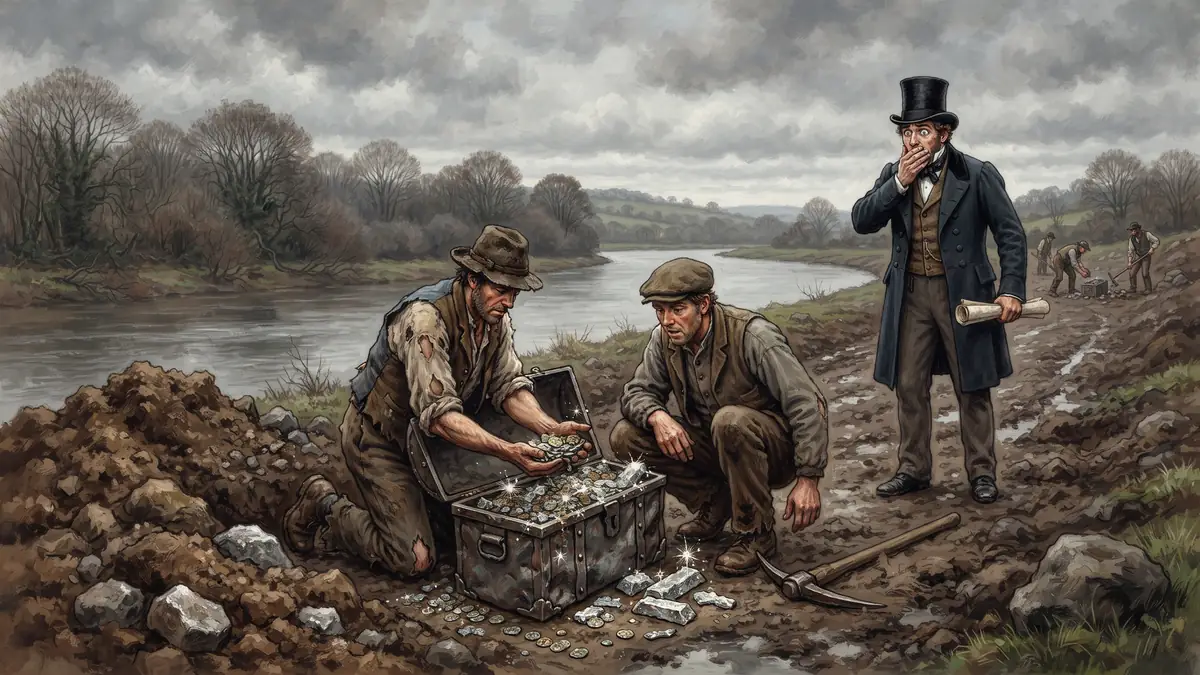
On 15 May 1840, workmen repairing the southern embankment of the River Ribble at Cuerdale, near Preston in Lancashire, in north-west England, came upon a buried lead box. Inside was silver. A great deal of silver. With more than eight thousand six hundred pieces and a weight that the sources put between 32 and 40 kilograms, the group is considered the largest Viking Age hoard ever found in Britain and Ireland.
What was inside
The hoard contained, above all, silver coins, in the thousands, together with silver bars (ingots), pieces of jewellery and cut-up objects, what is called hacksilver. Among the coins, most come from the Viking kingdoms of eastern England, the region known as the Danelaw. Others are from the kingdom of Wessex, of King Alfred and his successor. There are also foreign coins: Carolingian, many possibly from Aquitaine, Byzantine, Scandinavian, papal, north Italian and Islamic. There was also English and Carolingian jewellery.
The lead box seemed to have been divided into small bags or packages. A later account speaks of a lead case inside a wooden chest.
When it was hidden
The date of burial is calculated from the latest coins. Scholars place it between 903 and 910, in the early years of the 10th century. A popular hypothesis links the hoard to the expulsion of the Norse from Dublin in 902. According to it, the group would be the war chest of a band that took refuge in north-west England. But it is only a hypothesis. Who hid it, why, and why it was never recovered are questions without an answer.
What happened after the discovery
At the time, English law gave the Crown the right to treasure found. The hoard was declared “treasure trove” and passed to Queen Victoria in her capacity as Duke of Lancaster. The Duchy handed most of it to the British Museum, where it remains. About sixty selected pieces went to the Ashmolean Museum in Oxford. Some coins minted at Quentovic, in France, are in Boulogne-sur-Mer. It is worth noting that, as the workmen found it, part of the material was probably lost or scattered before reaching the authorities. The exact figures vary for that reason.
Why it matters
For those who study the Viking economy, Cuerdale shows that silver circulated by weight. Coins, jewellery and bars could be cut to make up the desired amount. It also shows the mixture of origins: English, Frankish and Islamic money lay in the same box, a result of the trade and raiding routes that linked the North Sea to the East. But there are limits: the hoard is a single find, and one cannot draw from it alone a picture of the Viking world.
To sort the coins of the hoard by origin, keeping only one origin in each pile, play The Cuerdale hoard.
Sources.
- British Museum, *The Cuerdale Hoard* (collection catalogue and record)
- James Graham-Campbell (ed.), *Viking Treasure from the North West: The Cuerdale Hoard in Its Context* (National Museums & Galleries on Merseyside, 1992)
- Gareth Williams, *Viking Coins and Hoards* (British Museum Press, 2020)