Elveskud: the ballad of the knight who refused to dance with the elf maidens
One of Scandinavia's most popular ballads tells of a knight who, on the eve of his wedding, meets elf maidens dancing in the woods. See how the story changes from country to country and how it reached Goethe.
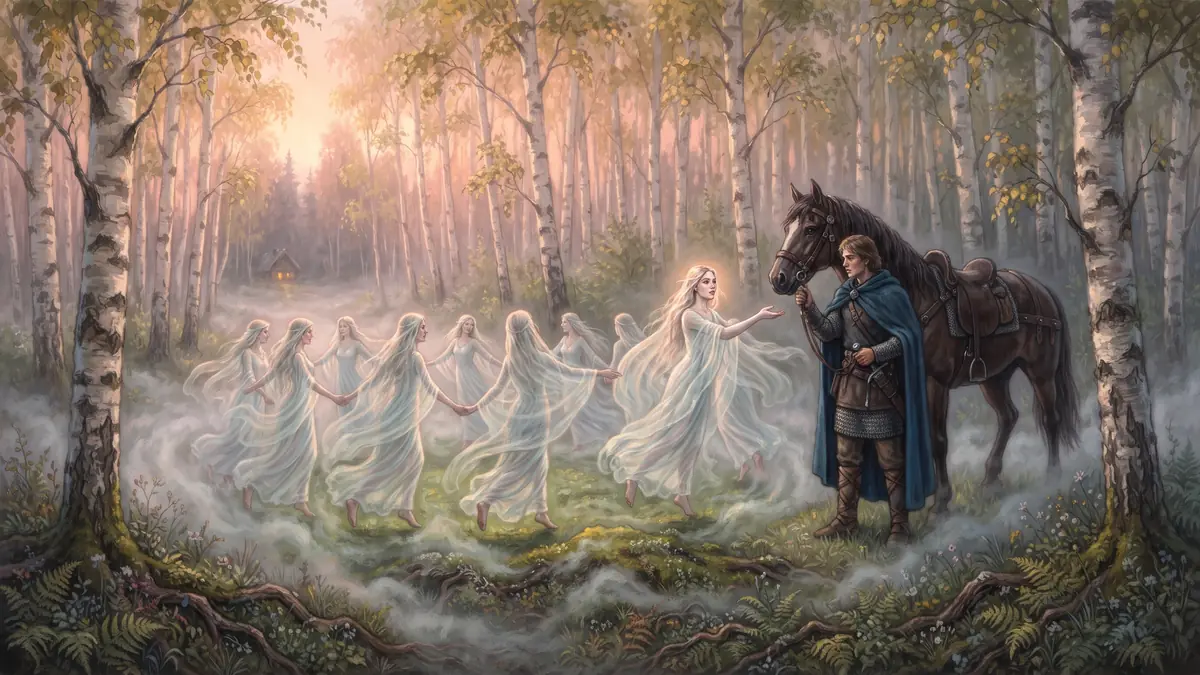
Elveskud, in Danish “elf-shot”, is the name of one of the best-known ballads of the Scandinavian tradition. The story is short and leaves a great deal unsaid, and perhaps that is why it was sung for so long in so many places.
The story
In the most common form, a knight called Oluf or Olav rides out at dawn, before a wedding fixed for the following day. In the woods he meets elf maidens dancing. One of them invites him to dance with them. He refuses and says he is to be married the next day. The elf then wounds him or sends him a fatal sickness, and he returns home dying. At home he gives his last instructions. In some versions the death is hidden from the bride for a while, and she learns of it only later.
The word “elveskud” comes from a popular belief: sudden illnesses could be caused by the invisible “shot” of elves. Over time the ballad spread and changed. In many Danish versions the knight dances with the elves, and the dance is what kills him. In Icelandic versions the bride does not even appear, and he refuses because he is a Christian. In one of them the elf maiden hides a sword and wounds him when he bends to kiss her.
Where it comes from
The ballad is older than the earliest manuscripts. The oldest known is the Karen Brahes Folio, from the 1570s. The oldest Swedish version is from the 1670s, and the best-known text is Peder Syv’s print of 1695. There are at least seventy Scandinavian variants, more than forty of them Danish and seventeen Swedish, besides Norwegian, Faroese and Icelandic versions. Some scholars suggest that the ballad has a Breton or French origin, but it is not known how it would have reached the north.
From the North to Goethe
In the 18th century the German writer Herder translated a Danish version into German under the title “Erlkönigs Tochter”, “The Erl-king’s daughter”. According to a much-repeated explanation, there was a misunderstanding here: the Danish word for “elf” was understood as “alder” (in German, Erle), and the “daughter of the elf king” became something tied to a king of alders, which later became the “Erlkönig”. That translation inspired Goethe’s poem “Erlkönig”, which made the figure one of the best-known themes of German Romanticism.
What remains
Elveskud shows how a story of the wood and of the border between the known and the unknown crossed centuries. What unites all the versions is a simple rule: whoever meets the hidden people is in danger. The dance, the refusal and the punishment can be read as a warning, and many people today still hear it as a song.
To dance in time, touching each lane at the right moment while the elf maidens’ song lasts, play The dance of the elves.
Sources.
- Svend Grundtvig (ed.), *Danmarks gamle Folkeviser*, no. 47 "Elveskud" (Copenhagen, 1853 onwards)
- Peder Syv, *Et Hundrede udvalde Danske Viser* (1695)
- Johann Gottfried Herder, *Volkslieder* (1778–1779), "Erlkönigs Tochter"