Eric Bloodaxe: the Norwegian king who ruled York and lost the throne twice
Eric, son of Harald Fairhair, was king of Norway and later of Northumbria. The sources record that he was expelled twice, but disagree on how he died. See what is known and what is legend.
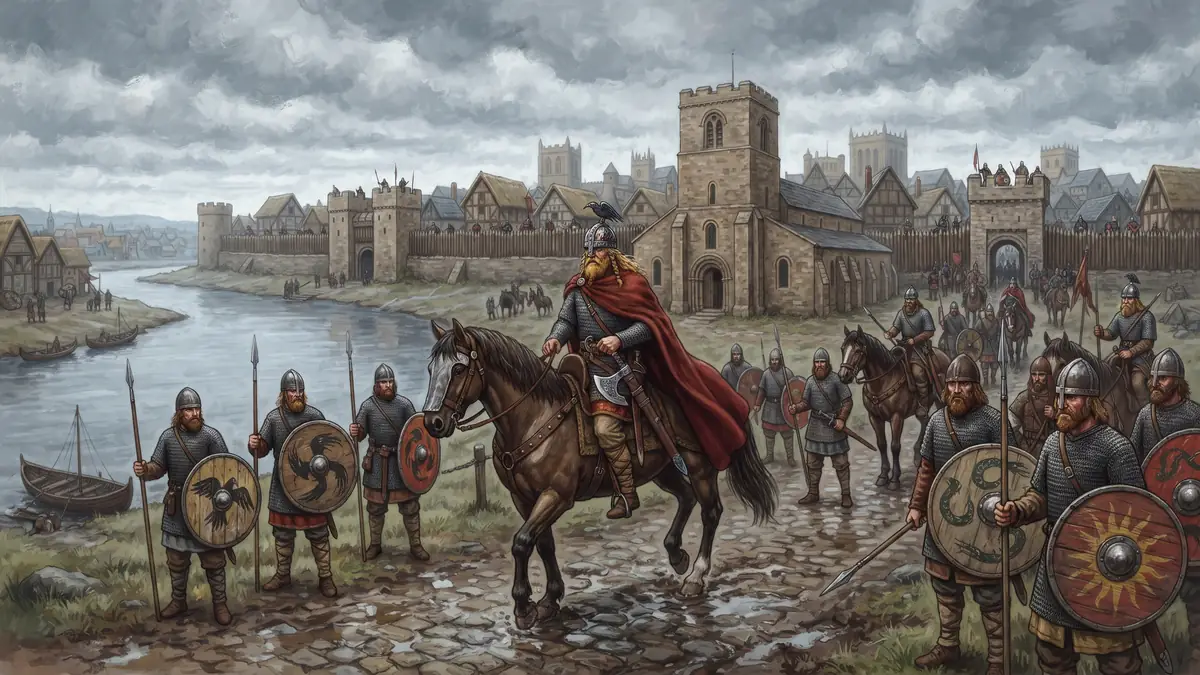
Eric “Bloodaxe” appears in the sagas as a cruel and violent king, but the sources closest to his time tell a drier and more political story. What is known with certainty is that he was king of Norway for a short time, that he later ruled York in northern England, and that he lost that throne twice.
From Norway to exile
Eric was a son of Harald Fairhair. The sources disagree about the length of his reign: some place it between 931 and 933, others between 932 and 934. According to the Heimskringla, written in the 13th century, his half-brother Haakon returned from England with the support of Norwegian nobles, among them Sigurd, earl of Lade, and Eric had to flee to the British Isles. Later versions say he had a base in Orkney, but an older source, the Fagrskinna, does not have him landing there.
The first reign in York
The Anglo-Saxon Chronicle gives the main facts. In 947 King Eadred of Wessex met Archbishop Wulfstan and the Northumbrian nobles at Tanshelf, where they swore obedience. But according to manuscript D, the Northumbrians broke their oaths, and in 948 “they had taken Eric for their king”. Eadred responded by raiding the north, burning the minster at Ripon and forcing the Northumbrians to renounce Eric and pay compensation. After that another king of Norse descent, Amlaíb Cuarán, took the throne for a while.
The second reign and the fall
Text E of the Chronicle says that in 952 the Northumbrians drove out Amlaíb and accepted Eric again. In the same year Archbishop Wulfstan was arrested and tried, possibly because of this change. In 954, manuscripts D and E agree on one point: the Northumbrians expelled Eric once more. It was the end of the independent Scandinavian kingdom at York. Soon afterwards the north came to be governed by earls under the king of Wessex.
How he died
Here the sources part ways. Roger of Wendover, in the early 13th century, says that Eric was treacherously killed by an earl called Maccus at Stainmore, after being betrayed by Earl Osulf, together with his son Haeric and his brother Ragnald. The Fagrskinna and the Heimskringla, for their part, say he died in battle at an unnamed place in England, alongside five other kings. Other Norwegian sources speak of an expedition to Spain, and one scholar proposed that “Span-” was a scribal error for “Stan-“. Most modern researchers prefer to think of an assassination during exile. The Rey Cross near Stainmore, which has been linked to him, is probably a 10th-century boundary marker. No grave has been found.
The Bloodaxe of the sagas
The nickname “Bloodaxe” (blóðøx) appears in texts written after Eric’s lifetime. In Egil’s saga, the poet Egill Skallagrímsson is captured by him at York and saves his life by composing a poem in his praise. That scene is famous, but it comes from a saga written in the 13th century, not from a record of the time.
What remains
Eric shows how fragile the power of Scandinavian kings in England was. They depended on the support of local nobles, of the Church and on the constant threat of the king of Wessex. When they lost one of these supports, they lost the throne.
To turn the road pieces and join, end to end, the way to York, play The roads of York.
Sources.
- *Anglo-Saxon Chronicle*, manuscripts D and E, years 947–954 (transl. Michael Swanton, *The Anglo-Saxon Chronicles*, Phoenix, 2000)
- Roger of Wendover, *Flores Historiarum* (early 13th century), passage on the death of Eric
- Alfred P. Smyth, *Scandinavian York and Dublin* (Irish Academic Press, 1975–1979); Clare Downham, *Viking Kings of Britain and Ireland* (Dunedin, 2007)