Hyndluljóð: Freyja rides a boar to the cave of the seeress who knows every family
In the poem *Hyndluljóð*, the goddess Freyja rides to the cave of a giantess and seeress to force her to recite the lineage of her protégé Óttarr. See what the text says and what scholars debate.
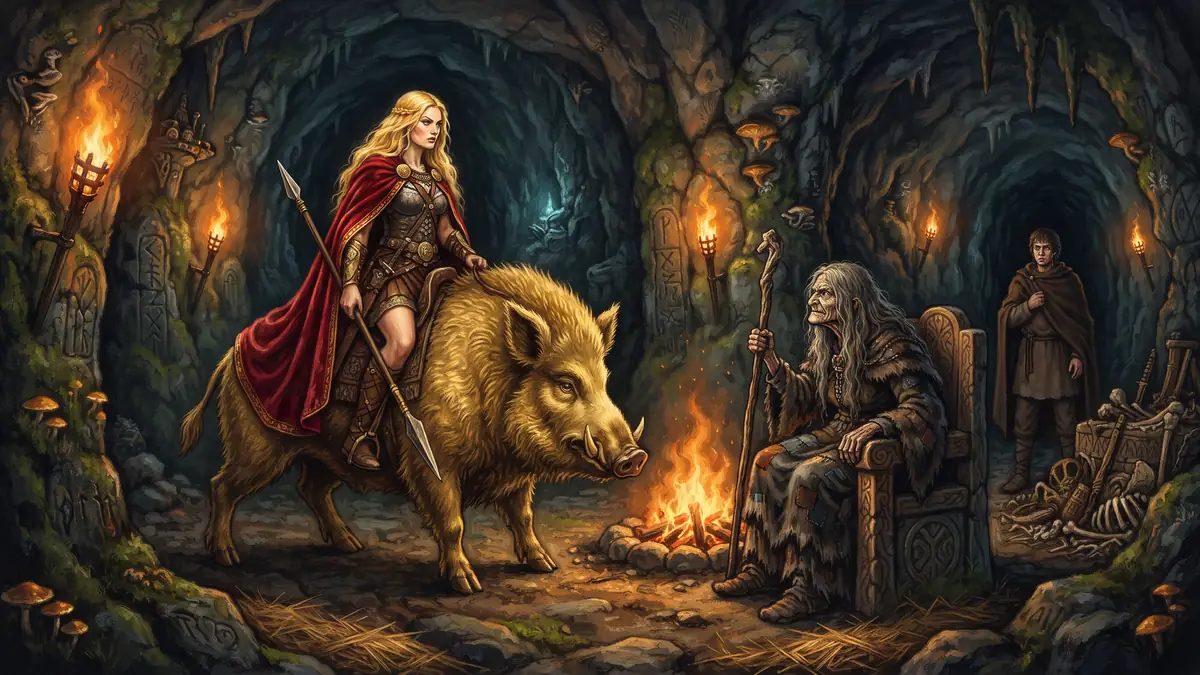
Among the poems of the Poetic Edda, the Hyndluljóð, the “Poem of Hyndla”, is one of the most unusual. It is not a battle or a prophecy about the end of the world. It is a long list of families, recited under pressure, at the entrance of a cave. For that reason it was long treated as a minor text. Today it interests us precisely because it shows how the Norse understood the idea of having ancestors.
What the poem tells
The text begins with Freyja waking Hyndla, a giantess and seeress who lives in a cave. Freyja says they must ride together to Valhalla, and that she is bringing a young man named Óttarr, son of Innsteinn. To hide him, Freyja has turned him into a boar called Hildisvíni, “battle swine”. The goddess explains why she protects him: Óttarr built her an altar of stones and reddened it many times with the blood of oxen, and she has not forgotten his devotion.
According to the poem, Óttarr is involved in an inheritance dispute with a man called Angantýr. To win the case he must prove his ancestry, and that is why Freyja makes Hyndla recite, one by one, the families he descends from. The seeress is reluctant and taunts the goddess, but in the end she speaks. She names kings, heroes and entire lineages, among them the families of the Skjöldungar and the Völsungar, who appear in other sources of the period.
A list with a piece of prophecy
In the middle of the poem there is a passage known as the Völuspá hin skamma, the “Short Völuspá”. These are verses that recall the great prophecy of the seeress, with references to the birth of the god Heimdallr and to the end of the world. Many scholars believe this passage was fitted into the poem later, so that the Hyndluljóð looks like a patchwork of parts that may come from different times.
Near the end, Freyja asks Hyndla to give Óttarr a drink that will make him remember everything he has heard, the “ale of memory”. The giantess refuses and curses the goddess, who answers by threatening to surround her with fire. In the end the seeress gives way. According to the poem, the drink would be handed to the young man.
When and where
The Hyndluljóð is not in the Codex Regius, the main manuscript of the Eddic poems. It survives in the Flateyjarbók, a great compilation made in Iceland in the late 14th century. That means the text we have was copied centuries after any time in which the poem may have been composed. Its date of composition is debated. Some researchers see it as a late poem, perhaps composed in the 12th century, when there was interest in genealogies; others argue that it reuses older material.
What remains
The interest of the poem lies in the way it treats memory and family. For the medieval audience in Iceland, knowing whom one descended from was a practical matter: it served to claim land, inheritance and prestige. Freyja, here, appears less as a goddess of love and more as the protector of a devotee and as the mistress of a hard task, that of forcing someone to remember.
To light, one by one, all the torches in Hyndla’s cave, knowing that each touch also changes its neighbours, play Hyndla’s torches.
Sources.
- *Poetic Edda*, *Hyndluljóð* (preserved in the *Flateyjarbók*, late 14th century)
- Carolyne Larrington (transl.), *The Poetic Edda* (Oxford World's Classics, 1996)
- Rudolf Simek, *Dictionary of Northern Mythology* (D. S. Brewer, 1993), entries "Hyndla", "Óttarr" and "Freyja"