Louhi steals the sun and the moon: the coldest episode of the Kalevala
In the *Kalevala*, the mistress of Pohjola, Louhi, hides the sun and the moon in a mountain and leaves the world without light. See how the episode is told and where the book comes from.
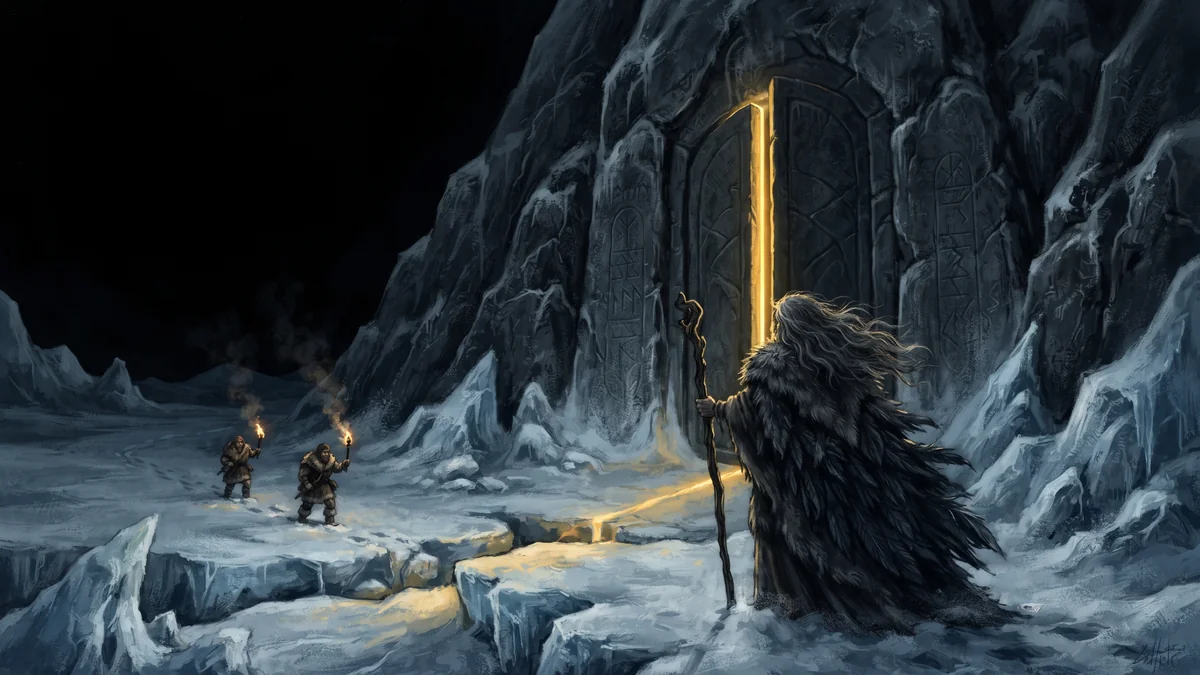
The Kalevala is Finland’s great epic poem, assembled by Elias Lönnrot in the 19th century from folk songs he collected on journeys through the country. The definitive edition is from 1849. Among the strongest figures in the book is Louhi, the mistress of Pohjola, the “Northland”, a cold and dark land. Louhi is a sorceress, the mother of maidens desired by the heroes and the constant rival of the people of Kalevala.
After the Sampo
Before this episode the book tells of the struggle for the Sampo, the magical object forged by Ilmarinen that brought wealth to Pohjola. The heroes of Kalevala steal it, and Louhi tries to recover it. In the end the Sampo shatters in the sea. Louhi, defeated, decides to take revenge with diseases and beasts against Kalevala. When that fails, she turns to something greater.
The theft of the light
In runos 47 to 49, Louhi hides the sun and the moon in a mountain of Pohjola and also steals the fire from the houses of Kalevala. The world is left in darkness. According to the poem, the supreme god, Ukko, tries to mend the situation and creates a new sun and a new moon, but they do not shine as they should. A fire falls from the sky, and the heroes follow it. In this passage the poem mixes several traditions, and Lönnrot joined songs that perhaps had no relation to one another.
The solution
According to the outcome, Ilmarinen, the smith, prepares to make keys and tools capable of opening the rock. Louhi, seeing that the heroes are determined, gives way and releases the sun and the moon, which return to the sky. Light returns to the world. It is an ending in which the strength of those who know how to work metal and the firmness of those who do not give up overcome a threat greater than that of any army.
How to read this episode
The Kalevala should not be read as the “religion of the ancient Finns”, as if it were a document. Lönnrot collected the songs, chose versions, reordered parts and wrote linking verses. The result is a literary work made from oral traditions, and it was very important for Finnish identity in the 19th century. The motifs, however, such as the theft of light, appear in many cultures, and scholars debate which parts have old roots in Finnish oral tradition and which are Lönnrot’s.
What remains
Louhi is a rare figure in literature: a powerful woman who acts on her own, with intelligence and ambition, and is at once feared and respected. The story of the sun and the moon shows what the Finnish songs understood by “north”: a cold and dark place that keeps the light the rest of the world needs.
To cross, lane by lane, the frozen field of Pohjola, dodging the gusts of cold, play Pohjola’s frozen field.
Sources.
- Elias Lönnrot, *Kalevala* (1849 edition), runos 47–49
- Keith Bosley (transl.), *The Kalevala* (Oxford World's Classics, 1989)
- William A. Wilson, *Folklore and Nationalism in Modern Finland* (Indiana University Press, 1976)