Magnus Barefoot: the Norwegian king who died in an ambush in Ireland in 1103
Magnus III of Norway led expeditions to the British Isles and Ireland, and died on 24 August 1103 in an ambush in Ulster. The sources agree on the date but disagree on the causes. See what they say.
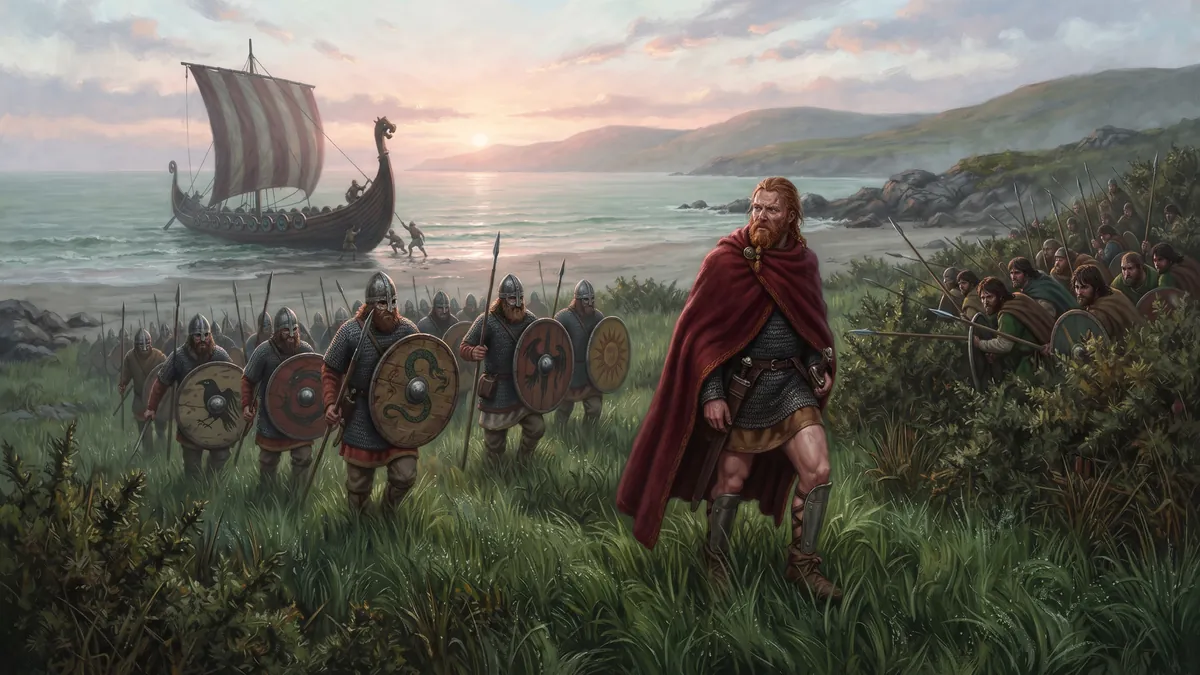
Magnus III Olafsson, king of Norway from 1093 to 1103, is known in tradition as “Barefoot” or “Bare-legs”. He was one of the last great Norse kings to lead expeditions of conquest in the Irish Sea and in the islands north of Scotland. He died in an ambush in Ireland, and that end is one of the most retold passages of the sagas.
The nickname
According to Snorri Sturluson, the king got his nickname because, after one of his expeditions to the west, he began to wear clothes in the fashion of the islands and Ireland, with short tunics that left the legs bare. Another explanation, in Saxo Grammaticus, says he fled a Swedish attack without shoes. The nickname therefore has more than one possible origin.
The expeditions to the isles
Magnus came to the throne in 1093 and shared power, uneasily, with a cousin, Haakon, who died in 1095. In 1098 he set out with a large fleet for the west and passed through Orkney, the Hebrides, Kintyre and the Isle of Man, where he used timber from the Galloway region to build fortifications. In the same year he won the Battle of Anglesey Sound, in which a Norman nobleman died. In 1099 he returned to Norway. There is debate about the agreement he supposedly made with the king of Scotland: some texts say the western isles were ceded to him, and one historian calls this a later fabrication.
The last voyage
Magnus returned to the west in 1101 or 1102 and used the Isle of Man as a base. He made an agreement with Muirchertach Ua Briain, king of Munster, and married his son Sigurd to Muirchertach’s daughter. On the wedding day he named his son co-king and gave him the government of the western lands. Muirchertach, in return, recognised Magnus’s control of Dublin and the region of Fingal.
On 24 August 1103, as he prepared to return, Magnus was killed in an ambush by the Ulaid, near the River Quoile, at Downpatrick. The sources give different causes: he may have landed to fetch cattle and food, the Irish may have taken his men for raiders, or Muirchertach himself may have ordered the attack.
The accounts
Snorri tells that the Norwegians were caught unprepared. The king was supposedly pierced through both thighs by a spear and then killed by an axe blow to the neck. The sentence the saga puts in his mouth, “kings are made for honour, not for long life”, is famous, but it comes from a text written more than a century later. The Annals of Ulster and other Irish sources treat the campaigns of 1103 as failures. The Chronicle of the Kings of Mann says he was buried near the church of St Patrick, and a local tradition points to a mound on Horse Island as his grave.
What remains
Magnus was the last Norwegian king to die in battle abroad. His death ended the attempt to keep direct Norwegian rule in the region. But the Heimskringla, which is the most detailed source, is also considered the least reliable in its details, having been written long afterwards. That is why the sagas are worth reading alongside the Irish sources.
To cross a field where hidden ambushes lie, using the clues of the numbers, play The ambush field.
Sources.
- Snorri Sturluson, *Heimskringla*, "Magnus Barefoot's saga" (c. 1230; transl. Lee M. Hollander, University of Texas Press, 1964)
- *Orkneyinga saga* (c. 1230), transl. Hermann Pálsson and Paul Edwards (Penguin, 1978)
- Seán Duffy, "The Irish Sea Region, 1000–1170", in *The Oxford History of Ireland*; *Annals of Ulster*, year 1103